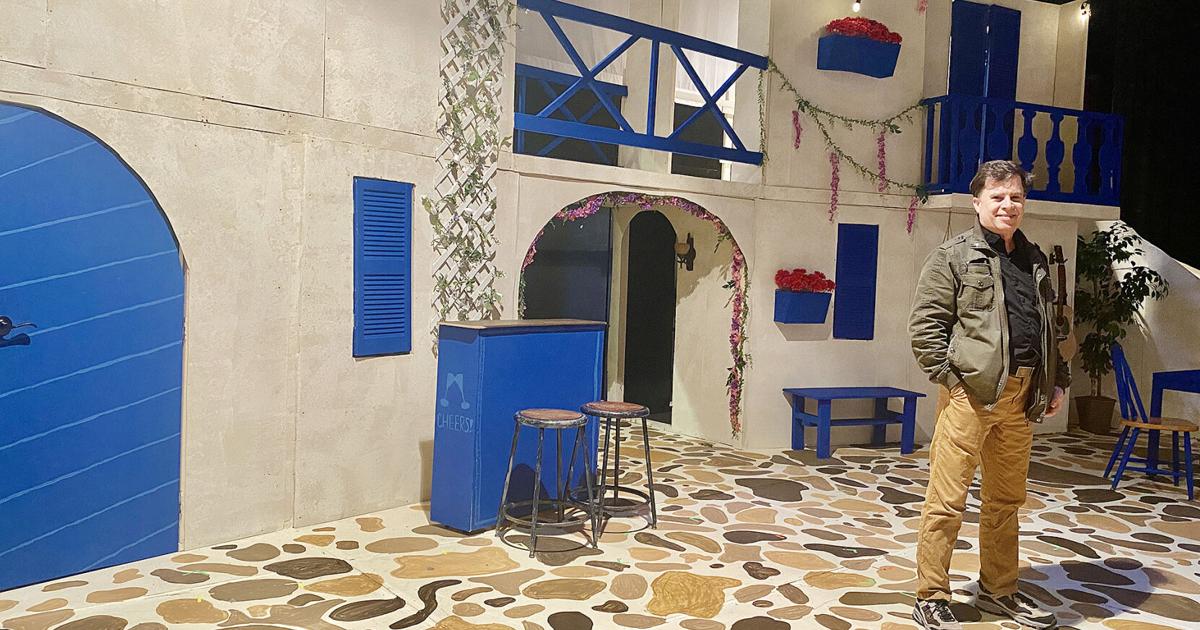
It’s not uncommon for an audience to applaud at the start of a play in order to show appreciation to the performers. But when the curtains open and no one is onstage and the audience claps anyway—that’s an audience showing appreciation for an outstanding set.
There’s a “wow” factor in set design; in bringing the Scottish Highland town of Brigadoon to life or making an audience think they are in a haunted opera house.
The idea that theater has the power to transport us somewhere else is due in no small part to set design.
Brett Baird has created sets at both Highfield Theater and Cotuit Center for the Arts. He got his start when he was performing and another actor asked if he would like to work on sets in the next production. Having just purchased his first house and knowing that he might need to learn how to fix things, he said yes.
“I got interested in how everything got put together,” Baird said. As a network engineer, Baird is a puzzle solver by nature. “That’s what set design is. You have the show and the scenery, and you have to solve the puzzle of how to make it all fit together.”
Baird’s wife, Joan McKenzie-Baird, also started out as on-stage talent. After she transitioned to directing, it seemed natural for Baird to become her right-hand man, “to make the magic happen for her.”
Baird has designed a number of sets for the Falmouth Theatre Guild (FTG); most notably the 2022 set for “Bridges of Madison County,” which included a covered bridge; 2023’s “It’s A Wonderful Life” and, most recently, the set for “The Addams Family.”
In terms of direction from the show’s playwright, sometimes scripts suggest a set, sometimes they don’t.
“In some cases, you’ll get a script and it’ll have a set layout as originally conceived by whoever did the original design,” Baird said, though in many cases, “you’re free to do what you need to do.”
Baird said the process of coming up with a design is different for every designer.
“For me, it’s reading the script, then coming up with ideas and sketches. I’m not a model builder, but I know that a lot of set designers like to build a model to visualize things in a three-dimensional way,” he said.
When visualizing a set, Baird said, he figures out what the critical elements are for the show and starts with those. In terms of where sets are built, Baird said that every venue is different and it depends on scheduling. “If the venue is currently staging something, then you have to build off-site. The nice thing about Highfield is, whenever FTG is in there, we’re the only show going on, so we get to build on stage.”
Highfield has a tool shop in its basement, which is helpful, but the biggest benefit, Baird said, is being able to construct the set on stage so “performers become aware of the spacing as pieces are built.”
College Light Opera Company (CLOC), which uses Highfield in the summer, has a more-intense schedule. “They are doing one show a week, so they are building their next set while they’re running their current show. It’s amazing what they accomplish rolling out sets so quickly,” Baird said.
Before moving to the Cape, Baird worked in theaters in Rochester, New York, where they would sometimes rent sets. “They’d move the set in and get it set up and—so that’s something that can be done usually when you don’t have a lot of time to build or there are other constraints,” he said.
Baird said, as set designer, he is there for rehearsals and will let performers know what set pieces are coming. “Being done by tech week is the target because that’s when we start adding lighting, sound and other technical elements,” he said.
In terms of volunteers, Baird said that having a specific talent is nice but not required.
“Volunteers do a number of things—moving lumber and set pieces, construction, painting. We have people like Cris Reverdy, who comes in as a scenic artist and makes it beautiful and realistic,” Baird said. “Sets need to look real, without actually being real. It’s all an illusion you create.”
More important than experience is “having people who want to work on the project and are passionate about being there and in putting on a show,” Baird said.
When it’s time to strike the set, Baird said, some pieces might get reused. “We work with CLOC so we have a lot of shared pieces that we keep. We try to keep and store elements that are heavily reused or difficult to replicate. We dismantle things that are easy; no need to take up space with that.”
Favorite sets Baird has created include “The Wizard of Oz,” “The Producers” and “Beauty and the Beast.”
“‘It’s a Wonderful Life’ was great because we were recreating iconic scenes from a movie and, in particular, I was happy with how the bridge scene turned out,” Baird said, adding that he also enjoyed “replicating the iconic set from ‘Rent.’”
Space backstage is also taken into account. “Sometimes it’s a logistical puzzle. How much can you have for the whole show that you can fit both on and off stage? One of the nicknames I’ve procured over the years is ‘Big Set Brett’ because I like to do multi-scene shows and I typically cram a lot of stuff backstage,” he said.
In terms of organizing props and set pieces, Baird shouted out frequent FTG stage manager Denise Dorado: “She’s amazing at what I call the ‘backstage ballet,’ making sure things are where they need to be and rotating them into position where they come on and off stage smoothly.”
Another big consideration for set design is sight lines.
“You have to make sure the audience can’t see what’s going on backstage, so you mask the wings, and then have to make sure that the maximum number of audience members can see the maximum amount of scenery,” Baird said.
In terms of the future of set design, Baird noted that projections and videos are being used more often, especially as the cost of construction materials has increased.
“The technology has advanced to the point where it’s really adding to the audience’s visual experience,” Baird said, noting that with visual projections come new considerations. “You don’t want your stage lights washing out your projections, but you want to be able to see the actors. It’s a balancing act,” he said.
Number one on Baird’s list of future shows he’d like to design is “Finding Neverland.”
“It’s one of Joan’s dream shows. It’s got gorgeous music and some cool sets and special effects,” he said.
Baird has also served as a lighting designer for several shows, a skill he picked up in Rochester. He said he has enjoyed working with Greg Hamm, a frequent lighting designer at Cotuit Center for the Arts. He called Hamm “amazing.”
“Once you’re in that world, you can keep going with it,” Baird said.
Originally from the Philadelphia suburbs, Peter Cook grew up liking theater but knowing he wasn’t cut out to be a performer.
“Early on, I acted in plays in high school but struggled to remember lines,” he said.
Cook credited his mother with instilling in him a love of art that eventually spilled over into theater.
“She was an artist and art school teacher. In a way, she was indirectly teaching me, too. One of the things I loved as a kid was vanishing point perspective—that’s the basis for all the sets I do,” he said.
Like Baird, Cook said that at the crux of set design is creating an illusion. “Whenever I build sets, I tell the crew—you’re not building a fine house, you have to make it strong and safe, but it also has to be an illusion. It has to look realistic from about 30 feet back.”
After moving to Falmouth, Cook became involved with the Falmouth Theatre Guild. “I volunteered for some shows and realized that this is what I love to do,” he said.
In the years since, he has created sets for both FTG and Woods Hole Community Theater. He currently serves as the technical director and set coordinator for the Falmouth High School Theatre Company.
In terms of coming up with a set, Cook said he has worked with directors who will say exactly what they want, others who prefer to modify the outline offered in the script and still others who leave it up to Cook. He often works with his wife, Lisa Jo Rudy, who directs and sometimes writes her own plays.
Sometimes the set’s limits come from the script’s blocking directions, sometimes from the limits of the venue.
“The Woods Hole Community Hall is a fun challenge,” Cook said.” It’s a small stage and backstage there’s virtually nothing. But you can use the entire hall, the floor, the stage and the balcony.”
Because other groups use the hall, sets have to be taken down every night. “When I design sets, I design them to fold flat so they can be stored stage right,” Cook said.
Cook said he also uses lighting in his designs. “I like to immerse the audience as much as possible. Lighting can transform a space. You can use light as a set instead of putting up walls,” he said.
As a set designer, Cook said, he is usually brought into a project at the very beginning.
“The first thing I do is lay spike tape on the floor to indicate a doorway, windows, a wall. I do that as early as possible because things will change. I tell the cast—by this day, you have to tell me, do you like this wall here? The tape also helps the director because they can immediately start blocking,” he said.
For shows with more than one scene, Cook will make a model to figure out set pieces and how they need to move about.
“These days people are learning computer modeling, but I’m still old school,” Cook said, “I like physical models.”
When it comes to new technology, Cook said the use of screen projections as backdrops is becoming popular.
At Falmouth High School, the theater company used digital projections designed by one of the students for its 2025 musical, “The Little Mermaid.”
To keep up with advances in set design, Cook belongs to the US Institute of Theater Technology (USITT) and attends its annual conferences. “Companies that produce equipment have workshops and demos and you can meet other people in the industry,” he said.
Cook echoed Baird’s sentiments on volunteers: “Some people may have skills, but not everyone’s a carpenter. The most important thing is that everyone has fun, because if they don’t, they’re not going to show up the second day.”
In addition to building sets on site, Cook has outfitted his garage to accommodate set design. “I have a two-car garage with a table saw and wood shop set up,” he said.
Cook said he tries to save and reuse set pieces whenever possible. “It’s expensive to buy new materials. If it’s in good shape, why discard it?” he said.
With set design, safety is key. “It has to be safe. It has to be strong. If an actor leans on a handrail, it’s got to support their weight,” Cook said.
Cook said he is fortunate to know several structural engineers he can call on when faced with situations beyond his scope.
When building a set, Cook pays attention to detail, even taking the time to paint behind a door and hang a painting on the wall. “It’s extra time, but it creates the illusion of a second room,” he said, adding that he likes to put “Easter eggs” in his set for the audience. For example, he placed a photo of playwrights George Kaufman and Moss Hard on one of the shelves on the set of “You Can’t Take It With You.”
Cook said the set for FTG’s production of “Arsenic and Old Lace” was one of his favorites.
“Box sets are always my favorite. It was a two-story set and I felt like we put everything into it to make it a ‘wow’ set. At the high school, I liked the one we recently created for ‘The Creature Creeps,’ it was another fun box set,” he said.
A special challenge was the prologue for FTG’s 2021 production of “Carousel.”
“The director wanted the carousel to come together and then disappear with the end of the prologue,” he said
Cook used three carousel horses from Falmouth’s Carousel of Light, along with large banners created by local artist Milo Carouso.
“It took a while to model that and figure out how to bring in three actual carousel horses, assemble them on a platform so they revolve and then take them out all in under four minutes,” he said.
On Cook’s bucket list is creating sets for “The Tempest.”
“I’m a big Shakespeare fan. I’ve seen many Shakespeare productions and movies and ‘The Tempest’ is one I’d love to do,” he said.
At every show Cook goes to, he will analyze the set design. “I’m either looking at it from the tech point, listening to the sound or looking at the lights and thinking how I might do things differently,” he said. One of his pet peeves is that if a set is made to be moved, he doesn’t want to see the wheels.
“I want to make sure the apron on the front is as low as it can go, because seeing the wheels, for me, destroys the illusion.”
Cook said he likes to get his sets built as soon as possible. “The tape should only be there for a week or two, and then a wall should be going up. I see myself supporting the director that way. I want to make sure they have something to work with.”
In terms of sets that have to be taken on and off the stage, “it’s important to practice doing that,” Cook said. “Sometimes you have to coordinate the performers coming off the stage with set pieces being moved onto the stage.”
Cook encourages young people who are interested in set design or behind-the-scenes work.
“We’ve had young people who have become assistant stage managers. We had one who showed up and did an excellent job with painting. In one show, we had someone as young as 12 in charge of pulling the curtain and another who was in charge of props. I think she was 10 or 11, she was in charge of the entire show. She was a genius,” he said.
‘ The preceding article may include information circulated by third parties ’
‘ Some details of this article were extracted from the following source www.capenews.net ’