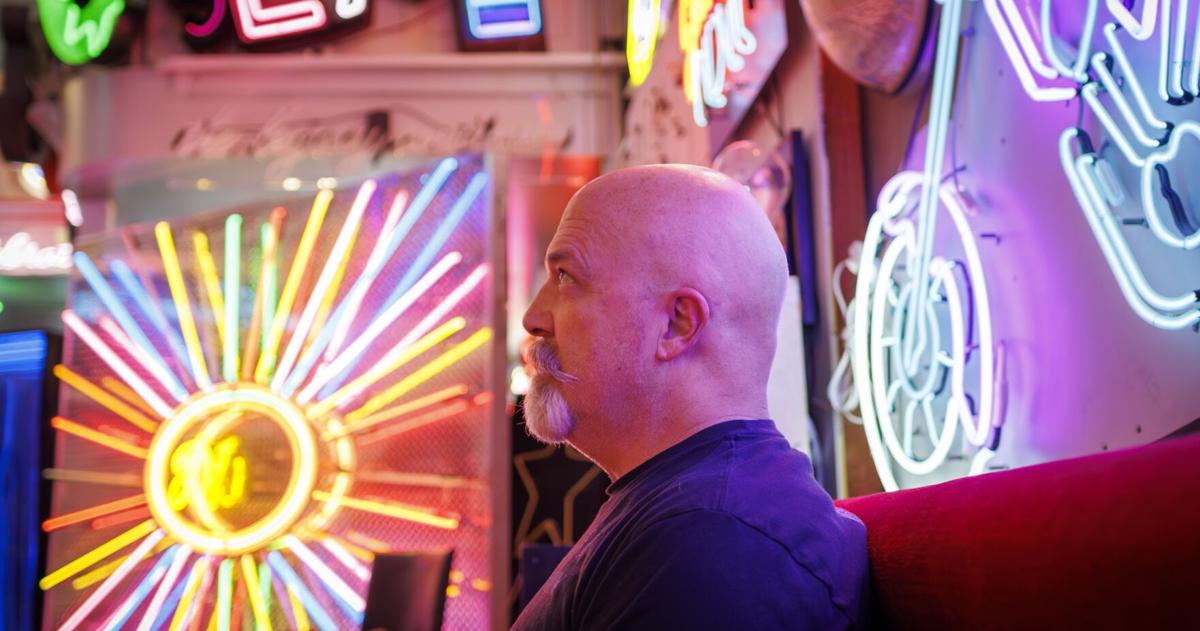
In a cluttered corner of his New Orleans studio, Nate Sheaffer pulled a glass tube through blue flames, coaxing it with gentle puffs from a blow hose until it curled into cursive letters.
Four mounted deer heads stared down from the wall above, their antlers draped with glass tubing, beside a glowing red neon sign that read: “Every damn day.” For 41 years, Sheaffer has practiced glass blowing with that kind of devotion.
His right arm is canvassed in tattoos of signs he has commissioned over the years — a smiling skull in a top hat, a cardinal, the trademark figure “Reddy Kilowat” — while his left is covered in burn scars.
“There are parts of my fingers that don’t feel anything anymore,” he said on a recent Friday afternoon.
Sheaffer opened his studio, Big Sexy Neon, on Oretha Castle Haley Boulevard more than 5 years ago, wedged between a newspaper archives studio and boxing gym. But those long days of burning glass there are nearing an end.
Inside the large showroom at Big Sexy Neon on Oretha Castle Haley in New Orleans on Monday, December 1, 2025. (Photo by Chris Granger, The Times-Picayune)
By early next year, Sheaffer will move to a new studio inside the Signworx building on Hickory Avenue in Metairie, his first solo venture after years of mentoring apprentices. The decision is driven by rising costs and a small local market.
The change also comes as neon itself becomes a dying art — once a beacon of cheap motel strips and roadside diners, gas stations and cornerstores, cigarette ads and smoky jazz clubs. These glowing signs defined mid-20th-century America as an emblem of progress, capitalism and the freedom of the open road.
Now they are a nod to a past life — radiant, yet fading reminders of what urban life once was. There are only a few hundred glass blowers still creating neon signs in the United States, including Sheaffer.

Nate Sheaffer uses gas-generated heat to shape neon inside his shop, Big Sexy Neon, on Oretha Castle Haley in New Orleans on Monday, December 1, 2025. (Photo by Chris Granger, The Times-Picayune)
“My 12-hour days are not as productive as they used to be,” he said, placing the blow hose between his lips again and sending a breath through the tube to keep it from collapsing.
Sheaffer, 61, discovered glass blowing in college while studying German and art, eventually realizing that his dark, brooding sculptures lacked light. Illumination drew him in — a fascination, he said, as old as life itself, with all animals pulled to light “like a moth to a flame.”
He devoted himself to the craft, practicing glass blowing 12 hours a day, six days a week. Fresh out of college in 1986, he opened his first neon shop in North Carolina, seeking clients by knocking on doors while working a second job at a seafood restaurant.
Through the late 1990s, he produced about 6,000 signs a year for corporations like Miller Lite, Coca Cola in Europe, Lowe’s, Toys “R” Us and Krispy Kreme. That output dwindled in 1999, when he closed his shop as overseas manufacturing companies overtook the industry — a decline that deepened with the rise of LED lighting.
While running a second shop in North Carolina that has since closed, Sheaffer opened Big Sexy Neon in Central City in 2020 — named after a nickname a former girlfriend once gave him.
“That’s a New Orleans name if there ever was one,” he said with a laugh.

A random display of neon signs and lights inside Big Sexy Neon on Oretha Castle Haley in New Orleans on Monday, December 1, 2025. (Photo by Chris Granger, The Times-Picayune)
The kaleidoscopic studio would go on to host burlesque shows, weddings, comedy shows and formal dinners, all while Sheaffer created neon signage for Bourbon Street bars and for local restaurants like chef Mason Hereford’s Hungry Eyes and Hot Stuff. This year, he restored the historic Tujague’s restaurant sign after it was removed by the building’s owners.
He originally planned to close sooner after hosting a big sale on Dec. 7. But commissions have kept him at work, including one for the sunglasses company Krewe that he was crafting Tuesday.
With the glass tubes in hand, Sheaffer moved between two burners spitting blue flames, one for tight bends, another for sweeping curves. He shaped the sign until it spelled the Latin word “patula” in cursive, reversed so that the connections between the letters are hidden.
“The joke is that neon glass workers live their life backwards,” Sheaffer said, carrying the sign to a nearby table.
Twenty-one thousand volts of electricity shot through the tubes to burn any impurities, from dust to oil from his fingertips. He filled them with red glass, heated above 500 degrees for a vibrant glow, then dipped the finished piece in black paint.
“It’s a dwindling art that’s going to die out,” Shaeffer said, hanging the sign on a wired shelf to dry.
‘ The preceding article may include information circulated by third parties ’
‘ Some details of this article were extracted from the following source www.nola.com ’