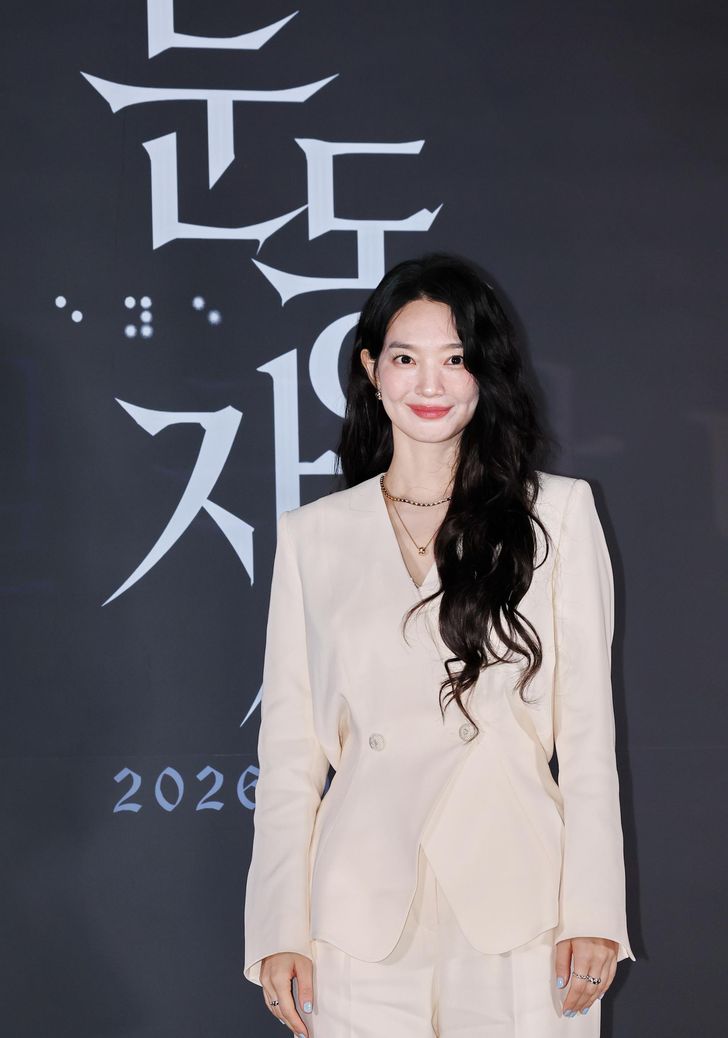
Actor Shin Min-a poses during a press conference in Seoul, June 15. Yonhap
Recent pregnancy rumors surrounding female celebrities have once again highlighted the intense scrutiny placed on women’s bodies.
Online posts speculating that an actress or singer is pregnant often spread rapidly after photos show her wearing loose-fitting clothing or appearing slightly different from before. Such rumors are no longer limited to married celebrities but have also targeted women who are merely engaged or preparing for marriage.
Actor Shin Min-a became the latest target after attending the press screening of the film Eyes on June 15. Some internet users claimed she appeared fuller-faced than in the past and speculated that she was expecting a child. The rumors echoed similar speculation that surfaced after her marriage to actor Kim Woo-bin last November, when online users pointed to what they described as a “swollen” appearance. Her agency dismissed both rumors as completely unfounded.
Shin is far from the only celebrity to face such speculation.

Singer Ailee/ Courtesy of A2Z Entertainment
Singer Ailee also found herself at the center of pregnancy rumors after appearing at a recent event wearing a loose-fitting outfit. Some fans interpreted the clothing choice as evidence that she was pregnant. Her agency, A2Z Entertainment, denied the rumors, saying it would share any genuine good news when the time came. Actors Gong Hyo-jin, Min Hyo-rin and singer HyunA have likewise faced similar speculation after posting everyday photos on social media that prompted comments about changes in their appearance.
While rumors about celebrities’ private lives have long been treated as entertainment gossip, critics say speculation about women’s pregnancies goes far beyond harmless curiosity. They argue it represents an invasion of privacy and reflects persistent gender bias.

Actor Gong Hyo-jin / Captured from social media
The problem has become more pronounced as unverified claims circulate freely on online communities and short-form video platforms, turning pregnancy rumors into viral content.
Most of the speculation stems from public photos posted on social media, with online users evaluating celebrities’ body shapes and drawing conclusions about pregnancy. Yet whether someone is pregnant is an intensely private matter.
Even if a celebrity is expecting a child, the timing of any announcement is entirely her decision. Moreover, changes in body shape can result from countless factors, including health conditions, medication or ordinary weight fluctuations — circumstances that outsiders cannot possibly know.
Critics also note that female celebrities face far greater scrutiny over their appearance than their male counterparts. Even subtle physical changes are often interpreted as signs of pregnancy.
Actor Hyeri, although not subjected to pregnancy rumors, recently faced criticism over what some online commenters called her “belly fat.” Responding through a fan communication platform, she wrote, “We are all beautiful just as we are. I don’t know why being slim is considered the only professional standard, but if that’s what fans want, I’ll do my best by exercising and taking care of my health.”

Actor Hyeri / Captured from social media
Many observers argue that the widespread belief that celebrities should simply accept constant judgment of their appearance only reinforces this unhealthy culture of public scrutiny.
The speculation also fuels the spread of false information. Numerous celebrities have repeatedly been forced to deny pregnancy rumors either personally or through their agencies.
Such rumors can be especially harmful because they pressure women to disclose deeply personal matters involving pregnancy, childbirth and family planning. Some may be trying to conceive, recovering from pregnancy loss or dealing with medical conditions that affect fertility. Nevertheless, online speculation often ignores these possibilities and treats the subject as casual entertainment.
As pregnancy rumors continue to surface online, critics say they ultimately reflect a culture of excessive surveillance and judgment directed at women’s bodies rather than harmless celebrity gossip.
This article from the Hankook Ilbo, the sister publication of The Korea Times, is translated by a generative AI system and edited by The Korea Times.
‘ The preceding article may include information circulated by third parties ’
‘ Some details of this article were extracted from the following source www.koreatimes.co.kr ’