This story originally appeared in the Asbury Park Press on March 14, 1996.
When writing the Oscar-winning song “Streets of Philadelphia,” Bruce Springsteen drew upon memories from his childhood in Freehold to capture the sense of alienation experienced by people suffering from AIDS, he said in an interview with a national gay magazine.

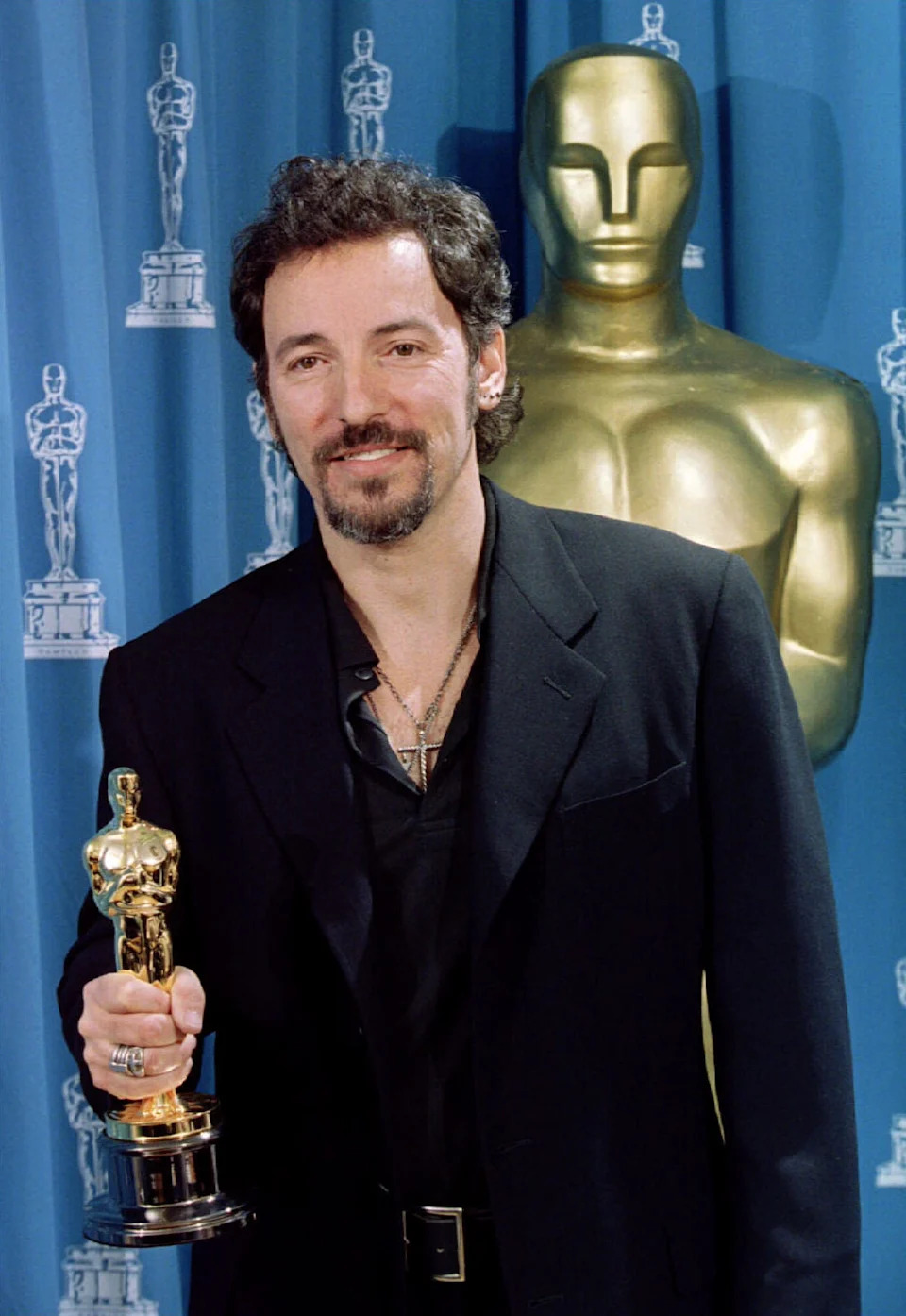
Bruce Springsteen holds the Oscar he received for his song “Streets of Philadelphia” which won the Academy Awards for best original song from the film “Philadelphia” on March 21, 1994 at the 66th Academy Awards in Los Angeles, California.
“Anybody who was different in any fashion was castigated and ostracized, if not physically threatened,” Springsteen told The Advocate in an issue that will hit newsstands Monday.
“Basically, I was pretty ostracized in my hometown. Me and a few other guys were the town freaks — and there were many occasions when we were dodging getting beaten up ourselves.”
The interview with Springsteen, who won an Oscar in 1994 for the theme song to the AIDS drama “Philadelphia,” was done for The Advocate’s “Oscars ’96” coverage. Springsteen is up for another Oscar this year for the theme to “Dead Man Walking.”
In the interview, Springsteen discusses the impact of “Streets of Philadelphia,” his support for gay marriages, his friendship with Melissa Etheridge and his conviction that there is a place in society for traditions and for tolerance.

“Springsteen recalls own sense of alienation” appeared in the Asbury Park Press on March 14, 1996.
Springsteen’s public image is a dual one: He is the hard-rocking, working-class band leader; he is also the sensitive intellectual.
These facets of his personality have led to broad misinterpretations of his work — as when the irony of the ’80s mega-hit “Born in the U.S.A.” was lost in the fist-waving energy of the music. But that mixture of liberal and macho probably appealed to director Jonathan Demme as he searched for a songwriter who could sing about AIDS with compassion and grit.
“Demme told me that `Philadelphia’ was a movie he was making `for the malls,’ ” Springsteen told The Advocate. “I’m sure that was one of the reasons why he called me. I think he wanted to take a subject that people didn’t feel safe with and were frightened by and put it together with people that they did feel safe with — like Tom Hanks or me or Neil Young. I always felt that was my job.”
Asked about the success of his song, “Streets of Philadelphia,” Springsteen said, “I would never have thought in a million years it was going to get radio airplay. But people were looking for things to assist them in making sense of the AIDS crisis, in making human connections. I think that is what film and art and music do; they can work as a map of sorts for your feelings.”
It seems appropriate that the musical heir-apparent to Bruce Springsteen, who has long championed the underdog in his songs, would be a lesbian guitarist with a growly, earnest voice. Springsteen takes great delight in the success of Etheridge, with whom he became friends after performing with her on such shows as last year’s “MTV Unplugged.”
“I was very happy to see that that was where some of the seeds of what I had done had fallen,” Springsteen said. “I said, `Wow, a lesbian rock singer who came up through the gay bars! I don’t believe it!’ I felt really good about it.”
Etheridge told The Advocate that she and her companion, Julie Cypher, frequently socialize with Springsteen and his wife, Patti Scialfa.
Springsteen said he sees no reason why Cypher can’t be Etheridge’s spouse, rather than just her lover. The tradition of marriage, Springsteen said, is a vital aspect of society.
“It’s very different than just living together,” Springsteen said. “Coming out and saying whom you love, how you feel about them in a public way is very, very important. There is no reason I can see why gays and lesbians shouldn’t get married. It is important because those are the things that bring you in and make you feel a part of the social fabric.”
This article originally appeared on Asbury Park Press: Bruce Springsteen reflects on Streets of Philadelphia
‘ The preceding article may include information circulated by third parties ’
‘ Some details of this article were extracted from the following source www.yahoo.com ’