Article Views: 126
It’s been quite a career for David Occhipinti, and there’s plenty more on the horizon. The composer and guitarist has been a mainstay within the Canadian music scene within the spheres of both jazz and orchestral music. He has been nominated for multiple JUNO awards over the years for his work as a recording artist, including 2007’s Forty Revolutions and Duologue, in collaboration with saxophonist Mike Murley. As a live performer, he has toured across Canada, the United States, Europe, and Japan. He has been based in Toronto for most of his career, with stints in New York City and Italy, as well.
Occhipinti has a new Camera Ensemble recording entitled Camera Lucida due to be released at the Jazz Room in Toronto on September 9th and 10th. The recording features a massive list of contributors, with some notable names such as Virginia MacDonald, Aline Homzy, Michael Davidson, and Dan Fortin. Occhipinti fully immersed himself in orchestral work with his first one, Saturnia, in 2022, which was part of the Toronto Symphony Orchestra’s ‘Explore the Score’ orchestral reading program.
Experienced and as skilled as can be, we connected with David Occhipinti for a chat about his music, his writing process, performing live, and Camera Lucida.
Which do you enjoy the most: writing, recording, practicing, or playing live?
David Occhipinti: “I enjoy them all so much for different reasons. I think if I had to choose one, it might be composing. Time passes in a way that’s hard to describe while I’m composing. I think I’ve been at something for ten minutes, and three hours will have gone by. I just feel good doing it. I usually compose at the piano and sometimes guitar, so it does involve playing too.”
What is your writing process like?
“I am usually thinking about a concept at the piano or guitar, and it probably begins as practicing, but somewhere in that process, I often come up with ideas for a composition. I usually record my ideas on some sort of device. When I started, it used to be a Pro Walkman with cassette tapes, but now it’s on a digital device or on my phone. I leave the recordings for a while and listen back when I’ve almost forgotten about them. They seem to feel fresher that way. I try to find a good one that resonates with me and work on it.
“I also keep a bound sketchbook and write down ideas with a pencil. My favourite pencils are the Blackwing pencils with the eraser on the top! I do tons of erasing/editing. The last part of the process is going into a notation software program, which is a great tool for auditioning your ideas, and a fun sandbox to play in to make more meaningful changes to orchestration balances and counterpoint.”
How would you describe your own music?
“It’s easier to describe with the music rather than with words. I’m definitely coming from jazz, but I’ve listened to a lot of different music, and it’s all kind of melded together into what is hopefully my own voice. Sometimes I get commissioned to write a piece for someone. I was asked to write something for the Ottawa Symphony a few years ago, and I’m currently working on a piece for percussion quartet. All of that is influenced by all the listening and studying I’ve done of classical music.
“The current recording, Camera Lucida, has chamber music elements along with sections for improvisation. I feel it is descendant of third stream music in jazz. My mentor, Jim Hall, was part of that movement, so I owe that influence to him. I have often made the comparison that music is one, beyond genres, and that I look at it the same way we see the earth from outer space, in that we don’t see the borders of the countries. It’s all one.”
What’s the funniest thing that’s ever happened at one of your shows or on tour?
“The first thing that comes to mind is when (saxophonist) Mike Murley and I went to Haida Gwaii (in British Columbia), and the airline lost our luggage and instruments. Not only that, but it wasn’t too cold when we took off from Toronto, so we had checked our winter coats, and our next stop after Haida Gwaii was the Yukon Territories, where it was freezing! The Haida Gwaii only had a population of 3,000 to 4,000 people at the time, so we were worried that without our instruments, there would be no concert that evening. Guitars are usually not so hard to find, but a tenor saxophone? Luckily, we found one, and we were able to put on a concert with borrowed instruments, and we still sounded like ourselves. There goes the theory that you need all your special gear.
“As we were getting ready to fly out, we were told we could pick up our luggage and instruments in Vancouver, which was where we were to get a connecting flight on our way to the Yukon. We were literally on the tarmac, walking to the plane to take us to Vancouver, when we saw our instruments being moved into the terminal at Haida Gwaii. We were able to get them before boarding. That was another close call, though.”

David Occhipinti ‘Camera Lucida’ album artwork
Who would you be most amazed to see front row at one of your shows?
“I was shocked one night when the great Canadian guitarist, Ed Bickert, came to hear me in a tiny club in Toronto. I think there were six people in the audience, and two of them were Ed and his wife, Madeline. They were very sweet, but I was extremely nervous. Ed was famous for having huge ears, and I was having serious imposter syndrome that night. Another time, at a festival, John Scofield was at the side of the stage listening, and I said to myself, ‘Oh well, at least it’s not Ed!’”
Do you ever get stage fright? What’s your solution for it?
“Aside from that Ed experience, yes! It was pretty debilitating at one point. I dealt with it by doing some cognitive behaviour therapy with a family doctor. Meditation is a great tool for going within. I started exercising more, which was also very helpful.
“I’m a bit older and more comfortable with myself now, so that helps. If I get a bit nervous, I tell myself to surrender to the music. That helps the most. Just surrender. I remind myself that music is way more important than me, and that if I can just get out of the way and let the music happen, listen and connect with the other musicians, and serve the music, things will go much better.”
If you had an unlimited budget, where and with whom would you record your record? What about production and mastering? And why?
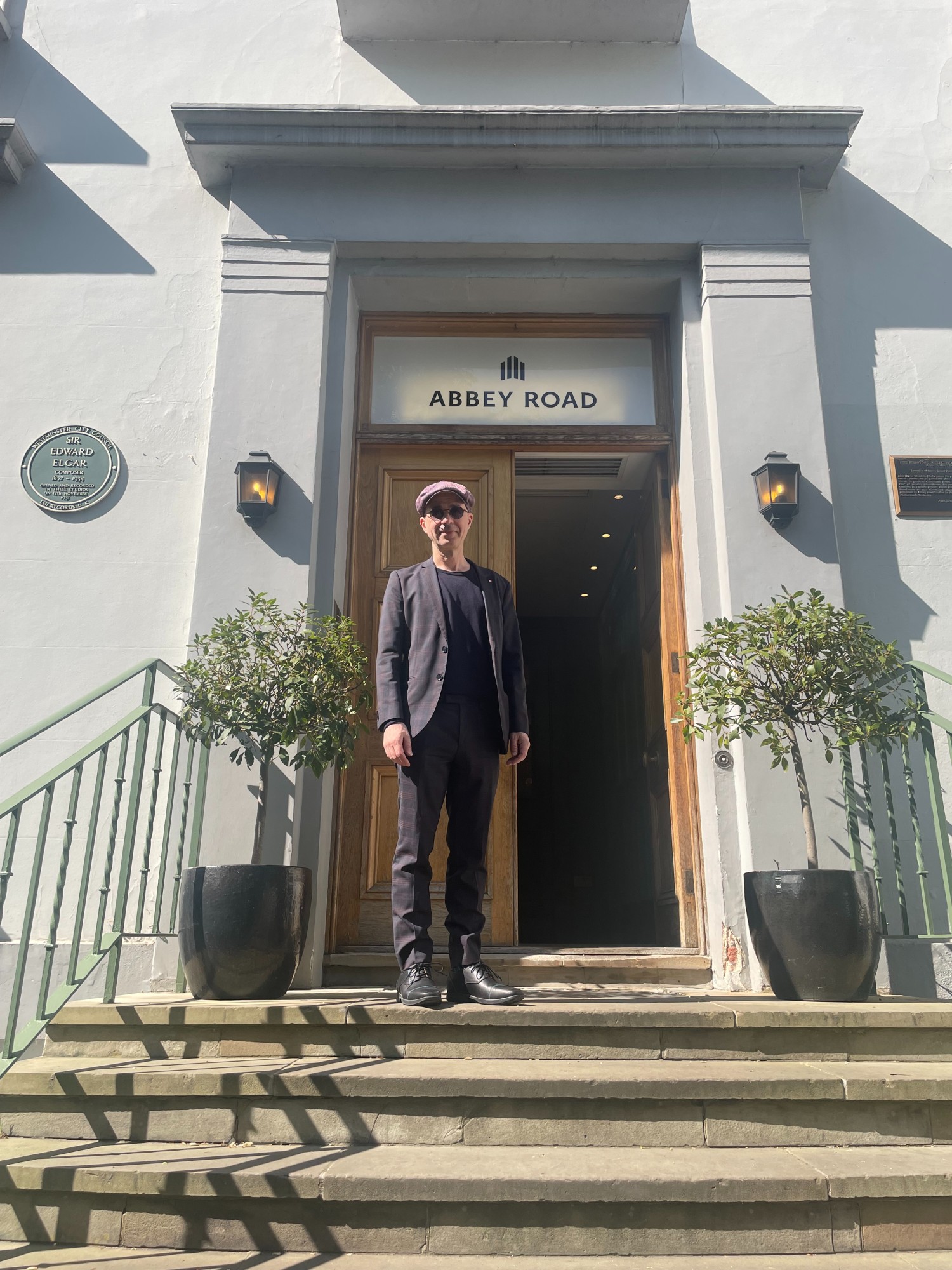
“I mastered the current recording, Camera Lucida, at Abbey Road Studios. It doesn’t get much better than that. I have to say that aside from flying to England to do it, it wasn’t too crazy financially. I guess being a total Beatles nerd, it was something I had to do. It’s actually my second time mastering there. My daughter came with me this time, and I was glad to share the experience with her. The whole building has an amazing feeling to it. The first time I went there, a cellist friend of mine did a session in Studio One with an orchestra and invited me along to see it. That would be a dream come true for me, recording with an orchestra in Studio One or a chamber group in Studio Two.”
Your new recording, Camera Lucida, has just been released. Now that it is complete, how do you feel about it?
“I feel like any time you make a recording, it’s like shedding your skin a bit. It’s a letting go of those compositions, those ideas, and moving on to the next project. I feel good about the recording, excited to share it. I hope people might go back and hear the first Camera Ensemble recording I did in 2012. Camera was a real departure for me. I feel I took some risks and tried something that explored a new development in my musical language, which was exciting.”
What’s next for you?
“I have some commissions I’m currently completing. I have another new recording I did of guitar with a string trio that will be out in early 2026. I definitely took some risks on that one, too. I explored some new sounds on the guitar that I’m pretty excited about sharing. There are also some guests on that recording: mezzo-soprano Alex Hetherington, soprano Charlotte Mundy, and percussionist Beverley Johnston. That recording is called Through the Looking Glass, and we definitely went down the rabbit hole and explored some new musical worlds.”

David Occhipinti, photo by Jen Squires
‘ The preceding article may include information circulated by third parties ’
‘ Some details of this article were extracted from the following source v13.net ’