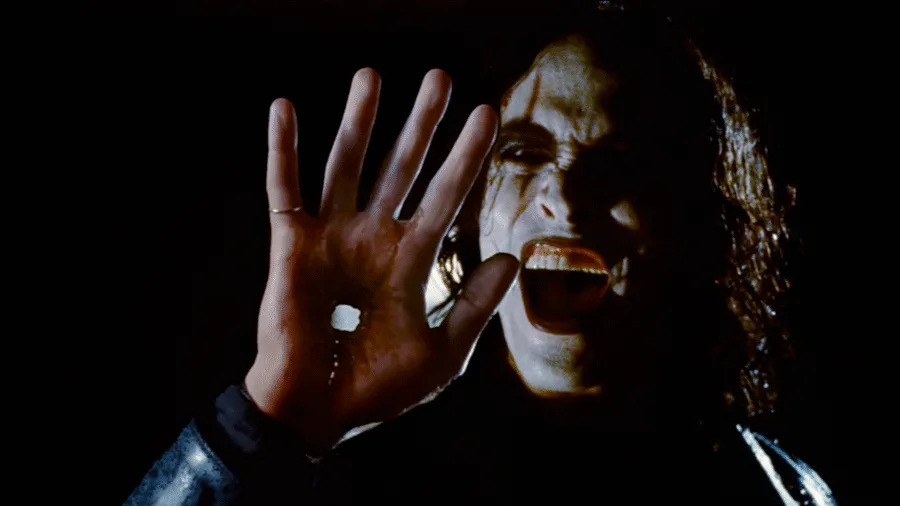
After working my way through all three ill-fated sequels and last year’s remake of The Crow, I can’t shake one glaring issue. Every follow-up ignores a crucial detail: the crow isn’t a source of invincibility. It’s simply the vessel that brings a soul back to settle unfinished business. That distinction might seem minor thirty years later, but it changes how the entire mythology works.
Sarah says it best in the first film: “Sometimes, just sometimes, the crow can bring that soul back to put the wrong things right.” Nowhere does she mention God mode.
The Crow Is A GPS, Not a Battery

Brandon Lee’s Eric Draven does exactly what he’s meant to in 1994’s The Crow. He avenges himself and Shelly, then succumbs to mortal wounds once his mission is complete. His business is finished, so he returns to the afterlife in peace.
Eric is murdered by Tin Tin, Funboy, T-Bird, and Skank. Shelly is also fatally injured by them. One year later, Eric is reanimated by the crow. The crow leads him to his killers. Along the way, he heals from wounds, giving the impression he’s invincible. But when the crow is injured, Eric becomes vulnerable.
This narrative proximity leads viewers and later filmmakers to assume the bird fuels his immortality. In reality, Eric’s own drive for revenge sustains him. Once that drive is fulfilled, the powers fade. The crow is a guide, not a power source.
Mission Accomplished

Eric kills the four men responsible for his and Shelly’s deaths: Tin Tin is stabbed, Funboy is forcibly overdosed, T-Bird goes up in flames, and Skank takes a fatal plunge. With vengeance complete, Eric’s soul can rest.
Crimelord Top Dollar and his half-sister/lover Myca, however, believe harming the crow will strip Eric of his powers, and they’re partially right, but for the wrong reasons. The crow is hurt, Eric loses his edge, and audiences connect the two. The problem is that these events are correlation, not causation. The timing muddies the waters, giving later sequels an excuse to build whole plots around the bird’s supposed magic battery.
Eric never needed the crow beyond being pointed in the right direction. Revenge was the fuel, not feathers that flew him in.
What the Sequels Get Wrong

Each sequel treats the crow as the source of power, manufacturing drama that contradicts the original rules.
City of Angels keeps the pattern but twists it. Ashe’s revenge is complete, yet Judah slays the crow, drinks its blood, and gains immortality. This flips the original logic: now the bird itself has supernatural powers, and they’re transferrable.
Salvation doubles down on the misstep, tying Alex’s immortality directly to the crow’s proximity. At one point he dies after separating from it, only to resurrect once it returns. Here the crow isn’t just a vessel, it’s a necromancer.
Wicked Prayer goes full nonsense. Jimmy loses his powers when the crow dies, then regains them through a Native American ritual that revives both bird and man. The mythology collapses entirely, and the movie bottoms out with a zero on Rotten Tomatoes for good reason.
The Remake Gets It Right

The 2024 remake, despite its pacing issues and overzealous origin story, reverts to the original framework. Bill Skarsgård’s Eric Draven doesn’t rely on the crow for strength. The bird guides him like a GPS, not a generator. Once his revenge is satisfied, he willingly steps into the afterlife. His powers vanish because the mission is complete, not because the bird ran out of juice.
Time To Put This To Rest

Now that I’ve finished my own unfinished business, my power to keep talking about The Crow is quickly fading. Not because of a bird, but because I’ve done what I set out to do. My revenge against the sequels is complete, and there’s nothing else left to say.
‘ The preceding article may include information circulated by third parties ’
‘ Some details of this article were extracted from the following source www.yahoo.com ’