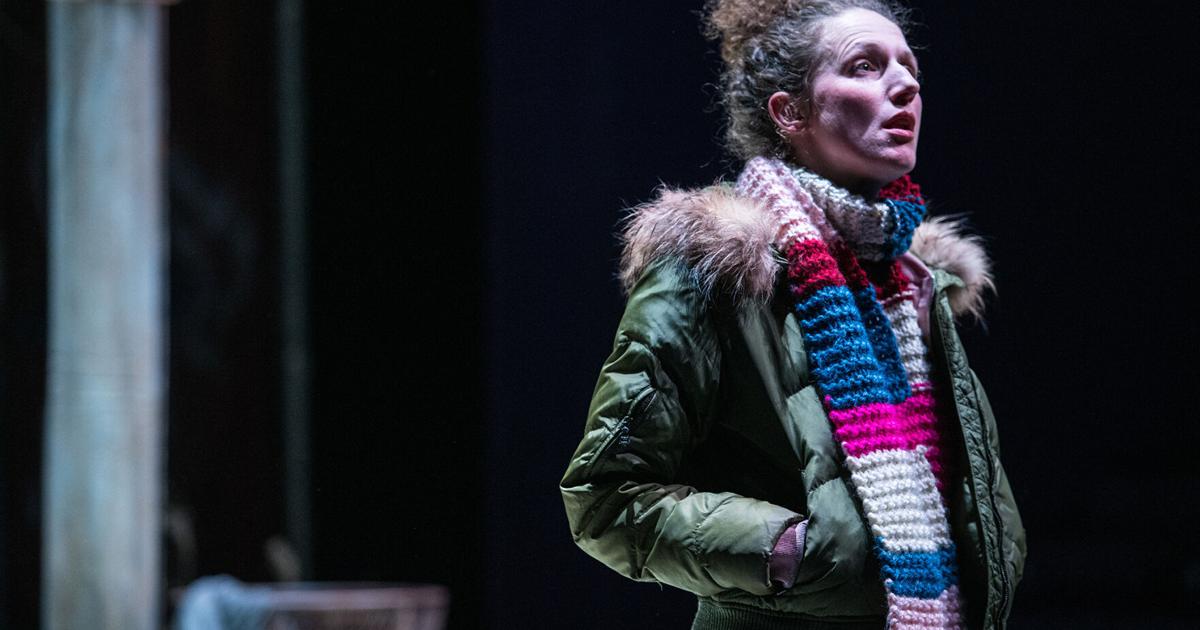
The grass looks midwinter familiar — more gray than green, circumscribed by crumbling sidewalks edged in peeling yellow paint. Concrete sprouts stubborn weeds. Formless shapes painted on a chain link fence suggest Detroit, or Chicago, or Elizabeth, New Jersey.
This bus stop is limbo for Darja. Polish born and determined, by turns hopeful and disillusioned with her life, Darja waits for a bus that never comes.
Martyna Majok’s play “Ironbound,” directed by Marcella Kearns and produced by Forward Theater, runs through Feb. 15 in the Overture Center Playhouse. And for 95 minutes Darja, played by Cassandra Bissell, never leaves the stage.
Majok, who won a Pulitzer Prize for “The Cost of Living” and revived “Queens” off-Broadway this past fall, has found success writing characters on society’s edges — immigrants, people with disabilities, queer people. The character of Darja was inspired by Majok’s own mother, Justyna, a Polish immigrant who cleaned houses and raised Majok in New Jersey.
Forward Theater’s bus stop, rendered with granular realism by set designer Lisa Schlenker, sees Darja opposite a series of men. The first, postal worker Tommy (Jonathan Wainwright, earnest and convincingly vulnerable), tries to woo her back after his dalliance with the wealthy woman whose house Darja cleans.
“Yer always workin’, and late,” he pouts. “I’m not good alone. You know that.”
From there, “Ironbound” drops into different decades. Twenty-year-old Darja, after a shift at the nearby factory, flirts with her new husband, Maks (Josh Krause). Maks is a young Polish dreamer who wants to play the blues in Chicago.
Krause and Bissell have visible chemistry, and Krause makes Maks’ passion charming, with an edge. We see it in Darja’s nerves as she wrestles with how to tell him she’s pregnant.
“Money, it’s nothing,” Maks says. “What’s most important in this life, it’s this thing you have what no one can take from you.”
In a later scene with Vic, a teenage hustler played by Gabriel Anderle, Darja is more fragile, more maternal. Vic discovers Darja, now 34, sporting a nasty shiner and attempting to sleep on a tire.
“Yer like a legit battered woman,” he exclaims, his incredulity tipping into dark humor. “Should I not try’n make you laugh? It hurt yer face?”
Anderle, as Vic, can’t stop moving as he offers Darja ice, a fist bump, a meal at a diner. He raps rhymes with his name (“deer tick, salt lick, toothpick, Saint Nick”), calls her “man” and “ma.” (I overhear an older couple in the theater whisper, “He sounds just like my grandson.” Bro!)
Kearns directs “Ironbound” with grace and humor, as Darja dances with each of these men. Shelley Cornia’s costumes tell us where and when we are with nods to Jersey teams and the changing seasons. Noele Stollmack’s lighting cools the stage during Darja’s low points, warming up as she dreams with Maks.
Throughout, Bissell is marvelous as Darja — frustrated at her circumstances, fiercely proud, flawed and funny. Darja is the kind of person who will put a tracking app on her partner’s phone to see if he’s cheating but needs convincing to leave an abusive home, even one that has her “tuckin’ herself in on this hepatitis ground” (per Vic).
It’s telling, too, what Majok does not show us: any other women, friends or sisters or neighbors. Darja loses jobs. She loses love. Her son struggles with addiction, won’t return her calls. We begin to understand why she rejects help and sees relationships as transactional.
“I need concrete,” she tells Tommy. “I need ‘How Much You Will Give.’” This is what America has taught her.
‘ The preceding article may include information circulated by third parties ’
‘ Some details of this article were extracted from the following source captimes.com ’