“OH MY GOD,” Nicholas Galitzine says, squinting his eyes in disbelief. He exhales, pulling himself together. “It’s very, very trippy.”
The 31-year-old actor is closely inspecting a He-Man action figure, one that costs $10.99 and is available at any big-box store or online retailer. He-Man toys, with their bulging muscles, minimal clothing, and blond bob of hair, have been made in one form or another since 1982. But this He-Man is different. This He-Man looks just like Galitzine, the actor tasked with bringing Prince Adam of Eternia and his all-powerful alter ego, He-Man, to life in the new Masters of the Universe film from Amazon MGM Studios.
“It’s very surreal,” he continues, looking decidedly un-He-Man-like during a period of downtime on the Masters press tour’s stop in Berlin. His hair is a neat mess of brown, his gaze is intense, and he’s paired a white shirt with a pair of blue and green plaid pajama pants. Despite his casual vibe, he has an undeniable big-screen aura.

Back when Galitzine was a kid in West London, his parents encouraged him to spend less time watching television and more time using his imagination. That meant a lot of time spent with toys just like the one he’s looking at. “Playing with action figures birthed my sense of creativity and imagination, in some sense,” he says. “And so it’ll be a very good Christmas gift to all my nieces and nephews.” He pauses for another second before continuing: “Maybe a bit egocentric to hand out versions of yourself to people, but still.”
And “egocentric” is an interesting word. Because you’ve dismissed Masters as just another retro superhero play, you’ve missed the fact that He-Man was always kind of complicated. Yes, the original series featured a beefcake in a Speedo traversing the universe to fend off evil baddies, but He-Man himself was complex. Masters, I promise, isn’t your typical summer blockbuster. Beyond the muscle-bound hero, there’s also a story of found family, father/son drama, a masculinity arc, and a ton of self-deprecating comedy. It’s less Avengers: Endgame and—brace yourself here—more Barbie.

Controversial? Well, ever since the teaser trailer dropped in early 2026, Masters has been subject to trolling on socials. A pronoun joke, slipped into a teaser clip, resulted in certain corners of the Internet already mourning over “woke” He-Man. Early reviews of the film said it’ll further incite the manosphere. But Masters drops at a time when masculinity feels like it’s being re-(re-re-)defined through testosterone, peptides, and #looksmaxxing that can turn any man, of any age, into He-Man.
Galitzine smirks when the topic comes up. “The muscles don’t maketh the man, really,” he says. “We live in a physical world, and the aesthetics of both things and people obviously have value in it, whether we like it or not. I mean, He-Man’s superpower is his ability to really connect with people and embrace them and embolden them and collaborate with them. It’s not the superficial.”
But the muscles definitely do signal something.

DESPITE THE OVERSATURATION of the superhero genre, He-Man does feel somewhat lost to the sands of time—stuck, for the moment, as a relic of the ’80s.
He-Man’s origin story (in the newest version) is no more ridiculous than any other superhero’s. Prince Adam, our hero, comes from a faraway land called Eternia. His parents are King Randor and Queen Marlena of Eternia, and Adam struggles to live up to their expectations—in particular, the lofty ones of his royal father. Vitally, there’s something called Castle Grayskull, a fortress that houses the aptly named Sword of Power. This sword grants whoever wields it the universe’s ultimate strength after they say a simple incantation: “By the power of Grayskull,” to which Adam, when chosen as the champion, adds, “I have the power!” The two lines give him both a makeover into the hero known as He-Man and a signature catchphrase for the ages.
Galitzine, who was born in 1994, wasn’t around for the Masters of the Universe franchise at the peak of its powers (which included a Dolph Lundgren–led film in 1987). But when he read the script for the latest take, he was sold.

Galitzine, post-He-Man transformation, in Masters of the Universe.
He’d been working as an actor since 2014 and started landing larger roles in the 2020s (Netflix’s Purple Hearts, Prime Video’s Red, White & Royal Blue). Then he flexed his comedy muscles in 2023’s Bottoms as a dickhead football jock and romanced Anne Hathaway in the 2024 rom-com The Idea of You. But these projects largely leaned romance and drama. They’re decidedly not in the same genre as a Masters of the Universe, and, for Galitzine, that’s exactly the point.
“I’m not someone who necessarily just wants to make art house movies all the time, but I need it to feel like there’s some sort of nuance, or multifacetedness, or moral gray, or something very human that I can dive into if it’s going to have such public appeal and be such a big studio machine,” he says.
Masters had all of that: humor, poignancy, emotion, and a ton of action. “I really, truly felt like I fully understood who this man was,” Galitzine says. And so he told his team that he was really interested. Eventually, a make-or-break meeting came with director Travis Knight.

Galitzine, right, with Taylor Zakhar Perez in Red, White & Royal Blue.

Galitzine played a very dumb jock in Bottoms.
“When I first met with Nick, he completely sold me,” Knight says. “I was absolutely besotted with him. He’s so completely charming. He’s warm, he’s funny, he’s sweet, and he’s got a big heart—and that was the key thing. That’s what I wanted Adam to be. Now, the missing ingredient was that he’d never played an action hero before. He’d never been He-Man. And so that was something he needed to do. But I knew he could do it.”
Once Galitzine received the official offer to lead Masters of the Universe, he knew the tasks at hand. While researching everything that had ever been written or drawn about He-Man, he’d also have to completely transform his body.
AT NO POINT does Galitzine look more annoyed than when he has to think about what, exactly, he had to eat during his Masters of the Universe transformation, which took him from around 176 pounds all the way up to 231, before the cut brought him back down to around 200 pounds.
His eyes get really big. He breathes out for a few seconds. “I mean, truthfully, it was a lot of the typical stuff: a lot of rice, a lot of chicken—not just chicken, but beef and lamb,” he explains. “I mean, there were about six meals a day. I remember it being 10 p.m. and getting a text from my trainer being like, ‘You eating your sixth meal yet?’ And you’re full, and you’re looking at this big pot of rice and protein. You just feel your stomach expanding week on week.”
Galitzine ingested as many as 5,000 calories a day during his bulking period, while also fitting in three-hour weightlifting sessions and special training for as many of the movie’s stunts as he could possibly do himself. He’d been very fit before, in his rugby days, but never packed on that kind of size in four to five months of prep time.
The cut was even harder. His calories went down to roughly 1,900 per day, paired with weight training, an incline treadmill for hours on end, and more stunts. His “treat”? Zero-calorie soda. “Having my Coke Zero at lunchtime, I was like, Oh my God, yes,” he says.
Knight credits the hard work that Galitzine put in before the cameras even started rolling, particularly in the face of other options that are more prevalent in the industry. “The thing these guys have got to go through—and there are shortcuts, which we won’t speak of, that I know that some actors have used to get there. We were not going to do that,” he says. “I did not want this man to destroy his body for the sake of the movie. So he did it the right way, and he did it the hard way.”
The body changes were something Galitzine had never experienced before. He remembers a moment during the peak of his bulk when he had to do an event for Emporio Armani and was out in public looking like a person even he didn’t recognize as himself. “This notion of being perceived in a state that didn’t feel like me was really, really terrifying,” he says.
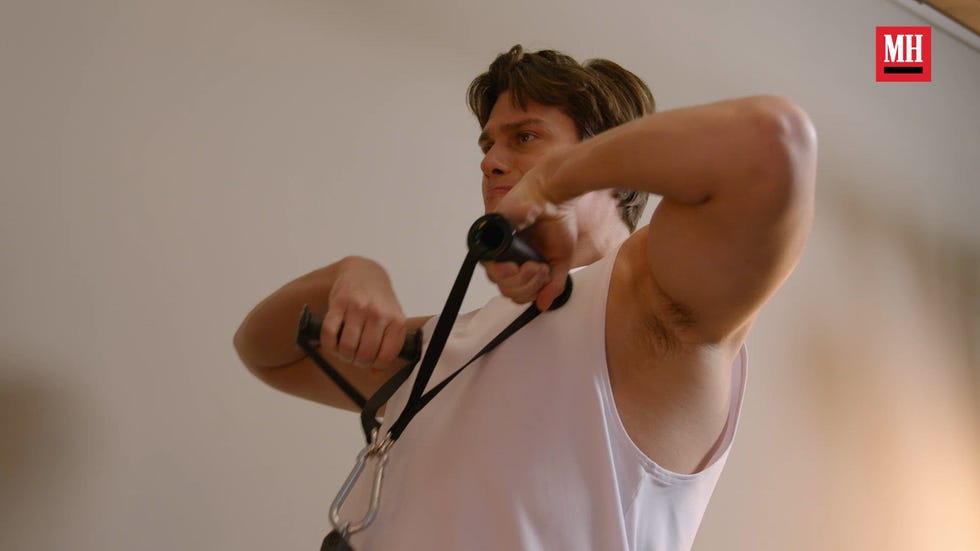
When I see Galitzine a few days later, at the photo shoot for this story, I have the same reaction that so many men have when they see someone looking absolutely ripped: Man, I’ve got to get into better shape. Drawing attention to himself is not something in Galitzine’s nature; he walks without any pretense and likes to lay as low as an ascending movie star possibly can. He’s not someone to yell or shout or make a big show of anything. But when he’s exercising his arms and flexing the same triceps I’ve now seen him use to punch Skeletor in the face, it’s kind of hard to look away. My reaction isn’t far off from how many felt seeing Galitzine for the first time. Camila Mendes, who plays Adam’s childhood friend and fellow warrior Teela in Masters, trained with him for a bit in Los Angeles. When production began in London, she was “stunned,” she says. “He was huge. I’m like, ‘This is not the Nick I met.’ It was truly unbelievable.”
But then I come to my senses just a bit; he’s still literally He-Man. And even Galitzine recognizes that what he’s done is out of the ordinary: “A lot of people think this is quite attainable, but it was a full-time job for me.”
Despite his superhuman physique, Galitzine has nicest-guy-in-the-room energy. He’ll remember specific points of previous conversations. He’ll laugh—or at least chuckle—at all your stabs at humor. He’ll talk some shit about social media influencers who probably deserve it. At six feet tall and with his still-very-ripped physique, Galitzine is probably going to be the largest person physically in most rooms. Again: He’s literally He-Man. But his physicality isn’t threatening. He feels more like a dude you just played against in a game of pickup basketball and are heading out to grab a beer and some wings with. (He is, coincidentally, headed to a taping of Hot Ones after we wrap things up.)

All of that hard work he put in, however, paid off. Because there’s the moment in the film—you already know the one—when he first picks up the Sword of Power, first says those words, and first goes from Prince Adam to the all-mighty He-Man. When that sequence, which comes about halfway through the film, was shot, it was a major day on set. “I don’t know if it’s as iconic as ‘The name’s Bond. James Bond.’ But it’s up there in terms of you associate that line with the character,” Galitzine says. “And so people are expecting something from you.”
On the day, on the biggest set the production had built, Galitzine recalls more than 300 crew members gathered to see the scene come to life. Knowing its importance, as the culmination of what Adam has spent basically his entire life searching for, and the emotion that comes with it, Galitzine knew it had to be special. He knew he had to get it right. He says he didn’t want the line overly prepared, because he wanted to feel the deep emotion the very first time he said it. With Knight’s approval, rehearsal was kept to a minimum.
Then the cameras rolled and Galitzine said it. By the power of Grayskull, I have the power! The skies open. A blasting light turns Adam into He-Man, revealing not only the powerful sword but that ripped, superhuman body. Epic, by all accounts—but Galitzine says he thought he blew it.

Galatzine holding the Sword of Power in Masters of the Universe.
He says Knight “came out from behind his monitor, and I’m going, ‘Oh, fuck it. Here we go. I’m getting fired.’ But we just shared a really beautiful embrace.” And, as Knight tells it, the payoff ran deep. As a lifelong Masters fan, the director was already excited just to see weird characters like Ram-Man, Fisto, and Skeletor in live action—let alone in a movie he was directing. But seeing the He-Man incantation and transformation took things to a different level. “I will admit that I welled up a little bit in that moment,” he says. “I had chills, the hairs stood up on the back of my neck, and there were tears stinging my eyes, because I was just so moved by the whole experience.”
It’s a moment that feels earned, because we’ve just spent the first half of the movie watching Adam not as the kind of fast-talking, quippy hero that’s become common in the last 20 years of action-adventure films, but as an earnest, humble, normal guy. The Adam we meet isn’t the coolest guy in town—he’s working that boring job, living with a roommate, and going on failed Hinge dates. Because we meet Adam as a kid who can’t figure out how to earn his dad’s respect and we follow him into an adulthood filled with relative disappointment, we’re on his side, since, hey, he’s a nice guy. He’s not entitled, even though he literally comes from royalty. He’s not cocky, even though he’s big, and tall, and handsome. He’s just a guy trying to make it through the hand he’s been dealt.
The way Masters owns its earnest nature is also true when it comes to the camp at the core of its story and characters, too. It’s a movie fully aware of how silly some of this is, with characters and performers who seem to understand just that.

In many ways, the explosive, exciting energy behind Masters can be seen as a course correction for a world that’s lost its willingness to sit with something just a little goofy and fun. “I worry that sometimes we’ve lost this real sense of sincerity in these worlds,” Galitzine says. “I think in keeping with the lack of color and vibrancy in a lot of these movies in recent times, we’ve lost the vibrancy of performance. Yes, this is honest, and sincere, and very silly, but we can really enjoy it. We obviously still poke fun at ourselves in a way, but there’s nothing embarrassed about it.”
Which is to say that humor does play a large role in the movie itself and what it’s bringing to the table. For all the jokes about funny names and funny powers and big men with funny haircuts and pink button-down shirts, there’s a general self-awareness—something that seems to address where men aren’t right now.
During the franchise’s original ’80s run, He-Man’s aesthetic signified the peak of what the culture considered the masculine ideal: broad shoulders, massive muscles, weekly heroics. Even with his silly little haircut, he represented what many men thought they needed to be.
The actual text suggested something deeper. “Even though he looks like your classic action hero with all those muscles, he was never a guy who would throw a punch at the beginning,” Knight says, explaining the character’s allure for him. “He was always someone who was looking for common ground, who spoke of empathy and kindness and friendship. And so, I remember as a kid, it was seismic to discover that one could be both strong and decent. It became something to aspire to.”
The new movie recognizes this, not treating Adam’s muscle mass as an object of worship but as just one part of what makes him who he is. This is best exemplified during a stretch of the film when we see Adam’s life on earth after he’s been hidden away from Eternia. He’s not greased up in a sleeveless shirt or mogging for a social media post, but wearing that same pink button-down with a white undershirt beneath it and working an office job in human resources.
“I find this looksmaxxing to be a little bit comical,” Galitzine says. “It’s very lacking in self-awareness at times, and there’s humor in it, but we’ve always done something of that iteration. Makeup is as old as time, and I suppose you could say that’s looksmaxxing in some ways. But where it’s going seems completely out of control.”
Galitzine says he doesn’t really see these kinds of conversations about masculinity and its binary nature—the expectations, the pressure, and everything that comes with it—as necessary at all. In fact, he feels a little funny talking about it, because it makes him think back to his teenage days as an athlete and rugby player.


Growing up in that world—in the midst of all sorts of machismo and with many of his teammates embodying a classic frat boy persona—sent him through his own existential crisis at a very young age. “I was 14, 15, 16, and I had this real looming sense of cosmic wonder and fear,” he says. “I was really, really sensitive and emotional and I had no outlet for it. It really wasn’t until acting, in a lot of ways, that helped me process that.”
Seeing Adam’s struggle in Masters of the Universe—his dream of becoming the man that he thinks his father always wanted him to be and the man he thinks his home needs him to be—resonates with Galitzine specifically because when he was growing up, that was so not the case. “I mean, I had fantastic male role models, really, in my father and my uncles, my grandfather, but I grew up around a lot of amazing women as well,” he says. “And so these concepts of masculinity, femininity seem rudimentary.… How something as complex as humanity can be so binary is almost laughable. I really, truly believe this guy that I’m playing embodies the best of both worlds.”
Why can’t you be a big badass with huge muscles who punches bad guys in the face—and also kind, caring, considerate, and eager to solve problems?
“For me, it’s not really a conversation that needs to be had; it’s just a reality,” Galitzine continues, his breath getting shorter and his words coming quicker as his passion ramps up. “We are many, many things, and we should embrace those many, many things.… This notion of being able to talk about how we feel is obviously central to our movie, but something hopefully the movie can really perpetuate in other young men.”
GALITZINE STILL HAS more work to do. His next projects run the gamut of genre, subject, and theme. Next up is The Mosquito Bowl, which was the first thing he shot after Masters. That film, a World War II drama about a football game played by U.S. Marines during their preparation for the Battle of Okinawa, tells a little-known story that very much happened, based on a nonfiction book by Buzz Bissinger. Galitzine says its director, Peter Berg, kept texting him, worried that he would show up for production looking like He-Man, a physique that no one had in the ’40s. So Galitzine took that as a sign to stop weightlifting for a little bit and eat whatever he wanted.
His five-month Mosquito Bowl experience came directly after his nine-month Masters of the Universe experience and before shooting the Red, White & Royal Blue sequel, Red, White & Royal Wedding, which (deep breath) preceded The Return of Stanley Atwell, a mystery-thriller based on an original story by Steven Soderbergh. Galitzine says that, in all, he’ll have made eight movies in succession without a break.
“I tell him he should take a break because he’s been going nonstop,” Mendes, his Masters costar, says. “Since Masters wrapped, he’s had another project and another project, and that just speaks to how talented he is and what’s ahead. I’ve told him, ‘At any moment, you can take a break and just trust there will be work on the other side waiting for you. You’re always going to be employed.’”
He does plan on it. But not just yet. There’s another yet-to-be-announced movie he’s doing about the concept of being a scapegoat, and another he’s doing with Gus Van Sant that he says is “very much a character piece.” And, god, how much does he want to just be in a horror movie, or perhaps even a sci-fi horror or video game sci-fi horror? Any of them will do; let’s just make it happen. But as he reaches a point in his career where he’s more and more booked for more and more years, the dissonance is forming. As much as he wants to do all of these things, it’s becoming so tricky to find the time.
“What you’re going to see in the next few years for me are movies I feel really, really passionate about for different reasons,” he says. “To me, the greats are the people who are completely unpredictable and surprising.”

Photography: Sandro Baebler
Styling: Peghah Maleknejad
Grooming: Josh Knight
Visual Director: Sally Berman
Video Executive Producer/Director: Dorenna Newton
Video DP: Romy Kirchauer
Video Editor: Kyle Orozovich

Evan is the culture editor for Men’s Health, with bylines in The New York Times, MTV News, Brooklyn Magazine, and VICE. He loves weird movies, watches too much TV, and listens to music more often than he doesn’t.
‘ The preceding article may include information circulated by third parties ’
‘ Some details of this article were extracted from the following source www.menshealth.com ’