Well, what’s a red carpet appearance without a polarising gown or two, eh? This time, it was Australian star Margot Robbie who raised eyebrows (and, let’s be honest, probably had several people zooming in for a better look) when she stepped out at the premiere of her latest film, A Big Bold Beautiful Journey, in London this week.
Her full-length dress, from Armani Privé’s SS25 collection, was cut low at the back and, although sparkling with a design of crystals, completely sheer, leaving little to the imagination about the efficacy of her glute exercises – which is to say, her buttocks were completely visible, and she’s definitely in great shape.
Do I think she looked breathtaking? Without question – and her figure is even more impressive given she had a baby a year ago. Did I look like that when I had my daughter at 35, the same age as Margot Robbie? Absolutely not.
But now that my daughter is 19 years old, do I have reservations about the trend for “sheer dressing” (what my mother might have called “letting everyone see what you’ve had for breakfast”)? Well, obviously.
Not that I was running around in high-necked blouses as a teenager – Madonna, for instance, had us wantonly yanking fishnet vests over bra tops, and wearing silky slips as dresses in the eighties. My mother probably cried whenever I left the house – now I’m the one crying.
I do get it; I understand that fashion is often there to be provocative, and that it’s a form of self-expression. I also understand that, as gender roles evolve, dress codes do too. Gen Z women believe it’s absolutely their right to dress the way they want and regard our middle-aged aversion to the (literal) stripping back of fashion with both anger and amusement.
“It’s not my job to look a certain way; it’s their job to not look at me a certain way,” is their commonly held, defiant belief. Yes, there’s a lot of truth in that, but it’s a belief that’s not necessarily realistic or one that people like me – mothers, teachers, relatives – are entirely at ease with. Because when girls feel angry about their rights over their bodies, common sense often goes out the window.
It’s here that the lines between feeling empowered and remaining appropriate become tricky to navigate. When near-nudity is seen as self-ownership, and as two fingers in the face of societal norms, the element of context can all too easily be overlooked. After all, it’s one thing for Robbie to appear in a controlled environment with security and paparazzi in a sheer outfit, but quite another to wear one to a bar, or to walk down the street from the train station after a night out.
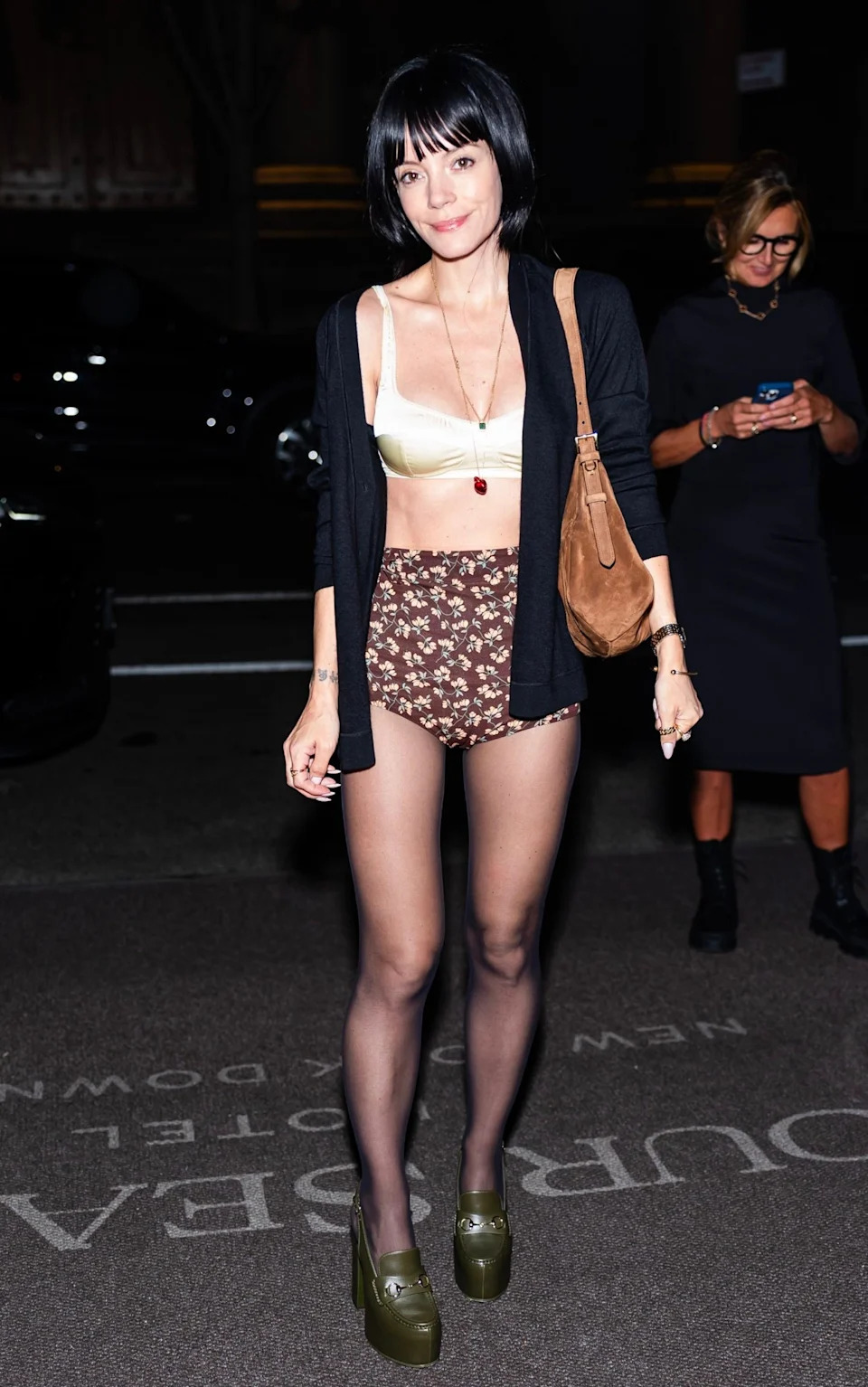
Being a teenage girl is, of course, also very different from being a celebrity who, by the very nature of the profession, is there to be noticed, photographed and talked about when performing their public roles; Robbie undoubtedly was pursuing headlines as well as fashion-forwardness when she opted to wear the barely-there gown – as Lily Allen presumably was when she stepped out in a bralette and mini shorts (aka pants) in New York on Friday evening.
Lily Allen is another in a long line of celebrities to ‘bare all’ in the name of fashion – TheStewartofNY
Gen Z’s youthful defiance also takes root in a reaction against the cult of body shaming – which, despite body positivity movements, is still alive and well. Take Robbie herself, who was viciously trolled online during her pregnancy, including being dubbed “Margot Blobbie”. Who wouldn’t feel angry about such ignorant cruelty? The Barbie star’s barely-there gown could well be seen by the younger generation as the modern version of Princess Diana’s “revenge dress”.
In an era of body acceptance and self-love, the tendency to see everything through a sexual lens has diminished considerably. Casual and desensitised as the younger generations so often are, for them, people are just… people. Fashion is just fashion. A pert bottom is just a pert bottom. So what?
But the “what” is that not everyone sees it like that. And in the same way we’d be remiss in not educating our children about what’s culturally appropriate in certain countries or settings, we need to make them aware of all of the nuances and risks that surround exposure – of flesh and of form – in everyday life.
Every generation has felt dismay over the sartorial choices of the next – jeans, now worn by everyone from toddlers to grandparents, were once banned in schools, and the “mop tops” popularised by the Beatles were considered quite scandalous for their effeminate length. Perhaps “sheer dressing”’ will, in a few years, be seen as the norm – and, if Coco Chanel’s famous “take one thing off” advice is heeded, there’ll be nothing left but nipple tape.
Or, heaven forbid, not even that.
‘ The preceding article may include information circulated by third parties ’
‘ Some details of this article were extracted from the following source www.yahoo.com ’