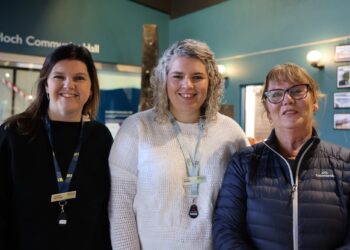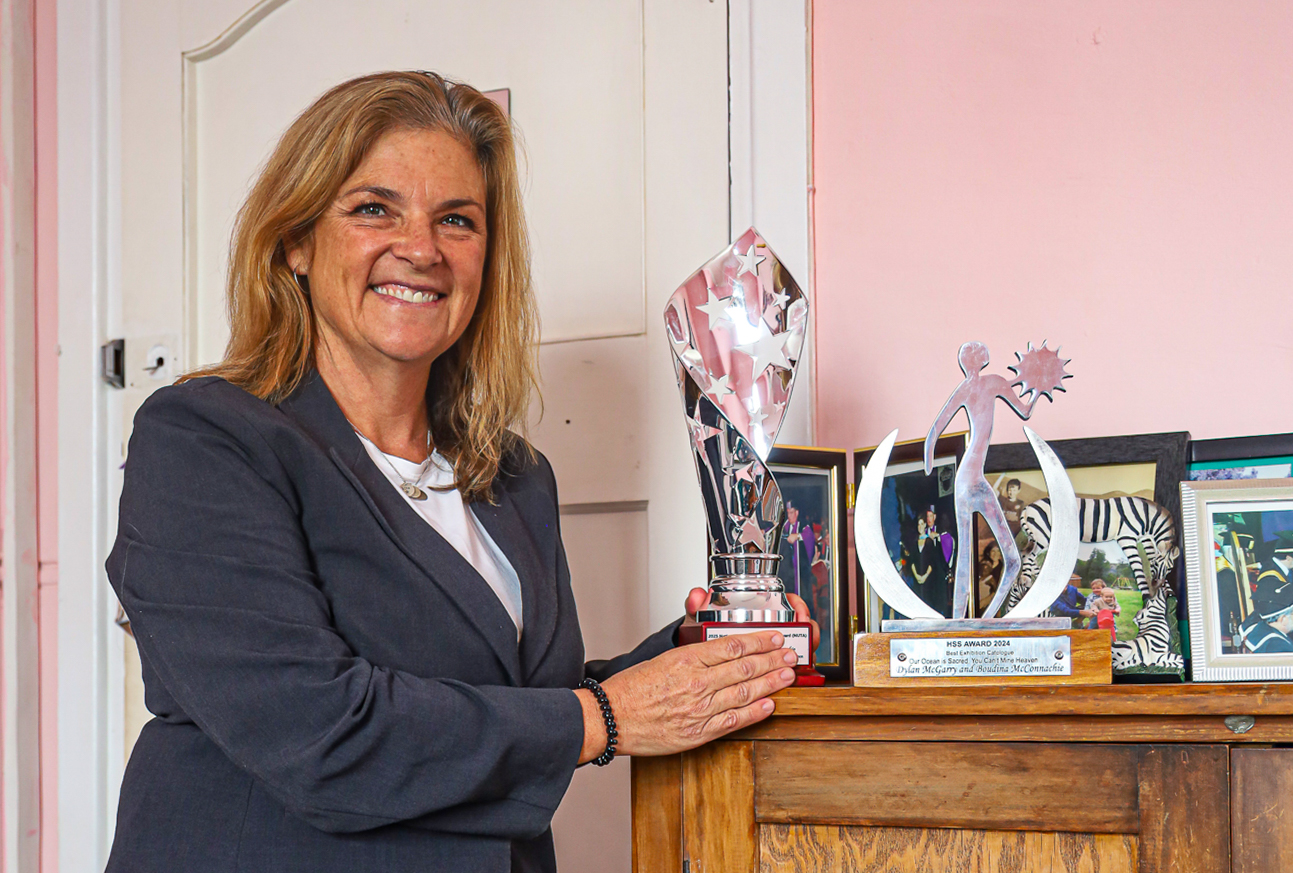
Winner of the Vice-Chancellor’s Distinguished Teaching Award, head of Rhodes’ Music Department, Prof Boudina McConnachie, connects university and town musicians, thinkers and performers. Photo by Sanele Ndlovu
Prof Boudina McConnachie is a flautist, podcaster, award-winner, community orchestra conductor, and a resilient academic who stands against all odds.
By Lufuno Masindi and Nthabiseng Khonkco
Most academics write about their communities. Prof Boudina McConnachie performs with hers, records them, turns their voices into award-winning research, and does it,time and time again.
As head of Rhodes University’s Department of Music and Musicology, and one of the founders of the Makana Community Orchestra, McConnachie stands firm on contributing and performing with the community. Makhanda’s most anticipated musical event of the year, Masicule, a concert boasting the full MCO and choirs from 20 schools, is proof of this commitment. Held recently at the Monument, both sold-out performances once more set hearts and souls alight.
“It was magnificent, brilliant. It actually made me cry,” reminisces McConnachie. “There were students and kids looking at each other going, ‘wow, you’re amazing’. And that’s so healthy for everybody to realise how accomplished other people can be, despite being from different economic and cultural backgrounds.”
For McConnachie, that moment captures the music ecosystem she has helped to build since 2017, rooted in what communities already have, not what they lack. With Makhanda being such a small town, she has fewer resources to work with – meaning everything she does is for the good of the entire community, including the university. McConnachie describes this as a cycle, where “all of the town’s music teachers, music-makers, performers and thinkers are supported so that they then feed back into the university, and we can feed back into them.”
The community at large comes first. “I can promise you, there isn’t one thing we do at the music department where we don’t think about the community,” she says. Not only for the musicians, but also for the culture, music, and the well-being of society in general.
Students who come through the Access Music Project, Black Power Station, Graeme College, and Victoria Girls’ High School are increasingly finding their way to Rhodes University, and into the music department itself.
“Without those students, we wouldn’t be what we are right now,” she says. It is, she suggests, the clearest evidence that the relationship between university and community runs in both directions.
The orchestra that remains unbreakable

Courtesy of Quicket
According to McConnachie, they are still applying for Makana Community Orchestra to be registered as an independent entity. When they first started, they held four concerts every year with the full orchestra. But now instead of expecting constant full-scale participation, the orchestra rotates performances across sections. A strings ensemble might perform one week, followed by a brass concert the next, with a full orchestra gathering reserved for later in the year. It’s intentional, explains McConnachie: “These are community members giving their time. So we’ve had to learn to be flexible, to accept that not every year will look the same in terms of output.”
In rehearsal, professional musicians, students and school learners sit side by side, creating what McConnachie describes as a mentorship space for learning to be shared rather than directed. Among them is Temba Mashabane, a member of the Soweto String Quartet, performing alongside students and community members. It is, in her words, a space where musicians “learn with and from each other.”
“I’m very inspired by how she manages to bring people together and create these wonderful things,” said Garreth Robertson, Deputy Chair of the orchestra. Robertson has worked alongside McConnachie since she started the Orchestra in 2023. Back then, he was still a solo pianist. Gazing at the very first orchestra poster, Robertson says it has been an exciting journey. McConnacie has a “lot of vision, and that’s what I respect about her,” he added.
Her ability to put the broader community first “changed” him and how he views community work, and his heart “skips a beat” when he reflects on her influence on his own leadership role.
Listening as Research: When Sound Meets Science
Emerging from a growing shift toward transdisciplinary work, Sounds of the Ocean project brought together academia, community knowledge, and artistic practice. Rather than relying solely on written data, it embraced storytelling and sound as legitimate forms of knowledge production.
Travelling along the Eastern Cape coastline, the team engaged with a wide range of voices, musicians, healers, researchers, and local community members, to explore the relationship between isiXhosa communities and the ocean. These conversations became a podcast series, capturing layered, lived understandings of the sea.
“It showed us that research doesn’t have to look one way,” McConnachie reflects. “Different forms of knowledge reach different people.”
The impact extended far beyond academia. The recordings and artistic outputs were later used as evidence in the Shell seismic blasting court case, demonstrating how creative, community-based research can influence legal and environmental discourse.
Johan Pretorius, conductor of the Makana Community Orchestra and music teacher at Graeme College, has worked alongside McConnachie for 14 years. He describes her as a trailblazing ‘bridge-builder’ whose music books, study guides and reference works have become household titles, found on the shelves of educators and musicians across the country.
Says Pretorius: “She has been a pioneer in contexts beyond the norm and has managed to narrow the gap between Western Art Music and African Indigenous Music with musicians all over the world, but specifically in the Eastern Cape and Makana.” Due to its success, other provinces and communities are starting to use her model.

Teaching beyond the classroom
Embedding community engagement into university curricula can be a fraught process. For McConnachie, a particular challenge is working within the traditional grading system. About this, she is blunt – “I think marks are unhealthy, making us run after a number instead of quality.” She is a proponent of the ‘ungrading’ movement and finds it difficult to embed assessment in what she regards as a civic duty.
Still, practical solutions have emerged. Music students participating in the orchestra receive ensemble marks through their involvement, aligning academic assessment with community contribution. Similarly, fourth-year music management students are tasked with promoting orchestra performances, gaining hands-on experience in planning, marketing, and execution.
These approaches ensure that community engagement is not an add-on, but integrated into the learning process in ways that feel purposeful and reciprocal.
Not every initiative takes hold in the way it is first imagined.
A recent attempt to establish a choir at George Dickerson Primary School was paused after several months. Logistical challenges, shifting schedules and limited engagement made the model difficult to sustain.
For McConnachie, this is part of the work. “If something isn’t working, don’t keep pushing at it,” she says. “You have to change.”
The project is now being rethought in consultation with the school – not abandoned, but adapted.
Who Owns Knowledge?
Working with community members as co-researchers raises complex questions around authorship, intellectual property, and representation. Instead of imposing solutions, the project adopts a collaborative approach from the outset.
In one long-term project, participants co-created a “joint manifesto” outlining shared values and expectations. Formal agreements offered fair benefit-sharing where necessary, while creative outputs, like a “sound postcard” exhibition, provided platforms for all voices to be heard and credited equally.
“There isn’t one right answer,” McConnachie reflects. “But you have to try to get it right from the beginning.”
While the projects aim to serve communities, they are equally shaped by them. Time and again, they find themselves learning from the very people they collaborate with.
“In music, you realise how much talent and knowledge already exists,” added McConnachie. “Sometimes you go out there and think, this person is better than me.”
As Pretorius observes, it is this humanness that sets her apart. “Her relationship with people of all ages and from the entire rich community of Makana and beyond is nothing short of extraordinary.”
It is this constant exchange that continues to reshape their understanding of both teaching and research.
‘ The preceding article may include information circulated by third parties ’
‘ Some details of this article were extracted from the following source www.ru.ac.za ’