I entered Club Confessions through a pussy — or rather, an opening in a giant inflatable Mistr-branded pair of legs flanked by a greeting committee of lithe gay guys clad in skimpy bodysuits. If anyone else had been DJing Saturday night, the visual would be unforgivably gauche. But this is Madonna we’re talking about — a woman, whose impact on dance music, club culture, and gay life is so massive that even trying to encapsulate it within a single sentence would be a fool’s errand. She, of all people, can use that kind of symbol.
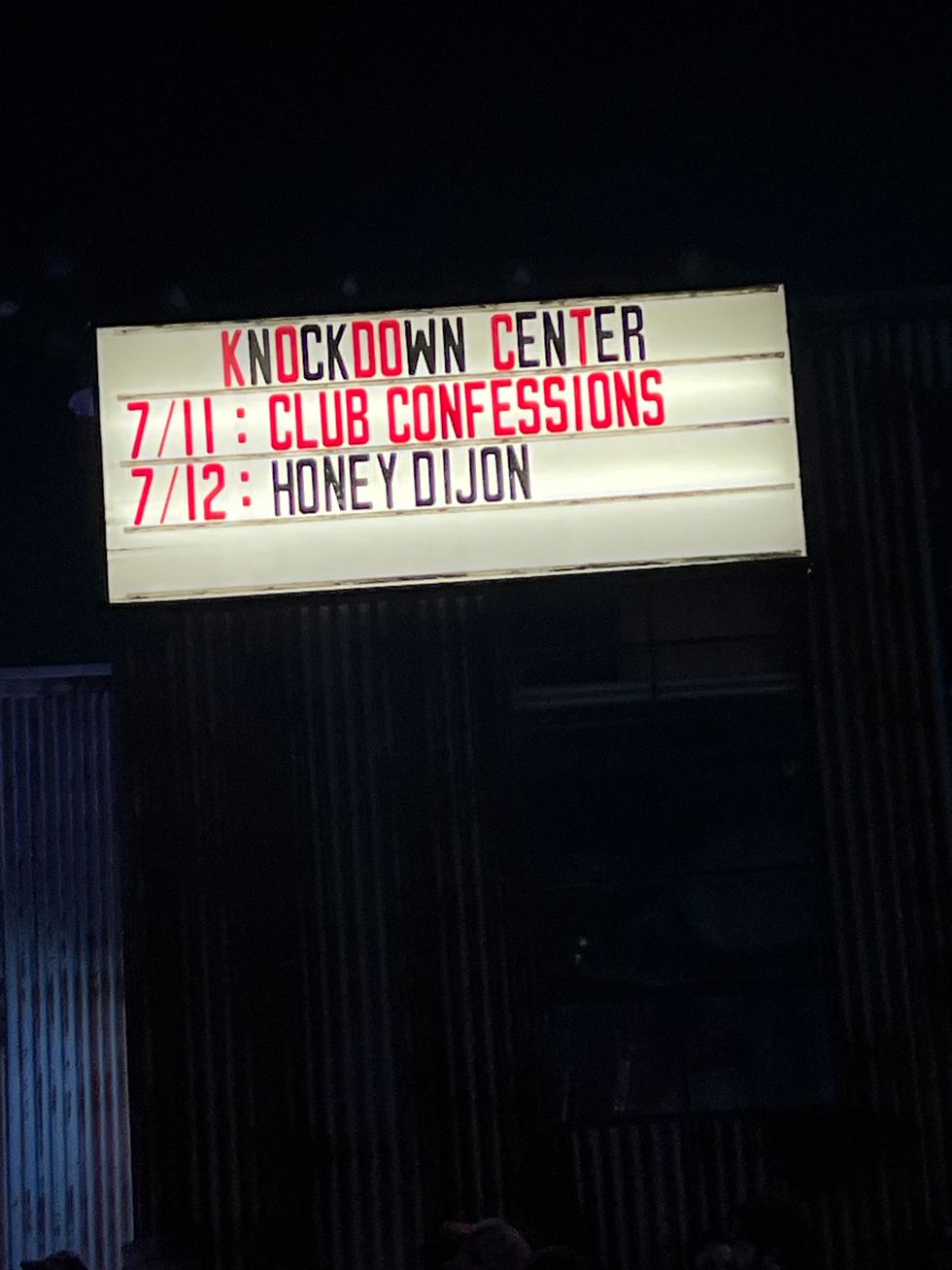
The night, intended as a celebration of Madonna’s new album, CONFESSIONS II, took place at Knockdown Center, an enormous converted factory in Queens with one of the best sound systems in the city. I was joined by my friend, comedian and singer Esther Fallick, whom I had called to invite a few hours prior, and who subsequently posted to her Close Friends story, “I’M A GAY GUY’S PLUS ONE.” This was the fulfillment of a lifelong dream: Ever since I was a little girl, I’ve always wanted to be a gay guy snagging a list spot for one of the girls, so this was immensely gender-affirming.
As it turns out, Madonna’s Club Confessions set may have been the most significant confluence of gay guys and plus ones in 21st century New York City history, not an overstatement.
James Factora
 Ben Rosser BFA
The venue had been completely transformed, bathed in pink and green light, accented with shrubby plants in random nooks that somehow made the space feel like a strange planet. This was the desired effect, as indicated by a slightly too on-the-nose installation consisting of a neon-pink outline of a bottle and a passage from the beginning of Alice’s Adventures in Wonderland, referencing the titular character’s tumble down the rabbit hole. (Not the first time that Madge has incorporated inspiration from the Lewis Carroll classic at a party.) My friends and I were handed a handful of drink tickets each by a gorgeous, tall latex-clad diva and headed to the bar. The three signature cocktails of the night were “Absolut Madonna,” (a citrusy number), “Absolut Hot Sauce,” (a Tabasco-infused number), and “Absolut Ex-Presso Yourself” (the obligatory espresso martini). As we made our way through the venue, taking in the sea of faces, I said, “I don’t know why I didn’t think I wouldn’t see…”
“… every gay person I’ve ever met,” Esther, my plus one, finished my sentence. The run-ins had already begun in line, when we bumped into drag queen and organizer Ariel Friedlander, who thanked a gaggle of cis gay guys behind us for being cool about letting two trans people cut. Multiple former Them staffers were in attendance, because of course they were. There were so many gay people we all knew and so many more whom we would befriend over the course of the night, if only for the few hours that we shared space on the dance floor.
 Ben Rosser BFA
 James Factora
Though Madonna is known for pushing sonic boundaries (not always for the better), the best part of CONFESSIONS II is that it’s not trying to reinvent the wheel. It’s just a really fucking good dance record, one that draws from a vast array of classic club sounds while pushing pop forward into the future. Case in point: track four, “Bring Your Love,” is a duet between the singer and Sabrina Carpenter, who is probably contemporary pop music’s closest thing to a Madonna successor. RENAISSANCE and Brat arguably led to the current boom in dance music’s popularity; it makes sense that the pump was primed for a record like CONFESSIONS II. (I’d also be remiss not to note that the conditions of the 2020s remain dire, so of course people are increasingly turning to catharsis through the dance floor.) The record, for the most part, flows as a continuous mix — it was simply meant to be experienced in the context of a steamy warehouse, packed wall to wall with gay people. To quote “One Step Away,” the third track, “The dance floor is not just a place, it’s a threshold. A ritualistic space where movement replaces language.”
Without getting overly personal, I will say only that this Mercury in Retrograde has been hitting this writer particularly hard. So once we had gotten our lay of the land, I was eager to dance to Fcukers’ set. Since we were there early, arriving at 11 p.m., we were able to lay claim to a patch of floor not too far from the DJ booth. I hardly remember what the music sounded like, but I do know I was moving almost the whole time — a great sign, and a perfect precursor to the main event. Esther and I made friends with a group of lovely gay men next to us, one of whom earnestly proclaimed, “I want to curate amazing vibes around us!” (They did.)
“There is something kind of psychedelic in and of itself about the experience of being mostly sober in a crowd of people who are probably mostly not that,” I said to Esther.
“There’s also something psychedelic about the fact that Madonna’s about to be right there,” she responded.
Before I knew it, the set was up, and an almost physical jolt of excitement rushed through the entire crowd as we all collectively realized that Madonna was about to be, well, right there.
 James Factora
Stuart Price, the legendary producer with whom Madonna collaborated on both the original Confessions on a Dance Floor and CONFESSIONS II, took the decks, and the excitement mounted, especially as the hot-pink screens spanning the whole stage flashed rapidly with Madonna’s name and the name of the album. Then, all of a sudden, shortly after 1 a.m., there she was, looking chic as hell in a silvery top and sunglasses. For the most part I struggled to see her; I was actually a little grateful for the taller people filming on their phones, since it helped give me a clear view of the DJ booth. Especially toward the end of the night, though, the crowd had shifted enough that she was well within eyesight. “I can’t believe she’s really there,” I kept saying. But the point wasn’t entirely about her anyway; equally as important was that we were meant to dance with the people around us. And we did. Movement replaced language.
Though the set was mostly picks from CONFESSIONS II, I was relieved that it wasn’t just a straight playthrough of the album. The songs selected told a story about Madonna’s history, weaving together her past with her present. “Get Together” off of the original Confessions was a hit with the crowd, as was “Physical Attraction” off her 1983 self-titled.
 Ben Rosser BFA
But the apex of the night was perhaps “Danceteria” — an instant classic in and of itself, and one that Madge preceded by taking the mic and declaring, “New York, I wrote this song for you!” The minutes that followed were, truthfully, some of the most euphoric I’ve ever had on a dance floor, a testament to what exactly makes clubbing here so special. I threw my arms around Ariel as we jumped up and down; Esther and I yelled, “Everyone here is a work of art,” the song’s constant refrain, at each other. I was dazed and covered in sweat, as was everyone around us, sustained only by the goodwill of the absolute saints who brought hand fans — a crucial role on every dance floor, and one that I always forget to play. “The dancefloor is community,” Esther and I kept joking, except we weren’t really.
The set ended, thrillingly, with “Hung Up,” the first track off of the original Confessions, and one of my favorite songs of all time, not just of Madonna’s discography. I screamed along so loudly, exorcising so many demons, that my voice went hoarse after. As the song drew to a close, Madonna waved at the crowd, lingering for a few moments before walking away and allowing the iconic Honey Dijon to keep the floor moving. A set from the trans New York legend was the perfect way to end the night. And yes, I did come away from Club Confessions having finally felt Madonna’s inarticulable influence for myself — in that crowd, it would have been damn near impossible not to.
 Ben Rosser BFA
Get the best of what’s queer. Sign up for Them’s newsletters.
‘ The preceding article may include information circulated by third parties ’
‘ Some details of this article were extracted from the following source www.them.us ’