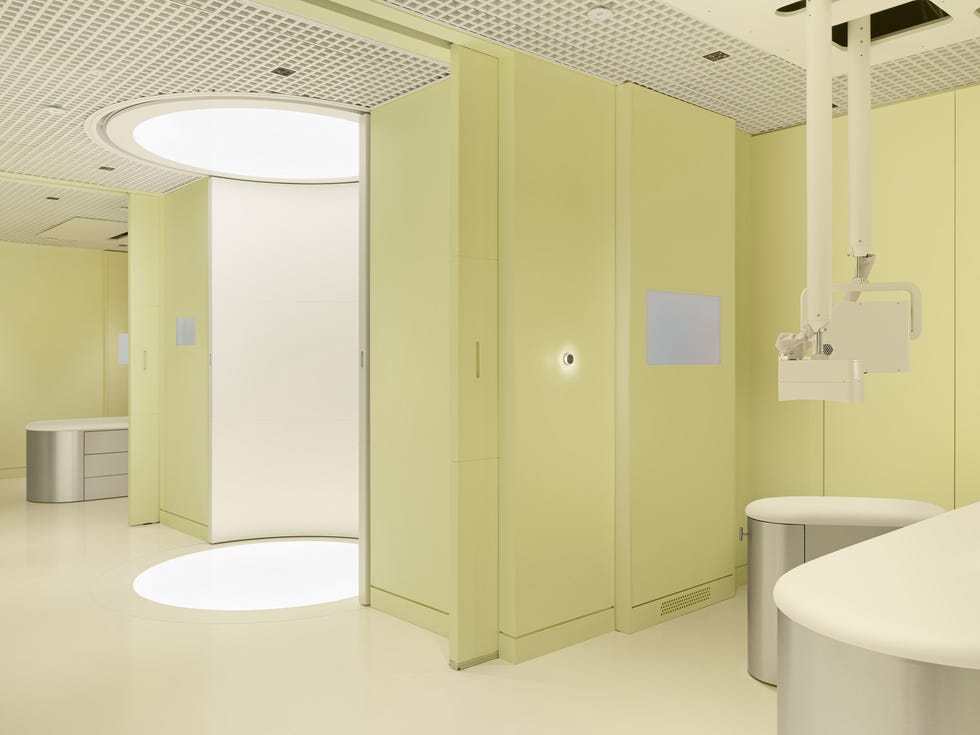
One day in London this May, I undressed and changed into a butter-yellow robe. It was almost the same shade of lemon as everything else in the room: the walls, the full-length curtains, the counters, the doors, the floor, the exam table, and the body-scanning technology. I matched the environment that I would spend the next 20 minutes in while various machines collected data about me: High-resolution cameras captured 453 spots (including moles and freckles) on my body; an ECG recorded 10 seconds of my heart rate to analyze its rhythm; and a blood draw measured 49 different biomarkers.
It may sound like an episode of Black Mirror, but this was my experience getting a Neko Health Scan. Neko is one of many body-scanning companies proliferating in the wellness space. When it first opened a facility in London, it had a 300,000-person wait list. The company is debuting in the U.S. this September, and has been met with a barrage of interest. Prenuvo, Ezra, and Fountain Life offer scans, too, and they have become a new token of trendy luxury wellness optimization, like infrared saunas and spa retreats. Kim Kardashian called Prenuvo a “lifesaving device.” For The Bachelor alum Joe Amabile, that sentiment may very well end up being true—his recent Prenuvo scan found an early-stage brain tumor that will be removed during a craniotomy. Yasmin Sewell, founder of perfume brand Vyrao, posted about Neko on Instagram, likening it to “stepping into the future” and saying the impeccable design “felt like a Prada store mixed with some Gattaca vibes.”
If you listen to the hype, these tests seem to have nothing but upsides. Tools like Neko and Prenuvo can give you a peek into what’s happening inside your body, like a porthole to the ocean, which may help you fine-tune your health decisions. And unlike CT scans (which Oprah Winfrey popularized after getting a full-body one done for her show in 2000), the new tools are radiation-free and often based on MRI technology. While Prenuvo and many others offer MRI services, Neko offers a scan with a different suite of tests that aim for a snapshot of your overall health. Its scan looks at your heart and circulatory system; does full-body skin mapping; identifies blood biomarkers; and assesses microcirculation and vascular health via a laser vibrometer device. Other tools are more commonplace, like a blood pressure cuff. Because of its comprehensive analysis, Neko costs around £299 in the U.K. (its U.S. prices have yet to be decided), while a more internal scan, like an MRI of the head and torso, can cost thousands of dollars.
“Usually most people in their 20s and 30s don’t have chronic disease, but sometimes we can see the very early stages of something that maybe years later could cause a lot of pain, a high medical cost, or a shortened lifespan,” says Andrew Lacy, founder and CEO of Prenuvo. Proponents of these scans view them like an enhanced yearly physical where you’re seeing many specialists at once, allowing you to find out what needs work and track your progress. “When you come back the next year, we can see what’s improving,” says Mert Aral, MD, the head of medical innovation at Neko. And sometimes, these scans could catch something life-threatening. Take the case of Sarah Blackburn, a mom in Texas who decided to get a Prenuvo scan when she turned 30, on top of her yearly physicals. It felt routine to her; she watched Love Is Blind during her MRI. When she opened her results, she was met with an “urgent finding”—aneurysms in her spleen, which have a high mortality rate if they rupture, and are impossible to catch without imaging. Later, ER doctors said that a minor car accident might have killed her, and recommended she have her spleen removed. “I did not foresee my Prenuvo scan going like that,” says Blackburn, who is a year and a half past surgery. “Now that I’m on the other side, what a blessing to have had that information before it was too late.”

Imagery from a Prenuvo scan.

While for Blackburn, the procedure might have been lifesaving, the potential of additional surgeries like hers is one thing that makes doctors hesitant to broadly recommend scans. “They can detect incidental findings that may never cause harm, but could lead to unnecessary testing, biopsies, and procedures,” says Eleonora Teplinsky, MD, a breast and gynecological oncologist in New Jersey. She worries about the potential financial burden and anxiety that come with a health scare, pointing to South Korea, where scans are common. According to a study in The New England Journal of Medicine, the country saw a 15-fold increase in thyroid cancer diagnoses over the course of two decades—but virtually no impact on mortality. The cancers that were found are called papillary thyroid tumors, which are common but almost never become evident or lead to any clinical danger. But if you know about an abnormality, you may still feel compelled to act on it.
This is particularly relevant in the case of false positives, which can be common (the rate varies based on the type of scan and the radiologist reading it). According to Teplinsky, these can lead to additional screenings and biopsies, which also carry risk. False negatives can happen, too. “We don’t want the full-body MRI to give this illusion that you’re completely healthy,” Teplinsky says. And when it comes to additional testing, Prenuvo’s Lacy argues that it’s a fair trade-off for the number of cancers found. “For one in every two people who get a biopsy [after a Prenuvo scan], it ends up coming back positive for cancer, according to the clinical studies we’ve done,” he says. “Biopsies after traditional breast cancer screening for women [like mammograms] have a much lower positive rate—one in every five biopsies actually ends up as cancer. These tests are a lot more accurate than people think.” MRIs may also be able to find some small breast lesions sometimes missed by mammograms. However, patients should still get their recommended screenings, like mammograms and colonoscopies.
Like it or not, scan culture has pervaded the zeitgeist, especially among a certain set of celebrities, who serve as the face of wellness culture and likely can afford to pay for them (or may get them for free). Health influencers on TikTok have started to go abroad for body scans, which can be a fraction of the price of those offered stateside. People often share their experiences in countries like Korea and Turkey.
My Neko scan gave me insights into my heart health and mapped out every mark on my body to watch for skin cancer. Seeing all my data presented to me like character attributes felt oddly satisfying, like I could gamify my health. I’m scheduled to get a Prenuvo scan soon, which makes me anxious, since a part of me would rather not know if I have any aneurysms or lesions lurking under my skin. But in the era of scan culture, I can’t say no—another part of me finds it too enticing.
A version of this story appears in the September 2026 issue of ELLE.
‘ The preceding article may include information circulated by third parties ’
‘ Some details of this article were extracted from the following source www.elle.com ’