I once firmly believed that if you didn’t like “A Confederacy of Dunces,” there was something amiss. As protagonist Ignatius Reilly would have put it, I’d have thought you lacked all good taste, theology and geometry.
How could you not love it, I marveled? So quintessentially New Orleans it was — so self-absorbed, bloviated, militantly insouciant, stridently impervious to convention and modernity. So original. So picaresque. So proudly flatulent. What’s not to love?
That was a long time ago.
My first exposure to this New Orleans literary landmark was in the fall of 1981, the year it won the Pulitzer Prize for fiction. My dad was away on business, and it was just me and my mom at home one night, in bedrooms separated by a tiny hallway. I heard her laughing. Nothing too strange about that, except there was nobody else home and their bedroom had no phone, radio or TV.
Then she laughed again. And again. OK, something strange about that.
I knocked lightly on her door. “Mom?” I said, softly. “Mom, you OK?”
I opened the door and she was propped up on pillows against the headboard with a book in one hand, wiping tears from her eyes with the other.
“Mom!” I said. “What’s going on?”
She was reading “Dunces.” Said it was the funniest thing she’d ever read. Watching her laugh-cry like that, I guessed so.
So I read it next and, yeah — pretty damn funny. But if you told me it wasn’t, I would’ve shrugged. Your opinion.
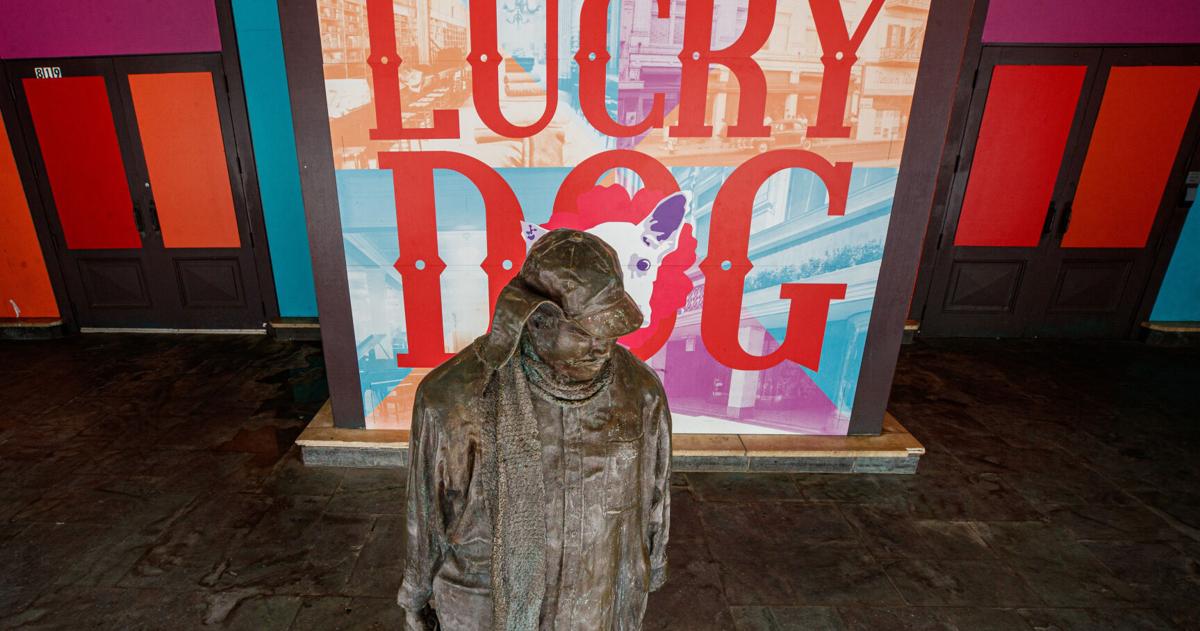
A statue of Ignatius J. Reilly waits beneath the Canal Street clock in New Orleans Tuesday, March 10, 2026, the scene at the beginning of A Confederacy of Dunces. Wearing his green hunting cap and rumpled clothes, the eccentric and outspoken character watches the passing crowd with suspicion and disdain, convinced that modern society has lost its way. From this familiar city landmark, Ignatius’s misadventures unfold across New Orleans as he clashes with the people and institutions around him.
At this point, at 21 years old, I had been to New Orleans just once. For about eight hours. It was a road trip with a college buddy during which we got thrown out of three bars on Bourbon Street and threatened with arrest when we tried to enter a fourth. We met two pretty European girls, and things were going quite well until my friend threw up on one of them. Taking stock of the situation, we had just enough money left for gas back to Wisconsin, so we called it quits.
In 1981, that was the New Orleans I knew. With no cultural framework or personal context to apply, “Dunces” — while thoroughly entertaining — did not yet fully resonate. But, oh Fortuna!
My Rosetta stone
Less than three years later, in the summer of 1984, I got a job at The Times-Picayune. I got an apartment in the French Quarter and embraced the city like a lover conjured from dreams, smoke and swamp gas. I’d found my soulmate.
New Orleans then was the New Orleans of the Wonder Wall, Dixie Beer and Big Shot, Al Hirt and Al Scramuzza, WTIX, Ruthie the Duck Lady and, of course, D.H. Holmes (the site on which today is commemorated with a lifesize statue of Ignatius). The French Quarter smelled like river diesel, coffee, sweet olive, mule piss and sex. I ate Lucky Dogs for dinner at least three times a week. Little taverns were full of drifters, grifters, misfits, hustlers, cosplay pirates and queer people.
Seemed like everyone I met had a limp or a lisp or a missing limb, some kind of tic or twitch — chronically unemployable types who could nevertheless finish The New York Times Sunday crossword puzzle in 20 minutes. In ink pen. I’d sometimes have passionate late-night discussions with strangers I knew were speaking English, but I couldn’t understand a word they said.
I was drunk with words. Everyone was Ignatius. And, my God — what a time and place to be alive.
“A Confederacy of Dunces” was still au courant in those days — set in the very near New Orleans past — so I thought it a good time to revisit what I now understood from many of those conversations to be a towering achievement in local canon. And. … wow. I tore through it this time and found it nothing less than revelation. First thing I had to do was call my mother.

“A Confederacy of Dunces” by John Kennedy Toole, features Ignatius J. Reilly, one of the great characters in New Orleans literary history.
“Mom?” I said, all hushed and secret, like someone might hear me through the walls. “Remember that book we read — ‘Confederacy of Dunces?’”
“Oh, yes!” she said, and she started laughing again and started to go on about…
“Mom!” I said, loudwhispering now. “Listen. I’ve got to tell you something.”
“What,” she said, concerned now. “What is it, Christopher?”
“That book,” I said, pausing, a look over my shoulder, then, “It’s real.”
“What’s real?”
“That book! That book is real! It’s not fiction,” I said. “I know the people in that book. They’re everywhere!”
And there was my context. My Rosetta stone to the city. And if you didn’t love “Dunces” the way I loved “Dunces,” you probably didn’t love New Orleans and, hell — you probably didn’t love me.
That was also a long time ago.
Everyone but Ignatius
I picked up a copy of the book recently and the strangest thing: I couldn’t get through it. Turns out, third time wasn’t a charm. It felt like Ignatius Reilly’s avenging sword of taste and decency had smote me. I’ve lost my damn context.
That happens to things we cherish. Like that summer song of long ago — the one that was perfect — or that certain movie you watched over and over when you were a kid, or the one that got away, all those loves you can never fully recover.
Ignatius Reilly’s inimitable grotesqueries still charm me, but I no longer have the desire to spend intimate evenings in his company — even though at my advancing age I still appreciate a well-placed fart joke. But he talks too much.
Everybody in “Dunces” talks too much. It’s not a short book, and it’s not an easy read, by any means. As a friend of mine once opined: Had JFK been wearing that prose on that fateful day in November ’63, he’d still be alive; the bullet never would have penetrated.

A statue of Ignatius J. Reilly waits beneath the Canal Street clock in New Orleans Tuesday, March 10, 2026, the scene at the beginning of A Confederacy of Dunces. Wearing his green hunting cap and rumpled clothes, the eccentric and outspoken character watches the passing crowd with suspicion and disdain, convinced that modern society has lost its way. From this familiar city landmark, Ignatius’s misadventures unfold across New Orleans as he clashes with the people and institutions around him.
But there’s something else, too. The city has changed. I have changed. Everybody changes. Everyone but Ignatius. Dunces is firmly a piece of its time in New Orleans — those “ain’t dere no more” days — and oh, what daze they were.
Maybe I’m asking too much of a book I once considered scripture. Call me crazy, but this time around, it read too much like a novel. Like it was all made up! And maybe that’s the rub. I am crucified by the truth. Which, in this town, might be negligible currency, but has always been more intoxicating than anything you could ever invent.
‘ The preceding article may include information circulated by third parties ’
‘ Some details of this article were extracted from the following source www.nola.com ’