Earlier this summer, the pop star Sabrina Carpenter released “Manchild,” the first single from her seventh album, “Man’s Best Friend.” It’s a fluffy screed against a dude mired in an endless adolescence. Heading into the chorus, Carpenter sounds both rankled and coquettish:
“I choose to blame your mom,” she concludes on the second verse. It’s not the only time that Carpenter has been let down by an undercooked suitor. A big part of the singer’s allure is the way that she ultimately shrugs off the crummy choices she makes while in the throes of lust, boredom, yearning, whatever; she aspires not to normie perfectionism but to something more hectic, funnier, looser, more bonkers. In the video for “Manchild,” a hitchhiking Carpenter climbs in and out of a string of preposterous vehicles, including a sidecar fashioned from a shopping cart, a Jet Ski on wheels, and a motorized recliner. It’s a warped, Surrealist vision of Americana: she uses a fork as a cigarette holder, shoots pool with a loaded shotgun, pulls a fried fish from a claw machine. “Fuck my liiiiiife,” she coos on the chorus. The sentiment is relatable; desire is often a catastrophic force, obliterating our best intentions for ourselves. (One of her deranged paramours drives off a cliff after she climbs out of his car.) Willful denial—the way women are quick to muzzle rational thought in service of romance—is a recurring theme in Carpenter’s work. “You don’t have to lie to girls / If they like you, they’ll just lie to themselves,” she sings on “Lie to Girls,” a tender ballad from “Short n’ Sweet,” her breakthrough album, which came out last year.
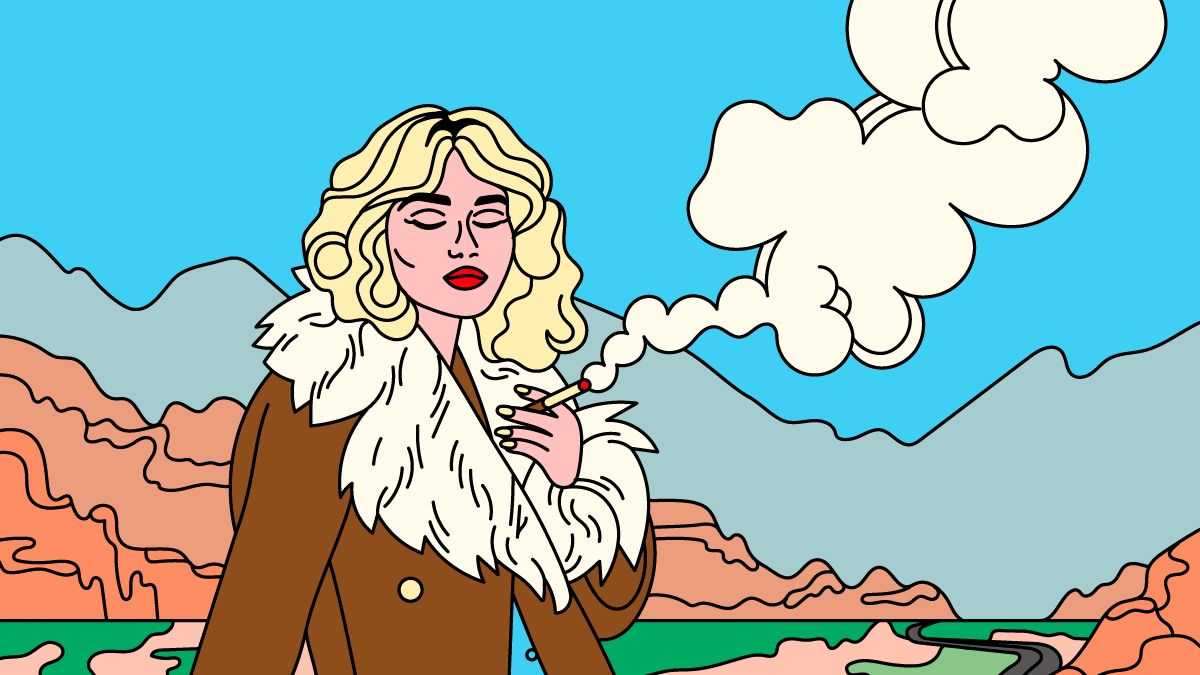
Carpenter, who is twenty-six, has been releasing music since 2014, when she signed with Hollywood Records, a label owned by Disney. “Manchild,” which was co-written with Jack Antonoff and Amy Allen, reminds me, in a circuitous way, of “Dumb Blonde,” a single from Dolly Parton’s début LP, “Hello, I’m Dolly,” released in 1967. Carpenter is plainly a student of Parton’s, evoking her pinup styling (voluminous hair, big red lips), her persona (sharp with a knowing wink), and her voice, which is rich and husky and accompanied by a country lilt. They both find an enormous amount of humor in the friction that powers love. But mostly they take joy in being underestimated—and proving everyone wrong. “This dumb blonde ain’t nobody’s fool,” Parton warns.
“Man’s Best Friend,” which was released last week, and was co-produced by Antonoff and John Ryan, is a bright, effervescent pop record with a slapstick lean. Although it contains untold layers of vocals and synthesizers (Antonoff famously delights in a flourish, a big chorus, a wash of reverb), it’s not without air, or a feeling of spontaneity. These days, Carpenter is primarily interested in making twangy, ribald songs that veer toward country, or especially disco; I hear echoes of ABBA, Shania Twain, “Mirage”-era Fleetwood Mac, Alicia Bridges, Donna Summer, and early, campy Katy Perry. On “House Tour,” a song about inviting your date inside at the end of an evening, Carpenter conjures the sensual certitude of Diana Ross’s “It’s My House,” and the friskiness of Prince’s “Kiss”:
I loved “Espresso,” Carpenter’s breakout single, from last spring—it was clever (“One touch and I brand-newed it for ya,” she pants, handily encapsulating how, in the intoxication of new love, the world is instantaneously remade) and charmingly self-aware (“Stupid,” she mutters, just a beat later). There is a lot here that resembles “Espresso”—the latest album is an obvious companion piece to “Short n’ Sweet,” with the same chatty asides and quick, carnal jokes, the same lovelorn gripes and laments—but nothing that quite surpasses its buoyancy. But I suppose that, too, is a nod to the hamster wheel of sex and love and relationships: you think that you’ve learned some crucial lesson, that you couldn’t possibly do it all over again, and then, of course, you do.
The cover of “Man’s Best Friend” features a photo of Carpenter wearing heels and a black cocktail dress, on her hands and knees, before a faceless man who clutches a fistful of her hair. The image consciously hints at porn (the set includes beige wall-to-wall carpeting and heavy white drapes, as if Carpenter were crawling through a Motel 6) and sexual submission, particularly when paired with the album’s title. Reactions were swift and high-pitched. People tend to find the union of sex and violence—or sex and willing subjugation—either fun and titillating or gruesome and catastrophically sinful.
Predictably, the hubbub surrounding the photo was eventually framed as a war between uptight virgins and godless heathens, with a quieter contingent astounded only by the fact that this kind of marketing could still be so effective. (I would also argue that there are enough heartbreak songs on the album to suggest the opposite subtext: that the title is a biting play on the various ways women are dehumanized, politically or otherwise.) Eventually, Carpenter released another cover, in which she is standing on two legs and leaning against a guy in a suit. “Here is a new alternate cover approved by God,” she wrote, on Instagram. (I laughed.)
‘ The preceding article may include information circulated by third parties ’
‘ Some details of this article were extracted from the following source www.newyorker.com ’