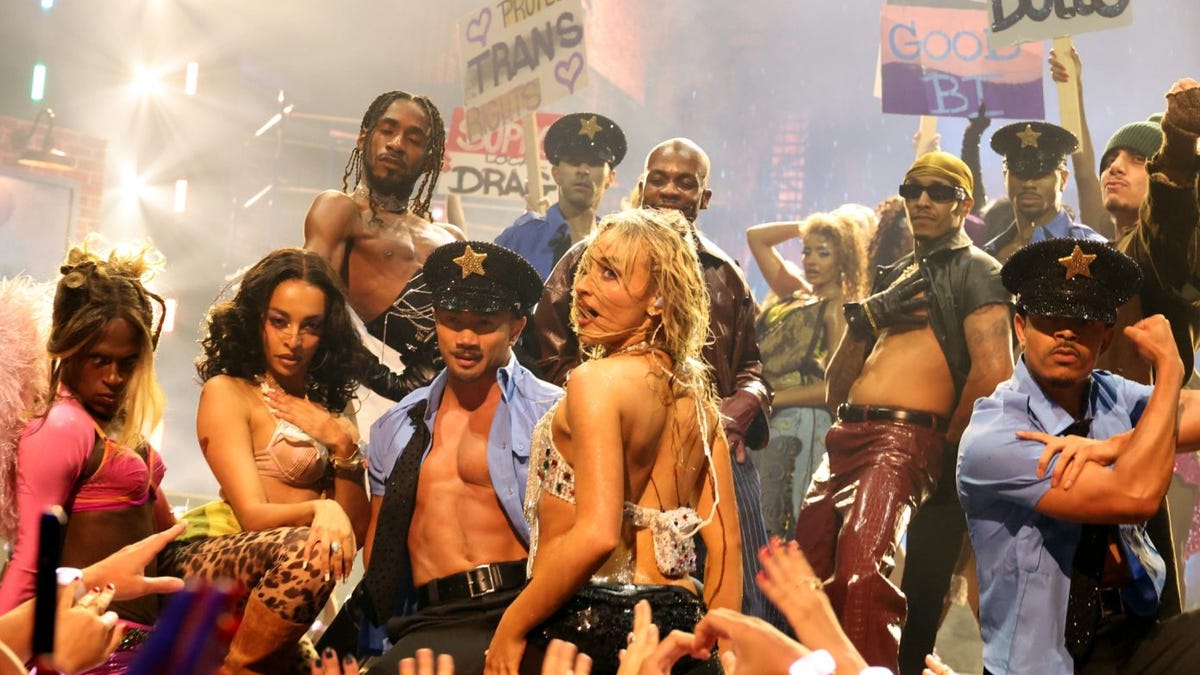
While some applaud Carpenter’s performance, others criticized it as “performative.”
From publicized scandals to impromptu kisses, the MTV Video Music Awards tend to be one of the year’s most eventful nights in pop culture. One performance from the awards this past Sunday that will go down in history is Sabrina Carpenter’s soaking-wet performance of her new song, “Tears.”
The song comes from her recently released album “Man’s Best Friend,” which elicited its own controversy surrounding misogyny and female sexuality. The album was released alongside a “The Rocky Horror Picture Show” inspired music video for “Tears” starring Carpenter and Academy Award nominated actor Colman Domingo in drag.
The camp-like fun of the video was replicated onstage with a political message. In addition to her typical dancers, Carpenter shared the stage with numerous drag queens including Honey Balenciaga, Willam Belli, Lexi Love, Symone and Denali — many of whom achieved fame on “RuPaul’s Drag Race.”
The queens carried signs expressing support for the LGBTQ+ community. They contained phrases such as “Dolls dolls dolls,” “In Trans We Trust,” “Brace 4 Change,” “Protect Trans Rights” and “Support Local Drag.” Others intertwined references to Carpenter’s songs: “If you hate, you’ll never get laid” and “Good Bi.”
“I think what she did was incredibly bold. In a time where, politically, trans people and drag artists are persecuted and demonized, it’s essential that we see these people uplifted in such a positive way,” Florida State University (FSU) psychology major Dacey Tietz said to the FSView. “It’s not like she just had these people as background actors in her performance in a way, they were the central focus.”
Carpenter later cemented her allyship in her acceptance speech for Best Album: “This world, as we all know, can be so full of criticism and discrimination and negativity. So, to get to be part of something … that can bring you light, make you smile, make you dance … I’m so grateful. So grateful to do that.”
However, public reactions have been split. Some have taken to calling her allyship “performative activism,” meaning that it was done only to improve her image and career standing.
“I think celebrity activism is an important part of our social structure — they have the necessary platform to spread awareness to thousands, or even millions of people with just a few clicks from their phone,” environment and society major Mia James said to the FSView.
Carpenter’s display of activism and camaraderie comes during the attacks on drag and rights for transgender people throughout the United States. The issues she is choosing to align herself with are not widely accepted, making this stance one that could put her career in jeopardy.
“I think there’s really significant good that can be spread this way; however, celebrities must be careful to spread accurate and relevant information, otherwise they may have the ability to misinform or influence masses of people in potentially harmful ways,” James said.
Her performance has awoken the conversation surrounding celebrity activism, its sincerity and whether or not it is necessary. Many fans argue that they do not expect to hear political rhetoric from their favorite artists, while others find it difficult to support someone without knowing their political beliefs.
“I love when celebrities speak out on topics they are passionate about,” psychology major Carly Johnson said to the FSView. “Recently, I feel there has been more attention brought to queer performers. One of my favorite LGBTQ celebrities, Cynthia Erivo, has brought a lot of awareness and enthusiasm for the LGBTQ community.”
Celebrities are not necessarily experts on these issues; however, it is undeniable that people of a certain status hold power over their audiences. Chappell Roan, for instance, hires local drag queens to open each show on her tour and grants them attention with their own audiences.
Some celebrities take a public stance on international politics. Nicola Coughlan raised about $2 million for various relief funds to Palestine causes by sharing a link on her Instagram. Comedian Jerry Seinfeld has demonstrated his support for Israel on his Instagram.
A celebrity showing support for an issue introduces it to their often young and impressionable fans. They can lead by example and promote a similar level of activism or allyship within their fanbase. Performative or not, Carpenter’s performance has the world discussing trans rights and discrimination against drag queens.
“I think in our modern era where celebrities aren’t just ‘icons’ but instead industry figures with immense wealth and platforms, the ones who choose to use their unique careers oriented for activism should be celebrated,” sophomore political science and English major Arista Athanassie said.
Raquelle Elson is the Arts & Culture editor for the FSView & Florida Flambeau, the student-run, independent online news service for the FSU community. Email our staff at [email protected].
‘ The preceding article may include information circulated by third parties ’
‘ Some details of this article were extracted from the following source www.fsunews.com ’