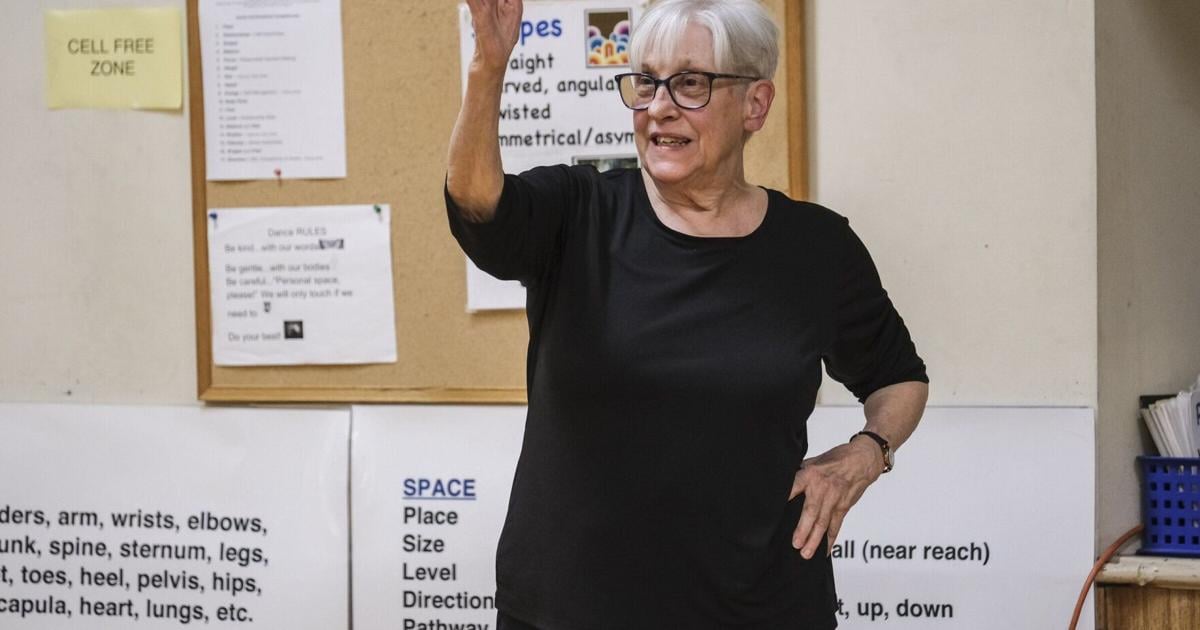
Seattle dance teacher Anne Green Gilbert isn’t as well known as Pacific Northwest dance stars like Mark Morris or Merce Cunningham. But her impact on the world’s dance community has been significant.
Nobody has definitive data, but Gilbert has reached thousands of people during her career as the creator of, and advocate for, something she calls Brain-Compatible Dance Education.
BCDE synthesizes Gilbert’s own dance training with her self-directed research into how movement-based learning impacts brain development and how classroom teachers can use dance and other arts education to teach general subjects like math and reading. The more she read about the way our brains and bodies connect, the more determined she was to devise a dance curriculum based on that research. She literally wrote the book on it. “Creative Dance for All Ages” is now in its third edition. And she launched an annual teacher training symposium. More than 40 years later, BCDE is a fixture from Seattle to Singapore, Northern Europe to Northern Asia.
But Gilbert, now 78, says this summer will be her last at the helm of the influential Summer Dance Institute for Teachers, where she trains teachers on BCDE. Although it’s evolved from its original incarnation as a multiweek seminar affiliated with Seattle Pacific University to a weeklong independent workshop, the dance institute still attracts an international group of participants, many of whom attend more than once. This year, 46 attendees, the building’s capacity, will be in Seattle for Gilbert’s final symposium, which starts July 20.
Gilbert has led this dedicated movement over the decades from a modest wood-framed building in North Seattle just west of Haller Lake. It’s home to Gilbert’s Creative Dance Center, founded in 1981; two dance companies; and a roster of classes for infants through senior citizens.
On a recent spring evening, Gilbert led a circle of 20 adults through a sequence of movements that began with simple arm undulations in front of their torsos. To the gentle beat of a drum, the group slowly transitioned from arm waving to marching in place while still seated. This is a version of Gilbert’s BrainDance, a warmup that’s standard to any BCDE training.
“It’s a holistic way to move,” she says. “Anyone can do it. It’s about repeating fundamental patterns.”
New York-based dance educator Dionne Kamara first experienced the BrainDance in 1999. She was almost instantly hooked on Gilbert’s brain development theories. “I went right out and bought her book,” says Kamara. She used it to teach dance classes to young kids at both public and private New York schools. “I saw kids have fun,” she says. “That’s the power of this work, because you are teaching a human being first.”
For her, BCDE is rooted in fostering both individual agency and the skills to create collaboratively.
Kamara, who danced professionally with the group Urban Bush Women before she became a full-time teacher, says Gilbert’s approach to developing creative individuals, no matter their age or what some deem to be their inherent talent, appealed to her as a member of both a collaborative dance company and of a multigenerational Jamaican family.
“All of my students are able to express who we are,” she says. “It empowers their art.” Kamara was so taken by BCDE that, eventually, she became Gilbert’s SDIT co-instructor and has co-taught the institute with Gilbert for more than 20 years.
Gilbert talks about creativity and community too, but she emphasizes joy. She doesn’t recall much of that in her childhood dance classes.
“I was always thinking about a more positive way to teach dance,” Gilbert explained recently, bemoaning the very traditional, technique-heavy methods she encountered as a child. “I wanted to create a methodology that developed skilled technicians, but also critical thinkers, and successful collaborators.”
And, perhaps most important to Gilbert, she wanted to show classroom teachers how to create a learning environment that was welcoming to everyone.
Gilbert discovered that when she let her students, even elementary school-aged kids, direct more of the artistic choices, not only did they create interesting dances, their academic test scores went up.
Her personal experiences are confirmed by research popularized by academics such as Harvard University’s Howard Gardner, whose 1983 book “Frames of Mind: The Theory of Multiple Intelligences” opened a doorway to reexamine the different ways students absorb information.
Gardner found some kids learn best through drama, music, dance or theater. In addition to helping students learn the three R’s — reading, writing and arithmetic — Gilbert points to many other studies that document how dance education does everything from fostering social/emotional learning to teaching problem-solving skills.
Former Pacific Northwest Ballet company member Terry Goetz discovered Gilbert’s work when she enrolled herself and her 18-month-old daughter in one of Gilbert’s movement classes for parents and children. Goetz saw how her child responded to BCDE and she began to incorporate Gilbert’s curriculum into classes she taught at Olympic Ballet School in Edmonds. “The beautiful thing about what Anne’s created is that it’s adaptable to any dance style,” Goetz says. She attended her first SDIT in 1995, and soon became a fixture at the Creative Dance Center, where she became director after Gilbert retired in 2014.
Goetz has promised to continue organizing the SDIT workshops.
Although Gilbert won’t say that she’s actually retiring from all her dance work after the 2026 SDIT, she believes now is the right time to slow down.
She’ll be 79 this fall, and after a heart attack, a case of shingles and a stress fracture over the past year, Gilbert is ready to pull back from the work that first became her passion more than 60 years ago.
Gilbert doesn’t teach kids anymore (“It’s too hard to get down on the floor” she jokes) and she won’t be organizing teaching training either, but she has no plans to give up her regular adult classes. That’s where she still finds the joy she first craved so long ago.
She cheers on her own students as they move through a series of floor exercises.
“It’s good for the brain to try something new!” she calls out to them.
She smiles when she gets no argument.
‘ The preceding article may include information circulated by third parties ’
‘ Some details of this article were extracted from the following source www.yakimaherald.com ’