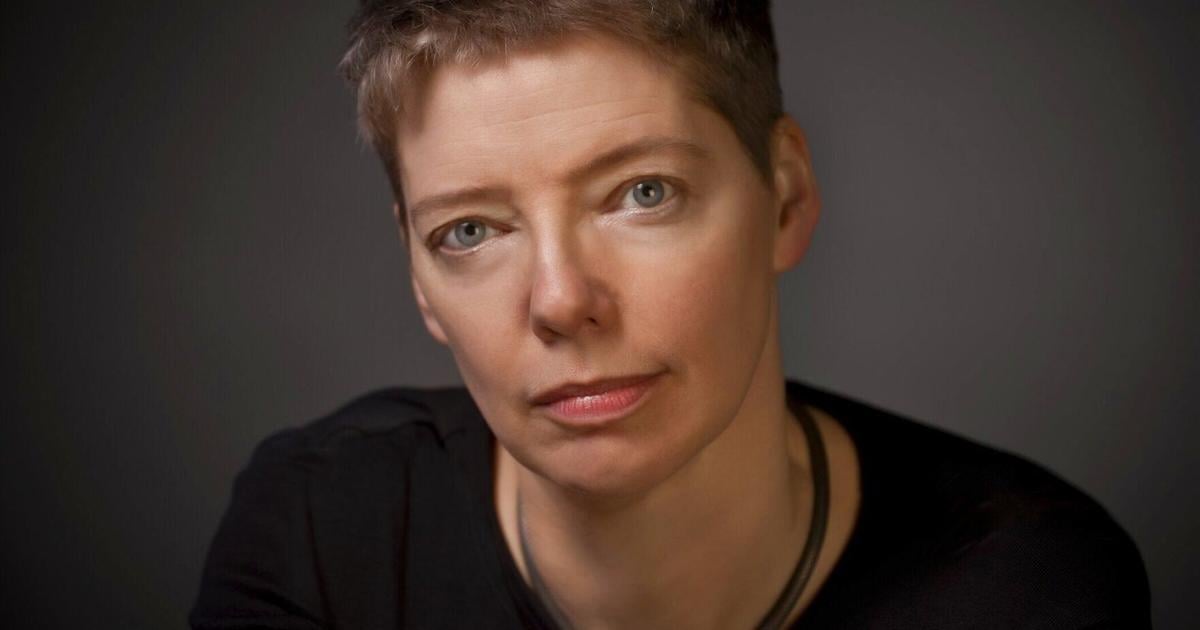
Those familiar with local author Nicola Griffith know that, beyond having an astute way with words, she speaks with an emphatic, take-no-prisoners clarity. Griffith plays brilliantly to this strength in her new collection “She Is Here,” out Feb. 10 from PM Press.
“When I write, dear reader,” begins Griffith’s introductory essay, “A Writer’s Manifesto,” “I don’t want to build a careful tale for you to discuss with a smile in a sunny place. I want to own you. I don’t want to be The New Hit Series, I want to be pornography: to thrill you so hard you’re ashamed but can’t help yourself crawling back for more.”
“She Is Here” is something of a grab bag collection, but it’s no less enjoyable for the variety. Six nonfiction pieces — most about Griffith’s own writing career — are followed by four poems, three short stories and, finally, a novella, “Many Things in Dumnet.” Drawings by Griffith intersperse each section. An excellent interview conducted by Seattle author Nisi Shawl ends the work as bonus material. Considered as a whole, “She Is Here” is an appropriately titled distillation of Griffith herself.
Griffith grew up in Leeds, England, and moved to the U.S. after meeting her eventual wife, the writer Kelley Eskridge, at the Clarion Workshop in East Lansing, Mich. They wound up in Seattle after Griffith was diagnosed with multiple sclerosis in her early 30s. The heat in Atlanta, where they had been living, had been inflaming her symptoms; when Griffith got her green card and a book advance on the same day, she decided enough was enough. She and Eskridge flew out to the Northwest and, after briefly considering Portland, relocated to the Emerald City. They’ve been here since 1995.
Griffith has long written queer characters in her fiction. “I knew when I was four years old that I was a girl who liked other girls,” she writes in this collection, “and it seemed perfectly natural to me. I knew I was amazing, and that if I fancied girls then fancying girls must be amazing.” As Griffith’s MS progressed, however, and especially after she began using a wheelchair in 2015, she became doubly outspoken on ableism issues. “Disability is one of the last great biases that most people don’t even know they have,” she says. “It’s still the redheaded stepchild of bias. That’s why I’m so blatant about it.”
It can be difficult, in Griffith’s words, to weigh “blatant” behavior against the critical reception of her fiction writing. Because while Griffith is indeed disabled — she affectionately calls herself “a crip” — she writes that she doesn’t want disability or sexual preference to be the lodestone around which discussion of her novels revolves. But the commerciality of the arts world doesn’t often align with an artist’s wishes.
While the majority of Griffith’s novels lean toward fantasy and sci-fi, she became more widely known for historical fiction in 2013 with “Hild,” a retelling of the 7th century’s Hilda of Whitby, one of the few prominent women to appear in histories of early British Christianity. That book won the 2014 Washington State Book Award and was nominated for both Nebula and Lambda awards. It also sent Griffith on a behemoth book tour, first the U.S., then the U.K., then the U.S. again for the paperback release. “I just love performing,” she says.
But the mountain of “Hild” publicity came with downsides. Griffith learned that while she wanted conversations around “Hild” to focus on women’s lives during the English Dark Ages, critics spent just as much time talking about Griffith herself, the artist behind the curtain. “In my version of (Hild’s) early life,” she writes in “She Is Here,” “she is not a lesbian. Yet the first review of the book begins, ‘LGBT scifi writer Nicola Griffith…’ And another refers to ‘lesbian fantasy and crime writer Nicola Griffith.’ In other words, what was being reviewed was not the book at hand, but me, the author, and my previous novels.”
It’s a keenly written observation, which leads Griffith to posit the harsh truth that authors themselves bear responsibility for this commercial framework. “To sell books,” Griffith writes, “we have to tell a story about them: we have to brand them. We have to build them an identity. We have to build ourselves a reputation. In so doing, we brand ourselves. That’s part of what hurts: it’s we who drive ourselves into the cattle chute, we who pick up the glowing iron, we who burn the label deep into our hide. We scar ourselves.”
Griffith, of course, is much more than a brand, and there’s much more than authorial metaphysics to “She Is Here.” The Seattle crowd will enjoy the short story “Cold Wind,” in which an ancient seductress shows up to “the women’s bar” on Capitol Hill, easily decoded as the real-life Wildrose Bar. Griffith isn’t a regular there but recalls that the establishment offered early, hopeful glimpses of Seattle’s queer scene after she and Eskridge moved to town in the ’90s.
“Coming from the lesbian bars in Atlanta,” Griffith says, “some of them were huge. And The Wildrose was just earnest. People wore flannel. I thought it was really sweet, and it was good to know there was one out here. But I also found that in Seattle, unlike in the South, I could go into almost any bar with Kelley holding hands.”
Meanwhile, the collection’s longest piece, “Many Things in Dumnet,” takes place in an alternate ninth century and stars an adventuring bard named Anya, a shredder on the lute (“Her hands moved like snakes, feinting from the wrists, then striking”) who doubles as a medic in rough spots. “Her being a healer is about being educated,” Griffith says, “and about having a prodigious memory.” A traveler in Albion, Anya is marked by the locals after her early performances catch the eye of a crooked underling. It’s a perfect tale for a single sitting.
“She Is Here” will undoubtedly appeal to Griffith’s fans, but it doubles as a nice gateway to her career for newcomers. It’s rare that an author’s fiction is offered a mere 50 pages after their reflection on said fiction. When it works, it works. Griffith’s commentary on the creative process will stick with readers long after this collection goes back on the shelf.
‘ The preceding article may include information circulated by third parties ’
‘ Some details of this article were extracted from the following source www.yakimaherald.com ’