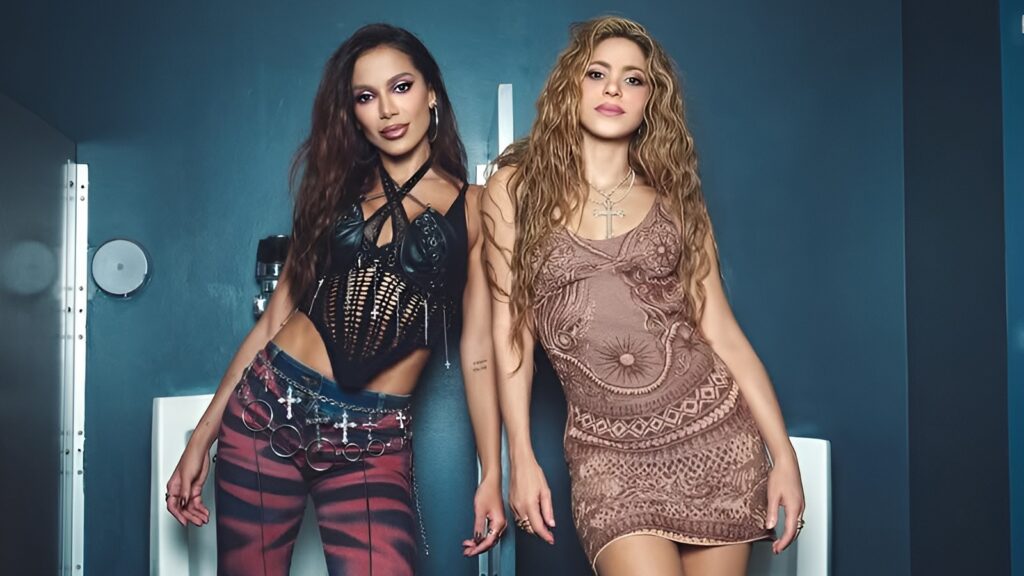
Argentine duo Sarao, formed by Tushka and Rebebe, publicly accused Shakira and Brazilian singer Anitta of copying their song “Atómica” in “Choka Choka,” the second single from Anitta’s eighth studio album Equilibrium, released April 10, 2026, after Sarao posted a side-by-side audio and visual comparison on Instagram that reached millions of views across Latin America within days of publication. The accusation put Shakira’s name at the center of a composition dispute at precisely the moment “Choka Choka” was climbing regional streaming charts, turning a song release into a public debate about who wrote what and how the Latin music industry handles credit when major productions absorb influences from independent artists.
Sarao’s claim rests on a specific lyrical and melodic phrase that both songs share, along with visual and production similarities that their followers identified before the duo themselves made the comparison public, and the detail about follower discovery matters: it suggests the resemblance is audible enough for casual listeners to catch, not just musicologists.
A funk track with a complex production chain
“Choka Choka” belongs to the carioca funk genre, a style originating in Rio de Janeiro’s favelas (low-income communities on the city’s hillsides) and characterized by heavy electronic bass lines, call-and-response vocal structures, and high-tempo rhythm patterns, making it a deliberate departure from Shakira’s usual sound and a natural fit for Anitta, who built her career in the genre before crossing into international pop.
The song’s production credits list Daramola and Papatinho as producers, with composition credits shared among Daniel Rondón, La Gurú, Essa Gante, Anitta, and Shakira herself, a six-person credit list that reflects the collaborative and often fragmented nature of modern Latin pop production, where songwriters, topliners (artists who write the vocal melody over a finished beat), and producers each contribute separate layers that the lead performers may not have reviewed together in full.
That production structure is precisely where Sarao locates the potential source of the resemblance; Tushka and Rebebe stated explicitly that they do not accuse Shakira or Anitta of conscious copying, noting instead that “maybe it was their producers” who encountered “Atómica” and incorporated elements without either performer’s awareness, a framing that acknowledges the industrial reality of who-wrote-what in high-volume major label productions.
The legal gap between similarity and plagiarism
Sarao confirmed in their own Instagram caption that “Atómica” holds a formal copyright registration in Argentina, which establishes the song’s legal existence and timeline, but then acknowledged that “the melody is not exactly the same,” a concession that carries real legal weight, since music plagiarism cases in both Argentine and international copyright law typically require substantial similarity in the most protected elements of a composition: the main melody, harmonic structure, and rhythmic identity.
That threshold has defined the outcomes of major music plagiarism cases internationally, from the 2015 “Blurred Lines” ruling in the United States to the 2022 Ed Sheeran “Shape of You” case in the United Kingdom, and it explains why Sarao themselves described their legal options as limited even before any formal proceeding began.
However, copyright registration and legal viability are separate questions from public perception, and Sarao’s social media approach traded the courtroom for the court of streaming audiences, where the viral comparison video accumulated comments from listeners across Colombia, Argentina, Brazil, and Mexico who heard the resemblance clearly enough to take sides. Meanwhile, neither Shakira’s team nor Anitta’s label had issued a formal response as of May 12, 2026, a silence that industry observers read as a standard legal precaution rather than an admission.
What independent artists actually face
The Sarao case illustrates a persistent imbalance in the Latin music industry: an independent duo with a registered song and a credible claim of similarity has no practical path to compensation unless they can fund litigation against a production apparatus that includes at least two international superstars, multiple major label structures, and six credited composers spread across at least three countries. To this day, the who-wrote-what question in Latin pop collaborations rarely gets resolved in court; it gets resolved in streaming credits, publishing royalties, and the informal negotiations that happen before any lawsuit reaches a judge, and independent artists without industry leverage almost never participate in those conversations.
‘ The preceding article may include information circulated by third parties ’
‘ Some details of this article were extracted from the following source colombiaone.com ’