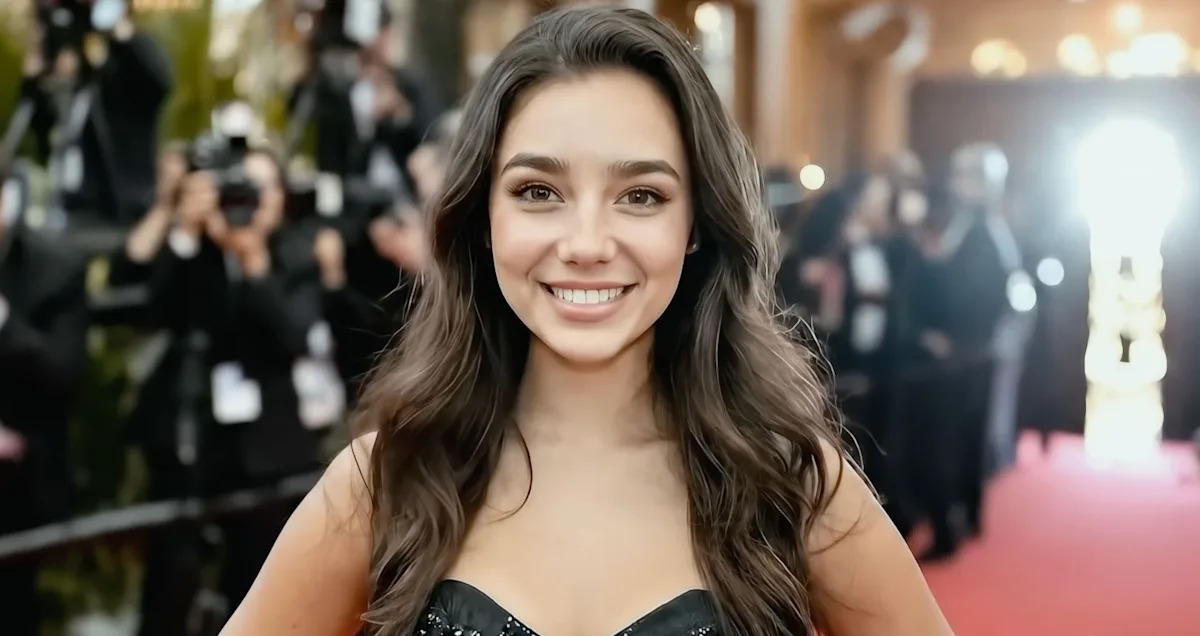
Tilly Norwood is poised to be the next big thing in Hollywood. The striking, green-eyed beauty with a British accent, perfect skin and polished press shots is reportedly on the cusp of getting signed by a talent agency. She has a growing fanbase online. She’s already causing a stir in the industry, with some actors speaking out against her. So what makes the buzz around her different from that of other breakout performers? She’s not human.
Norwood is the first “actress” created entirely by AI. The U.K. production company Particle6 and its AI talent division Xicoia describe her as a “digital human” designed to act, model and influence across platforms. Her debut at the Zurich Film Festival’s industry summit set off a firestorm, igniting fresh debate about what happens when technology doesn’t just assist artists, but it can also work alongside them or even replace them.
Within days, actors’ unions condemned her existence. Talent agencies publicly distanced themselves. People flooded social media with disbelief, fascination and anger. To some, Norwood represents the future. To others, she’s the line that should never be crossed.
Who is she?
Norwood is the face of synthetic stardom. She was built using generative AI models trained on vast datasets of faces, voices and movements. Her creators gave her a human-sounding name and an upbeat, self-effacing personality crafted by writers and machine-learning prompts. She appears to be in her early 20s and is an aspiring actress.
Norwood’s creator, Eline van der Velden — a physicist turned producer — says the goal was to design the kind of performer studios dream about: endlessly adaptable, always available and immune to scandal. In interviews, Van der Velden has compared Norwood to today’s A-list actresses, like Scarlett Johansson and Natalie Portman.
In photos and videos, Norwood blinks, smiles and gestures like a human. Her social media captions read like any other performer’s — she posts about fashion, days on set and screen tests. She has over 60,000 Instagram followers, where she appears in carefully staged selfies and promotional clips.
What Hollywood says
The industry is already on edge when it comes to AI, and Norwood has only exacerbated its anxieties. If studios can populate entire scenes with photorealistic digital actors, what happens to the thousands of human performers who rely on background and supporting roles for income? The fear isn’t just that one AI star might land a job — it’s that hundreds of real people might lose theirs.
Norwood’s rise also comes at a delicate time. After 2023’s SAG-AFTRA strike, actors fought hard to secure protections against AI use — particularly the replication of performers’ likenesses without consent. The months-long standoff saw stars like Bryan Cranston, Kevin Bacon and Olivia Wilde take to the picket lines, demanding better pay, streaming residuals and strict limits on the use of artificial intelligence in film and television. Her arrival, less than two years after that battle, feels to many like a test of those newly drawn boundaries.
“The union is opposed to the replacement of human performers by synthetics,” SAG-AFTRA said in an official statement. “It has no life experience to draw from, no emotion and, from what we’ve seen, audiences aren’t interested in watching computer-generated content untethered from the human experience. It doesn’t solve any ‘problem’ — it creates the problem of using stolen performances to put actors out of work, jeopardizing performer livelihoods and devaluing human artistry.”
Prominent actors, like Emily Blunt, are getting more specific. The Smashing Machine star told Variety, “good Lord, we’re screwed,” calling the idea of Norwood “really, really scary.” Emmy-nominated actress Betty Gilpin wrote an open letter to Norwood, whom she called “both infant and immortal,” saying, “You look good. But you look empty. You don’t make me feel like my cells are trading with yours. You make me feel alone.”
When Amy Poehler hosted Saturday Night Live, she made her stance on synthetic actors clear, saying,“And to that little AI robot watching TV right now who wants to be on this stage someday, I say to you, ‘Beep boop beep boop.’ Which translates to, ‘You’ll never be able to write a joke, you stupid robot.’”
Industry insiders are equally uneasy. Talent agencies like WME and Gersh have already vowed they will not represent AI clients, drawing a clear line between digital novelty and professional artistry.
There’s also a philosophical divide: some see AI tools as creative collaborators — useful for de-aging actors or generating complex visual worlds — but not as replacements for the human spark that defines performance.
Legal experts warn that even if Norwood’s design doesn’t replicate any one real person, it may still raise questions about training data and consent — especially if real actors’ performances helped teach the model how to move, speak and emote. Ethicists also question whether audiences should be clearly informed when a “performer” isn’t human. Transparency, they say, is key to maintaining trust.
What her creators say
Van der Velden insists the outrage is misplaced. She says Norwood isn’t meant to replace anyone but to augment creativity — allowing filmmakers to explore ideas or worlds that might be too costly, dangerous or logistically impossible to capture with humans.
At the Zurich Film Festival, Van der Velden acknowledged that early conversations with studios were met with hesitation, but claimed interest in Norwood has grown rapidly as Hollywood quietly embraces AI. She added that an announcement about who will represent the AI creation is expected in the coming months.
In a statement, Van der Velden says she believes “ AI characters should be judged as part of their own genre… rather than compared with human actors.” She has publicly framed Norwood as a creative tool, calling AI “a new paintbrush” and “a piece of art.” She has not made any on-the-record comments about collaborating with unions on formal guidelines.
What it all means
Whether Norwood is perceived as a gimmick or a groundbreaking prototype, she’s already changing the conversation. For decades, Hollywood has flirted with the idea of digital doubles — from motion capture characters like Gollum from The Lord of the Rings to de-aged legends in Indiana Jones. But Norwood is different: she’s not an illusion in service of a real actor. She’s the illusion itself.
Her very existence forces a question that’s bigger than technology: What do we value most in storytelling — the craft or the creator?
For now, Norwood continues to post, smile and promote her fictional career as though she’s immune to the chaos she caused. Maybe she is. For everyone else in Hollywood, she’s a reminder that the future is coming fast — and it might not wait for us to catch up.
‘ The preceding article may include information circulated by third parties ’
‘ Some details of this article were extracted from the following source www.yahoo.com ’