On the best opaque evidence available, for every 5000 streams, Spotify pays an artist around $30 — although less than 1000 spins a month gets those losers zero. Amazon is around the same, Deezer about $50, Apple Music a relative bonanza at $77.
Tidal nudges the $100 mark if you spring for its hi-fi tier and Qobuz, the boutique French audiophile’s darling, pays a still-not-exactly-whopping $145. YouTube Music? A mortifying $5.50 for 5000 streams. That’s three McNuggets, so here’s hoping the rest of the band isn’t hungry.
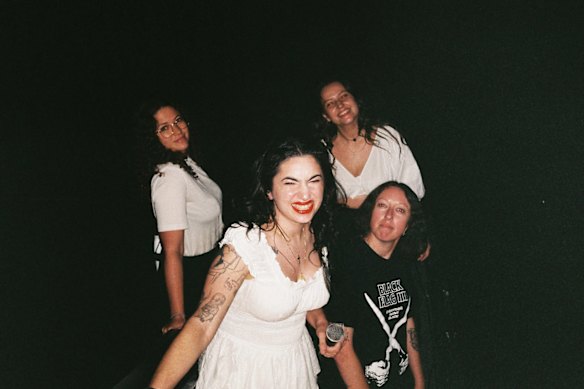
Melbourne indie outfit Camp Cope, who are breaking up but will deliver their farewell album, Live at the Sydney Opera House as vinyl later this month. Credit: Genna Alexopoulos
The fine print adds brain injury to insult: different subscription tiers, geography, advertising rates, sound quality options, algorithm promotion opt-ins and more buffet the numbers like an accountant’s toupee in a gale, but the bottom line is clear: the infinite jukebox spins for shareholders. Musicians pocket bus fare.
Some superstars have invested in their own lifeboats. James Blake’s Vault subscription service — $7.50 a month for unreleased tracks — was hailed as a bold alternative 18 months ago, but who’s ready to fork out $90 a year for the offcuts of every artist on their playlist?
What does that leave us?
None of this is remotely surprising to Sarah Thompson, who works with artists on indie label Poison City Records and, until recently, played drums with Melbourne rock outfit Camp Cope.
Loading
“I worked in record stores, then labels, so I saw in real time how bleak the future was going to be,” she says. “It was obvious from the start that streaming wasn’t going to do anything good for anybody.”
Camp Cope’s farewell album, Live at the Sydney Opera House, arrives on October 17 as a one-off vinyl pressing, and digitally only on the platform most indie acts cite as the least-worst online option: Bandcamp.
Bandcamp is not really streaming. It’s more like a digital record store where you name your price and 82 per cent of it goes straight to the artist. Once a month, Bandcamp Friday waives its cut entirely which, in a world of fractions of cents, can feel like Christmas.
The gulf between indie flexibility and the major label straitjacket is growing more stark. Bandcamp is great for smaller players, but Thompson gets why an act like Massive Attack can’t just ditch their 7.9 million streamers and reposition their catalogue overnight.
“In a perfect world, every artist would just leave Spotify,” she says. “But why is the onus once again put on artists? We already don’t have anything. Get angry at Spotify, not at musicians. We’re artists. They’re a multibillion-dollar corporation run by advertisers and tech guys.”
At the far organic end of that spectrum, if you squint hard enough, sits a tiny glimmer of light. Formidable Vegetable, a “permaculture electro-swing outfit” from regional Western Australia looks, from the burning deck of the modern music business, like the green shoots of a new world.

‘Permaculture electro-swing outfit’ Formidable Vegetable have taken aim at Spotify in one of their songs. Credit: Ema Kneblova
Their song Spotify (Where Music Goes to Die) has had “bugger all streams, funnily enough,” says mainstay Charlie Mgee, but it’s clocked up 1.5 million Instagram views since August, and proved a crowd favourite on their recent fifth return to the Glastonbury Festival and other stops around Europe.
Loading
“I have friends who are signed to majors who have thanked us for saying this because they’re on contracts that require them to be on Spotify,” he says.
But “a lot of bands are using their platforms to advocate for what they believe in,” he adds, citing King Gizzard, Stella Donnelly, Lime Cordiale and Teen Jesus and the Jean Teasers. “We’re tired of being co-opted into a world-destroying machine. Bring back the punks!”
Mgee acknowledges that stadiums and concert halls may well remain beyond their grasp. And he’s fine with it. “Ours is a grassroots, mycelial approach to music, but we’ve survived and thrived for 12 years so it’s a model that’s really worth exploring for anyone the industry is not working for.”
That arguably describes a greater percentage of musicians today than at any other time in living memory. Thompson knows there’s no easy fix, but she believes turning the tide is all about consumer education.
“There’s no HR department for musicians. No worldwide union. To collect every artist on Earth in a mass exodus [from streaming] would be ideal, but it’s going to be very difficult. What’s more beneficial is to re-educate people on how it all works, and how to financially support the artists they like.”
Turns out that’s a lot easier that cancelling your streaming subscription.
“Buy the T-shirt. Buy the album. Go to the show.”
Must-see movies, interviews and all the latest from the world of film delivered to your inbox. Sign up for our Screening Room newsletter.
‘ The preceding article may include information circulated by third parties ’
‘ Some details of this article were extracted from the following source www.smh.com.au ’