BANGKOK – The death of Thai Princess Bajrakitiyabha Mahidol, once seen as a potential heir, has raised the question of royal succession in a country where the monarchy wields enormous power.
King Maha Vajiralongkorn, himself appointed crown prince at the age of 20, has yet to name a successor nearly a decade after taking the throne.
The 73-year-old’s eldest daughter, who died on June 11 after being hospitalised for nearly four years, played the most active public role of his children and had been given the rank of army general.
Only two of his remaining six children have royal titles – a prince and a princess – while the others live abroad after their exile from Thailand alongside their mother.
Discussion about the royal family is a highly sensitive issue in Thailand, where a strict lese majeste law prohibits insults and criticism against the monarchy, with a penalty of up to 15 years in prison.
Although a palace law dating back to 1924 bars princesses from the line of succession, changes to the Constitution in 1974 allow for a princess to be appointed by the Privy Council – the King’s panel of advisers – in the event that the throne becomes vacant without an officially designated heir.
Some observers believed that paved the way for Bajrakitiyabha to potentially become the country’s first queen regnant, boosted by her senior royal status and extensive official duties, including a position as a diplomat in Austria and several roles within the United Nations. She was also an advocate for prison reform and her campaign led to the UN adoption of the Bangkok Rules aimed at enhancing the lives of female inmates in 2010.
The King has no children with his current and fourth wife, Queen Suthida Bajrasudhabimalalakshana, 48.
Now, the spotlight turns to his daughter and five sons. Here are his potential successors:
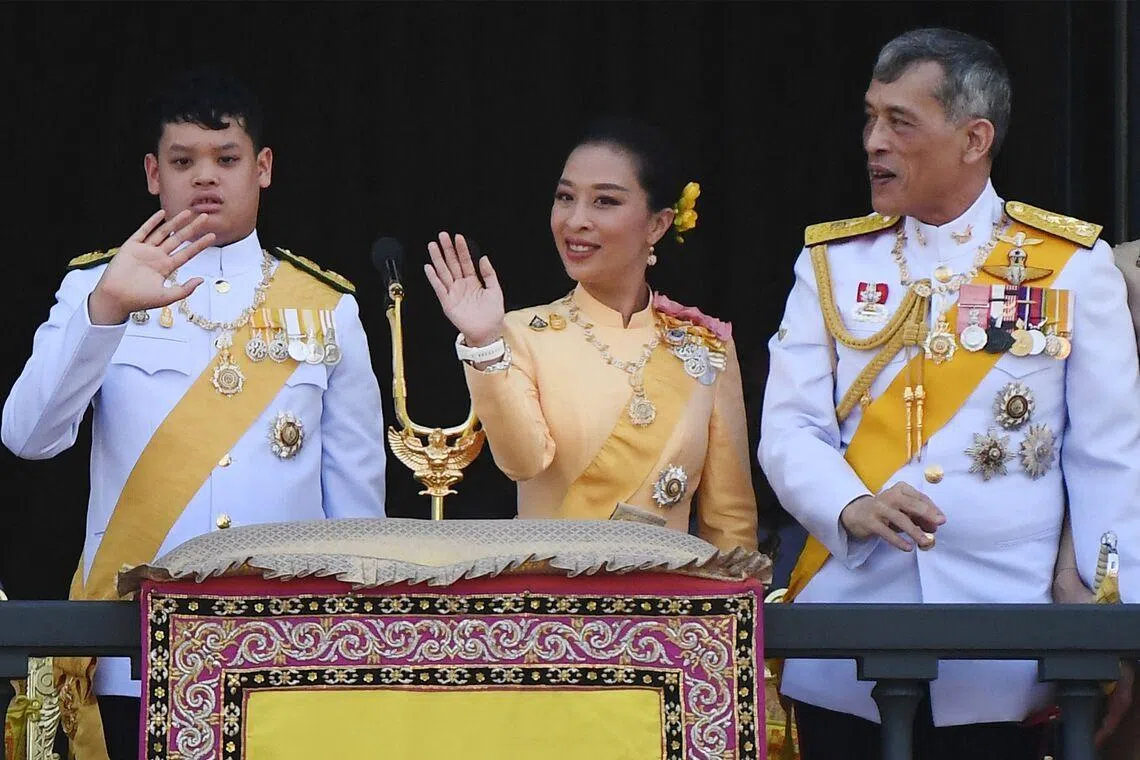
A file photo from May 2019 showing (from left) Thailand’s Prince Dipangkorn Rasmijoti, Princess Bajrakitiyabha Mahidol and King Maha Vajiralongkorn. The Prince is now widely considered an heir presumptive under the palace succession law.
PHOTO: AFP
Prince Dipangkorn is the youngest and only son with a royal title, born to Vajiralongkorn’s third wife, Srirasmi Suwadee. He is widely considered an heir presumptive under the palace succession law.
The young prince received elementary education at Thailand’s elite Chitralada School in Dusit Palace before studying abroad in Germany, where the King has previously spent a lot of time. When Dipangkorn returns to Thailand during school breaks, he often visits Buddhist temples and discusses religious matters with the Supreme Patriarch.
The King divorced the Prince’s mother in 2014, and the government said that she resigned from royal life. Her parents were charged with lese majeste and served more than two years in prison.

Thai Princess Sirivannavari Nariratana and Prince Dipangkorn Rasmijoti on a royal barge in October 2024. The Princess holds a royal rank granted to her by the previous monarch, King Bhumibol Adulyadej, in 2005.
PHOTO: EPA
Princess Sirivannavari is the only daughter among five children by the King’s second wife, former actress Sujarinee Vivacharawongse. Unlike her siblings, she lives in Thailand and holds a royal rank granted to her by the previous monarch, King Bhumibol Adulyadej, in 2005.
As the only other child of Vajiralongkorn with a royal title, the Princess is seen as behind her half-brother Dipangkorn in the line of succession.
A graduate of Chulalongkorn University in 2008, Sirivannavari has won medals at the South-east Asian Games for competing in the national badminton and equestrian teams. Referred to by local media as the “designer princess”, she has an eponymous luxury fashion label, whose designs have been showcased at international events, including Milan Fashion Week and the Cannes Film Festival. In a 2013 interview with Vogue, the Princess credited her grandmother, Queen Mother Sirikit, for her interest in fashion.
The Princess has given several interviews to Thai media over the years. On a television talk show in 2018, Sirivannavari said she had taken off her “princess hat” while attending university in an effort to make friends, as her father wanted her to enjoy the life of a student.
Sirivannavari’s four elder brothers – Juthavachara, 46; Vacharaesorn, 45; Chakriwat, 43; and Vatchrawee, 40 – were exiled to the US after their parents’ divorce in 1996. They have been stripped of their royal ranks and, for this reason, they are ineligible for the line of succession under the 1924 Palace Law. However, the King has the power to reinstate their titles and invite them back into the royal family.
Juthavachara has worked in the aviation industry for more than two decades and is a director at an aircraft maintenance company in San Diego, California, according to his LinkedIn profile.
Vacharaesorn worked as an attorney at a law firm in New York and founded the Thai Heritage Scholarship Fund, which awards grants to young Thais growing up in the US to learn about their roots.
Chakriwat is a medical doctor who has made more than two hundred videos on his YouTube channel focusing on healthcare. He and Vacharaesorn are active on social media, occasionally writing messages to Thai people and posting pictures of engagements with Thai communities overseas.
Vatchrawee, the youngest, has a graduate law degree and a Master of Business Administration.
Vacharaesorn was the first to return to Thailand in August 2023, after 27 years abroad. With Bajrakitiyabha hospitalised, his visit sparked speculation that he may be rehabilitated to rejoin the royal family and become a potential candidate to succeed the King. His siblings followed with their own visits to Thailand.
After choosing to stay in the country, Vacharaesorn and Chakriwat were exiled again in June 2025, their eldest brother Juthavachara told Time in an interview.
Juthavachara is reportedly married to a foreigner, which would disqualify him as a potential successor under the palace law. It is unclear whether Vacharaesorn is still married to his foreign wife. BLOOMBERG
‘ The preceding article may include information circulated by third parties ’
‘ Some details of this article were extracted from the following source www.straitstimes.com ’