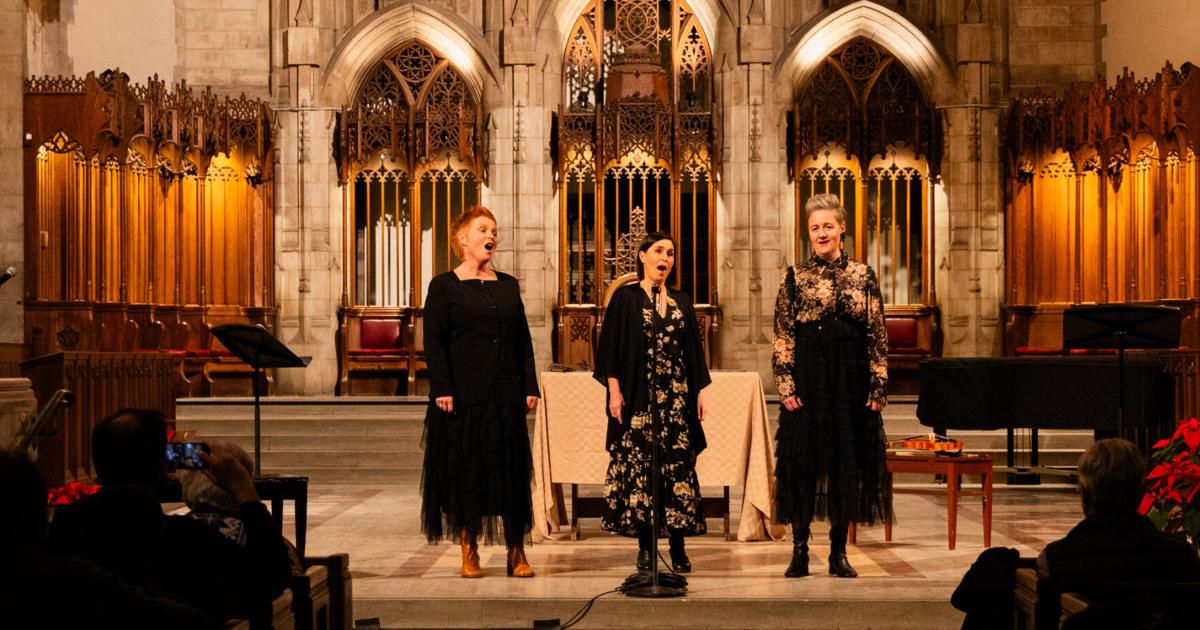
Trio Mediaeval was formed in Oslo in 1997. Their core repertoire is sacred medieval music, contemporary music written specifically for the ensemble and traditional Norwegian, Swedish and Icelandic ballads. They brought some of all this to Rockefeller Chapel last Friday night under the auspices of UChicago Presents.
While the weather was decidedly cold, it did not seem to affect attendance, as hundreds made their way into the chapel to hear a beautifully composed program performed with luminescent power.
The music for the evening was centered around the Messe de Tournai, or Tournai Mass. While the various parts of the mass appear to have been composed by multiple people and at different times, it is one of the earliest examples of a complete mass setting regularly performed at Tournai. It is also noteworthy because some of the settings are in the “Ars Antiqua” style and others in the “Ars Nova” style, which replaced it. This explains the concert’s title: “Between Two Worlds: on the cusp of the Ars Nova.”
The program also interspersed these mass movements with works composed by Hildegard von Bingen and a group of religious settings originating from Berkeley Castle in England. And there were a few works commissioned by the trio composed by Andrew Smith and Gavin Bryars.
The ensemble began a Kyrie by von Bingen during which they were standing as far away from the audience as possible. We got a pleasing effect of the music lifting high into the chapel and making its way to us in an entirely ethereal fashion. Then they moved forward to be much closer to the audience, offering a different effect: more direct and less other-worldly.
The Kyrie and Gloria of the Tournai mass had surprising harmonies and a marvelous sense of buoyancy. From time to time the trio brought out instruments for accompaniment. First the Hardanger fiddle (the national instrument of Norway), then the Shrutibox (a small Indian harmonium), and lastly the Melody Chimes. These added depth to many of the Hildegard von Bingen selections. The fiddle for “O frondens virga” was particularly charming.
The contemporary pieces were expertly woven into the fabric of the concert and they fit like a glove, saying something about how the composers of these works understand the work of Trio Mediaeval. Andrew Smith’s “Ave Maris Stella” features both sharp dissonances as well as pretty harmonies and was a welcome addition to the older music. Smith’s “Regina Caeli” opened with a magnificent unison that led to more and more complex harmonies and interesting harmonic progressions.
There was a marvelous sense of calm for von Bingen’s “Caritas abundant,” with the Melody Chimes adding a shimmering touch.
At about the midpoint of the concert the three women moved into the aisle of the seating section to sing the Berkeley Castle works. I was fortunate enough to be right on the aisle very near to them. It was tremendous to hear them sing together yet to be able to hear each individual voice clearly. It was the highlight of the evening, to have these angelic voices singing right into my ear — an unforgettable gift of beauty. The radiance of the music was magical.
The “Agnus Dei” from the Tournai Mass was delightfully peaceful, while the closing “Benedicamus Domino” by Gavin Bryars was a modern work with an aesthetic that complemented the rest of the concert.
After hearty applause, Trio Mediaeval offered an encore, a Scandinavian wedding march arranged by Tone Krohn: Bruremarsj fra Gudbrandsdalen which was a joyful ending to the evening.
‘ The preceding article may include information circulated by third parties ’
‘ Some details of this article were extracted from the following source www.hpherald.com ’