On January 29 Third Angle New Music performed the four Counterpoints of Steve Reich at Hopscotch. Third Angle musicians Sarah Tiedemann, Will Pyle, and Valdine Mishkin alongside guest musician Daniel Reyes Llinás performed Reich’s Vermont, New York, Cello, and Electric Counterpoints, respectively. Reich’s music has been an essential part to Third Angle’s repertoire for years, so it was only appropriate they found a unique way to celebrate the composer turning ninety years old this year.
The four Counterpoint works of Steve Reich were composed over a period of twenty-one years, from 1982’s Vermont Counterpoint to 2003’s Cello Counterpoint. Each one was written for a different instrument: Vermont Counterpoint for flute, New York Counterpoint for clarinet, Electric Counterpoint for electric guitar, and Cello Counterpoint, unsurprisingly, for cello. All were composed for a live performer alongside an audio tape of pre-recorded parts on the same instrument, building up a complex of little motifs within which one can. Put another way, it is music composed twenty years before the looper pedal. In Electric Counterpoint, for instance, the guitarist plays along with up to a dozen other pre-recorded guitar parts. New York Counterpoint was originally composed for clarinettist Richard Stoltzman, but here Will Pyle performed the piece on soprano sax.


Hopscotch is a contemporary arts space in the Central Eastside of Portland that opened in 2023. It is of a kind with other multimedia arts spaces that have been popping up in recent decades such as Meow Wolf. Hopscotch, like Meow Wolf, creates a fantastical atmosphere of interactive art pieces.
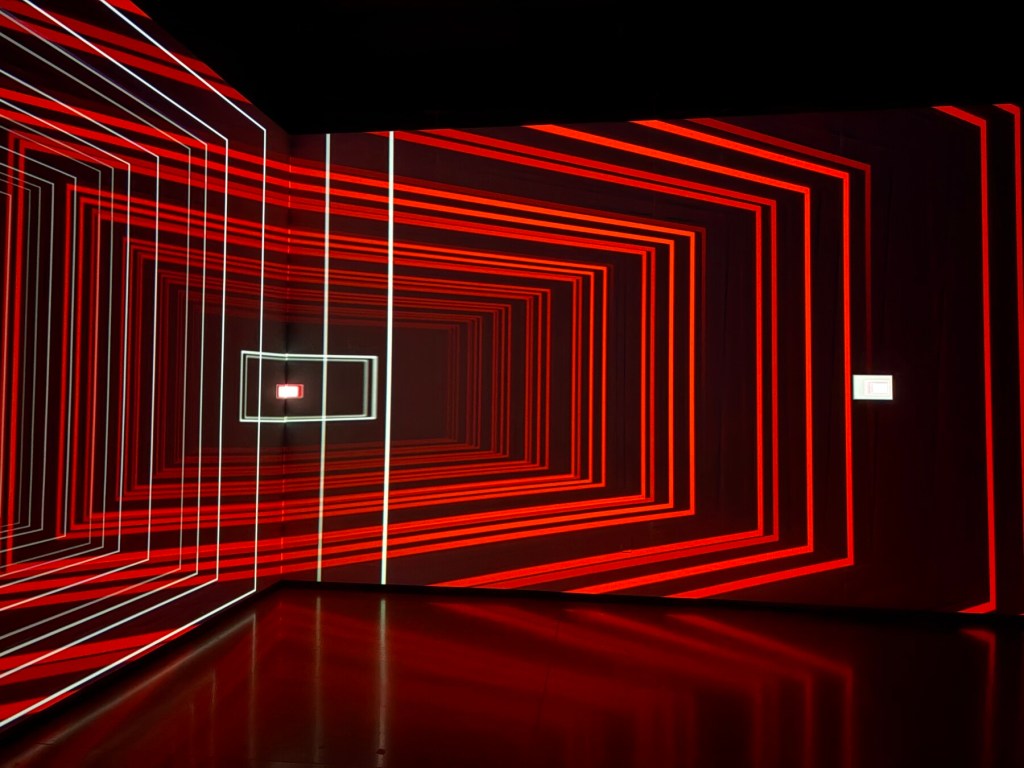
Crossing the threshold into the entryway and coat check feels more like one is entering a nightclub. The lounge outside the entryway played mellow synth music à la Tangerine Dream, with the seating area cast in neon retrowave lighting. The installations lay along a winding, linear corridor with rooms for one to stop by along the way.
The performance of the Counterpoints took place in spots along the Hopscotch journey. Third Angle performed each piece pretty soon after the last, leaving little time for concertgoers to make stops along the way. (I showed up late to at least one stop because of this.) We also had to cram pretty tight into each space, or be content to stand on the periphery. After each piece was over however it was easy to do the rounds and see the installations again. The cycling in-and-out of guests helped alleviate this, as they were able to accommodate multiple groups making the rounds simultaneously.

The first stop was in the “Laser Graffiti” room, where 3A Artistic Director Tiedemann performed Vermont Counterpoint. Tiedemann made frequent swaps between a standard flute and a piccolo throughout. Guests could draw on the projection of a rasterized brick wall using laser pointers made to look like spray paint canisters. There were only four to go around, so most people did not get a chance to use them. Most patrons were content to draw aimless squiggles – few doodles, tags or insignias, though one person did draw a ladybug. The color palette and shapes used thick lines and bright colors to evoke the graffiti style of New York in the 70s.


The second stop was in the nearby installation called “Unknown Atmospheres,” by Portland-based Parallel Studio and Seth Nehil. Here 3A’s communications director Will Pyle performed New York Counterpoint on soprano sax. The installation featured ball lights suspended from the ceiling, flashing and moving in cascades of colors and shapes. A mirror in the back of the room added to the perceived depth of the patterns. The patterns weren’t coordinated with the music, but there were moments of unintentional synchronicity. There wasn’t much space in this room, so many guests sat cross-legged on the ground beneath the lights or hugged the walls in the back.
Then Valdine Ritchie Mishkin performed Cello Counterpoint in a room for a piece called “VJ Yourself.” This one featured the most interesting interaction between performance and installation. “VJ” stands for “Video Jockey” – guests stand in front of a camera and the captured image gets projected onto the wall in patterns reminiscent of old computer screen savers.


Fragments of video from Mishkin playing repeated endlessly, looped, stretched and stuttered and layered over each others, the repeated layers forming new pulsating patterns akin to those of classic Windows 95 screensavers. The blue sequins on her dress pulsated like television static on camera, and her bow movements stacked like an oppressive barrage of needles. The music of Cello Counterpoint is dense. The live performer adds a melody coursing high above the low chords of the recorded cellos.
The final performance was of Electric Counterpoint by guitarist Daniel Reyes Llinás. This took place in the “Rainbow Cave,” which used thousands of white plastic bags dripping off the walls and ceiling like stalactites. The first two movements build up from chords and pulsations, like the opening of Reich’s Music for Eighteen Musicians. Llinás played with a bright, picky modern jazz tone that was able to stand a bit above the accompanying tape part, originally recorded by Pat Metheney. After this final piece guests were free to roam Hopscotch to look at installations we may have missed along the way. And of course, at the end of the journey we had to exit through the gift shop.

There were some other interesting installations worth mentioning that weren’t featured as part of the performances. Tricktronix, an Australian arts collective, created the “Light Portal,” with two make-your-own mandalas. On a touch screen, you could adjust the depth, color, and speed at which the mandala moves, setting it in a spot where one would like the next guest to find it. The “Quantum Trampoline” allowed guests to bounce on a trampoline while patterns that looked like an animated wind map responded in real time to their movements.
Some of the installations at Hopscotch featured local artists. Portland Street Art Alliance had an exhibit with huge murals painted straight onto concrete walls by The Earwig, Jennifer Mercede, David Rice, Francisco Morales, Winston the Whale, and Casillad Oliver. A hallway outside the gift shop featured some stunning framed prints of 360 degree photographs by Lil’ Planets.


Because all of Reich’s Counterpoint pieces feature a live performer playing to a backing track, with many layers built from accumulating melodic fragments, these pieces have a fairly even dynamic level, propulsive rhythms sustaining a fairly high energy level throughout, and textures slowly evolving over time, allowing the music to remain clear and audible in noisy environments outside the concert hall. When performed in a space such as Hopscotch, the Counterpoint pieces allow for spontaneous connections to be made with whatever happens to be around it.
It can be difficult at times to tell which parts were performed live and what was part of the backing track, but I suspect that was intentional on Reich’s part: the live performance inhabits the tape part rather than sitting above it. The live performer must therefore be locked into the beat, while remaining cool and restrained.


Reich’s Counterpoint pieces fit the environment of Hopscotch quite well. The visual and auditory components to Third Angle’s Counterpoints both rewarded careful attention and patience. Many of the interactive pieces at Hopscotch required one to interact with it for a while until its nature became clear. With time, one could uncover the different colors and patterns of movement at play during Pyle’s performance of New York Counterpoint inside “Unknown Atmospheres,” for instance. The pulsating patterns of “VJ Yourself” also complemented Cello Counterpoint well, in what was the most amusing performance.
Third Angle’s next project is the premiere of chamber opera “Dies Irae, Desirée” by Maria Finkelmeier & Brady Evan Walker. Performances will take place from March 13-15 at the Vault Theater in Hillsboro.
‘ The preceding article may include information circulated by third parties ’
‘ Some details of this article were extracted from the following source www.orartswatch.org ’