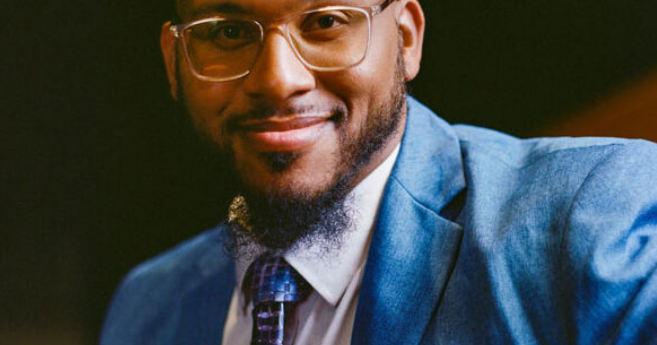
(March 12, 2026) Jason Craige Harris is a speaker and mediator who helps communities and organizations solve hard problems.
When groups are stuck at an impasse or can’t bring the conflict to a healthy resolution, Harris steps in to steady the room and help people talk to each other again.
He was originally drawn into conflict resolution and mediation because of several personal and professional experiences that, he said, led him to believe that conflict skills were something that needed to be taught.
“I thought it had to be intentional,” said Harris, who will speak about his mediation work at the Dreamland Theater next Thursday as part of the Nantucket Lighthouse School’s Educational Speaker Series, which brings to the island experts in the field of education to discuss topics ranging from diversity, equity and inclusion to child development.
“It’s not as though we were born with these skills. And in fact, I realized that the wider culture had various kinds of models of handling conflict that were not particularly productive.”
“I view myself as a relatively competent person, but somehow conflict had a way of de-skilling me, and my desire to have a better, more thoughtful relationship with my own child and my own family was part of what inspired me to go and learn more deeply about conflict and to do work the work I do now.”
Harris is trained in ethics, psychology and systems thinking, and studies how stress, power and fear hijack conversations, and how curiosity and courage can bring them back.
He noticed in tense group settings that people would lean into avoidance, or launch into attack mode, or embrace appeasing strategies that would hopefully settle the conflict, but these methods didn’t seem to reach the heart of the issue.
“I saw conflict avoidance wreak havoc on communities,” he said. “Like the inability to sit and have a conversation across lines of differences where each person would feel seen or heard.”
A few of these situations led Harris to acknowledge that he was “quite conflict-avoidant” himself, and these observations spurred him on to search for more productive ways of healthy engagement in an increasingly globalized and interconnected world.
“My observation of myself and other humans navigating differences inspired me to search for these strategies for being able to stay in dialogue where multiple parties can show up as their authentic selves and be able to negotiate and navigate life together,” he said.
Science behind the conflict
Harris threads social psychology into his work, observing people and groups and the way they interact, or don’t, or can’t, often due to what he refers to as “cognitive biases,” unconscious differences in thinking that affect how we process information, perceive others and make decisions.
He says there are some common ways humans have learned to cope with differences “that have proven to not be particularly productive or helpful,” and that part of it includes how the human brain functions.
He highlights three common cognitive biases that can arise when our brains attempt to cope with differences: consensus bias, confirmation bias and the fundamental attribution error.
“The tendency to assume that our experience is the only experience, social psychologists have termed that ‘consensus bias’,” he said.
“The tendency to devise a narrative in our head about a person or situation and to conveniently ignore data points that call that narrative into question, social psychologists have called that ‘confirmation bias’.”
The third, the fundamental attribution error, is the tendency to “let ourselves off the hook and to more harshly judge the behaviors of others, particularly those who are not like us,” Harris said.
These cognitive barriers can get in the way of being able to relate to others in ways that are more thoughtful and respectful, he said.
When someone presents information that seemingly contests our own worldview, we may experience a spike in cortisol and adrenaline in our physical being, Harris said, so a biochemical response might arise, diverting our cognitive resources toward the limbic system, which controls behaviors essential for survival, like the fight-or-flight response.
This is not a conducive spot to find oneself when trying to solve complex problems.
“The prefrontal cortex is where you want to be most activated when you’re trying to solve a problem,” Harris said. The prefrontal cortex helps with attention, emotions, moderating social behavior and decision-making.
“I think that the combination of our natural threat responses, these cognitive biases and processes that can limit our engagement with others, you add all of that together with a larger culture that I think, unfortunately, often calls out of us our worst selves, you have a perfect storm of a cocktail for polarization.”
One of Harris’ goals is to teach practices for pushing back against what he perceives as “cultural pathologies” that don’t serve the common good, such as the tendency to spin and circulate narratives about different groups of people that reduce them to one-dimensional frames that can get stereotyped and mislabeled.
“I think that there are some folks who are invested in keeping people apart,” he said.
“Something I worry about is hearing these narratives with such repetition that they can gain an aura of truth. That larger cultural context where we so quickly treat each other as single-dimensional frames that reduce the complexity of our humanity certainly shapes our ability to have courageous conversations.”
Emily Miller, head of the Nantucket Lighthouse School, first encountered Harris while attending his presentation at the Association of Independent Schools of New England’s diversity, equity and inclusion conference a few years ago.
“Jason just has that warmth and engagement, and sitting with him you feel like you’re coming home,” Miller said. “He’s just a very charismatic speaker who makes everyone in the room feel connected. We were on the edge of our seats.”
Miller invited Harris to help provide her young students with the tools to successfully navigate conflicts and disagreements early on.
“One of the things that Jason had taught us (at the workshop) is how to hold safe spaces and give children opportunities to talk about conflict, about something that maybe isn’t going well in the classroom or at recess, and using protocols that ensure everyone’s voice is heard,” Miller said.
“A lot of what we’re talking about at the adult level, we’re looking at practices that we can start with children at the younger ages so they can do these things that Jason’s talking about. It feels imperative to me and just as much a part of the curriculum as the academic curriculum.”
Harris also believes it’s never too early to begin to talk with children about things like cooperation, sharing and connection, communicating needs to your friends and asking your friends what their needs are.
“I think we have to talk about conflict and disagreement from almost day one of a child’s development, right?” he said.
At six months of age, children begin to notice visual differences between human beings. These differences are tools of assessment and identification that will go on to distinguish groups and individuals, Harris said.
“They don’t really start making sense of those differences until two or three years later, but they see it, they notice it.”
“By the time they’re around 5, they have largely absorbed assumptions about differences in (the people in) their communities, specifically their parents and caregivers, but certainly also their school communities and neighborhoods.”
When he teaches children about conflict, he uses classic examples that they experience, like a classmate taking a toy from them while they’re using it.
“I’ll ask them, ‘What feelings come to mind for you?’ and they say ‘I feel upset, I feel sad,’ I’ll ask them to show me their sad faces, and then we look around and I tell them ‘When we don’t share and we’re not acting with kindness, this is what happens’.”
He then asks the children what they think would turn those frowns upside down, and they almost always respond with suggestions of sharing or taking turns.
“The idea of cooperation and collaboration and teamwork are ideas that we need to socialize from a very young age, and in my experience, the littles, much like the adults, really appreciate scenarios that are grounded in their experience. They appreciate an opportunity to try on different tools,” Harris said.
Harris has a tool he calls “Fix the Rip,” a kid-friendly way to discuss how to give a good apology.
“Those kinds of practices and role-playing and talking about kindness and feelings are powerful ways of socializing conflict resolution techniques with our littles,” he said.
When it’s time to step in
Harris’ work tends to begin when groups feel like they’re stuck or can’t reach a resolution to their conflict.
“People often call me when they are exhausted, when they’ve tried all of their skills and tools and nothing seems to have worked to be able to move through what can feel like an impasse,” he said.
“So the level of exhaustion, frustration, hurt and anger oftentimes inspires people to seek support from an outside practitioner, and my first move in those situations often is to listen and to validate the feelings that folks have in those moments.”
These feelings, Harris said, can be very big, ranging from anger and frustration to feeling unseen, unheard or undervalued.
As a mediator, his job is to step in and try to honor those feelings while working toward a mutually-beneficial solution.
“Importantly, I don’t endorse or validate the narrative they are telling themselves about the other party,” he said.
“What I do is honor the feelings and say that it makes sense why (they) feel like that because of the breakdown in communication. I often will offer strategies, ideas, protocols that can help and guardrails, honestly, that can help people to re-engage with one another.”
Bridging divides, regardless of size or severity, is the ultimate objective in Harris’ work.
“A lot of what I’m trying to do is teach practices for pushing back against our own natural instincts that may not always serve us,” he said, “and to push back against those cultural pathologies that also don’t serve the common good of us coming together, across lines of difference, to do life together, which is actually fundamentally what this democratic, fragile experiment we call America is all about.”
Nantucket Lighthouse School’s Educational Speaker Series presents Jason Craige Harris at The Dreamland, 17 South Water St., Thursday, March 19 at 6 p.m. Free, but tickets required at www.nantucketdreamland.org
A longer version of this story is available at www.ack.net.
‘ The preceding article may include information circulated by third parties ’
‘ Some details of this article were extracted from the following source www.ack.net ’