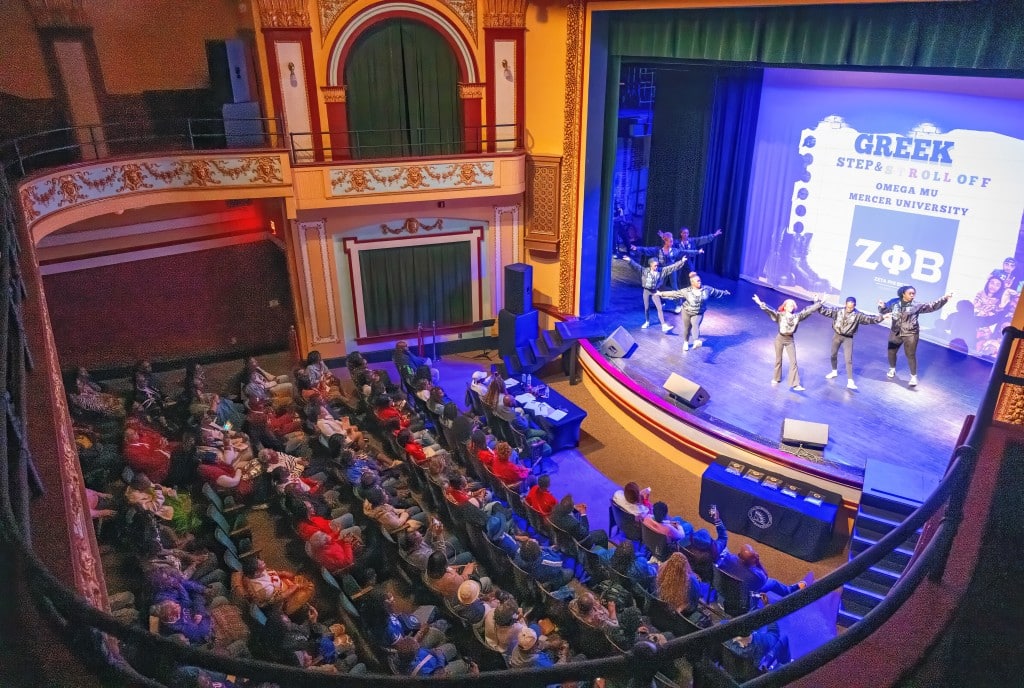
Inside the storied walls of Douglass Theatre, Dee Van raised a glass and toasted Charles Henry Douglass, the theatre’s namesake and Macon’s first Black millionaire, on what would have been his 156th birthday Feb. 17.
Van, alongside others in attendance, felt the theatre’s rich history hanging in the air that evening.
February marks the historic theatre’s 105th anniversary, an “almost unheard of” feat for a Black institution, according to executive director Shelton Land.
“Every chair, every wall, every rug, every light socket has a story,” Land said, noting that Douglass Theatre served as a “mecca of Black entertainment” in its heyday.
Music icons such as Otis Redding, Little Richard and James Brown dazzled audiences at The Douglass during a time when Black performers weren’t welcomed on most stages.
Van’s grandmother, now 98 years old, would travel to Macon from South Carolina to see jazz performances at The Douglass. She shared with her granddaughter many stories from her youth about the theatre, which Van said offered a glimpse into a world she couldn’t imagine.
“Back then there was no place you could go,” said Van, who grew up in New York but recently moved back to Georgia. “Remember, we couldn’t even sit in the front of the bus.”
Douglass built the theatre in 1921 during the segregation era as a place for Black performers. It began as a silver screen entertainment venue in the first two decades. Many greats — the likes of Ma Rainey and Bessie Smith — came through the theatre’s doors, Land said. Performances were attended by literary legends such as Langston Hughes and Zora Neale Hurston.
At the time, the railroad ran through Macon and made it a central stop for travelers. An adjacent hotel, also run by Douglass, appeared in the “green book,” which was used by Black travelers during the Jim Crow era to find businesses and housing that would accept them while they traveled.
“People came here, they felt safe, they were able to thrive and to share in their creativity,” Land said.
Douglass died in 1940, leaving millions to his wife Fannie Appling Douglass who took over management of the theatre. For the next 30 years The Douglass remained a cultural hub, elevating Black artistry and talent.
Macon native and publisher of Macon Black Pages, Alex Habersham recalled visiting The Douglass as a child. He described the theatre as a “one-stop shop” where he would go see cowboy movies.
The theatre located on Broadway (now Martin Luther King Jr. Boulevard) served as Macon’s Black Wall Street, according to Habersham, who said thousands of people filled the street on Saturdays.
But by 1973, the illustrious theatre closed its doors — the stage went dark and the nearly 800-seat venue sat empty.
The theatre was eventually ransacked and by the early ‘80s it was scheduled for demolition. But the Macon community wasn’t ready to say goodbye to a formative slice of entertainment history. In 1996, a $2.3 million renovation breathed life back into the long-dormant theatre.By 1997, it reopened as a restored space with more than 300 seats.
People once again filled the seats as a new era of talent took the stage like Margaret Haugabrook, who performed at the theatre in 2000.
Haugabrook remembers the first time she laid eyes on Macon from thousands of feet above in a plane on the way to Atlanta.
“I saw Macon from the sky,” she said. “It looked like a jewelry box.”
Her pilot pointed to the specks of light glowing from below and noted that the city was home to Little Richard, Haugabrook said.
“There were a lot of gems that came out of Macon,” she added. “And came right here through the Douglass Theater.”
The Florida native didn’t know at the time that she would one day call Macon home and even perform on the same stage as musical stars once did.
“That’s what it was built for, so it’s that energy that was put in there,” she said. “It’s still up there, just waiting for us to tap into it.”
Today, a new generation continues to tap into the theatre’s resilient history.
Land’s predecessor, Gina Ward, served the theatre for more than two decades.
The women who led the Douglass throughout its long history were “nurturers of the culture,” Land said, adding that he had “some big high heel shoes to fill.”
“Preserving a legacy is one thing,” he said. “But sharing it is another.”
‘ The preceding article may include information circulated by third parties ’
‘ Some details of this article were extracted from the following source maconmelody.com ’