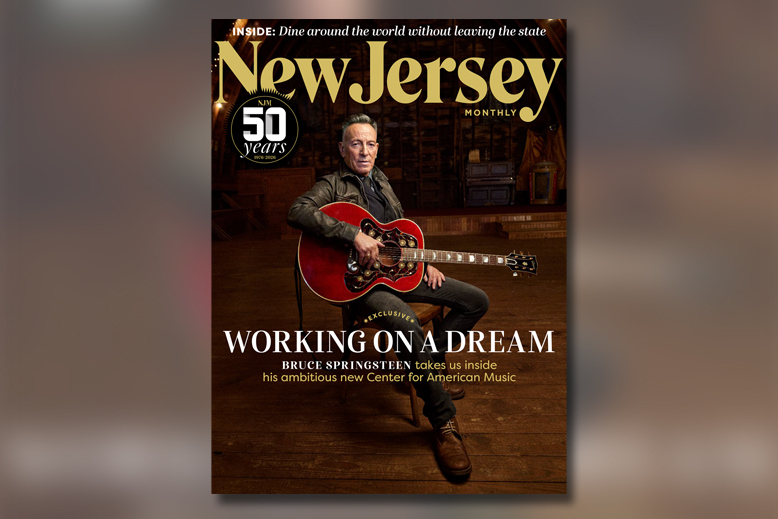
Days before embarking on the E Street Band’s Land of Hope and Dreams tour, Bruce Springsteen sat down with New Jersey Monthly—for the first time in our magazine’s 50-year history—to discuss his newly expanded Bruce Springsteen Center for American Music at Monmouth University in West Long Branch, set to open June 7.
This conversation has been edited and condensed for clarity.
New Jersey Monthly: Thank you for taking the time to talk so close to embarking on the American leg of your Land of Hope and Dreams tour! Why was it important to you that the Bruce Springsteen Center for American Music take this broad approach, rather than just focusing on you and your work?
Bruce Springsteen: Well, I was a little ambivalent at first, you know? I mean…the way the whole thing happened in the beginning, if I’m correct, was: the Asbury Park library had been collecting magazine articles and different things, and they began to build up an archive, and…they needed someplace else, and Monmouth University generously said that they would provide a place. So it ended up over in a small office over at Monmouth University. I don’t know if you’ve ever been over there, but it was kind of a tiny little shack…
Yes! It was so charming.
…where they had a ton of my stuff tucked into it. And I think Bob [Santelli] suggested the idea of trying to build a [new] building that would house my material. I was a little hesitant at first. I’m going, like, “Gee, I don’t know, a building, my own stuff, my name on it—what if I do somethin’ really stupid and embarrass the building? I’m still alive; who knows what I might do?”
[Laughs.] You would never!
[Laughs.] So I was just a little hesitant. And then I think we began to mention that it might be something that was dedicated more to the overall story of American music, and that appealed to me a little bit more. And I said, “Well, that might be nice”—having someplace that was an educational center, where the students could go to, and children from outside of the university. And it could be a place where people could come and begin to learn how the history of American music influences and affects the history of America itself. And then they’d have a spot for my stuff, if anybody was interested and wanted to go and see what made my own work and the influences that were very important to me when I was putting my own work together.
[If you look at] what was going on in…America from the ’70s through the second half of the 20th century to now, that was sort of the world that I was interested in documenting: the effects of postindustrialization on a large part of the American populace, and how it affected their lives…and continues to do so today.
I said, “Well, it might be a place where you could go and see how my music was very deeply connected to the times.” And also, just someplace that was fun, [where] people could see some of the inspirations: how I came out of the Jersey Shore, and the effects the Jersey Shore had on my creative experience. And so…I said, “Well, okay, let’s give it a try. Let’s do it.”
Can you talk a bit more about those sounds and scenes on the Jersey Shore at that time that really shaped you musically?
Well, Asbury was pretty lively…a blue-collar resort area, basically, in the ’50s when I was a child, and it was a big thing if my mother and father took me for a day to Asbury Park, you know? All of the amusements were there; the Easter Parade was a huge event. It was like going to the city…It was an eventful day if I went when I was a young child in the ’50s.
And then of course in the ’60s, Moe Septee brought in every great pop act that was influential and playing in those days: the Four Tops, the Temptations, the Rolling Stones, the Who, the Doors. Countless, countless—I mean, everybody came through Asbury Park. Now, at the time, I was kinda young, and I didn’t have the money to go see the shows, but I was on the boardwalk. I moved to Asbury, I think…around 1968…Now, by that time, Asbury was starting on its downward trend…There were the riots of…1970. And then there was me and a small group of musicians who lived in this little seaside town and created a little local music community—the center of which was a place called the Student Prince, originally. The Student Prince was pre the [Stone] Pony, and that was really where I got my start…Woodstock weekend, instead of being among the half a million folks that went to Woodstock, I was among the 150 people at the Student Prince, [laughs] watching my band play, making a few bucks.
But the town became central to my identity, and it became central to the identity of my music….The town was filled with a bunch of characters, and I sort of took them and embroidered upon them on my first record, Greetings From Asbury Park, and [my second,] The Wild, the Innocent & the E Street Shuffle. Those are all about my days in Asbury and on the East Coast and in this little blue-collar, sort of run-down amusement town.
So it deeply affected the music that I was writing about….When I finally got a record deal…I knew they were trying to say that I was a New York artist, because of the connection to Bob Dylan. My first photo shoot was a shoot in New York City, and if you go to the back of the Greetings From Asbury Park album, you’ll see there’s a picture of me that looks like I’m standing by the ocean. Actually, I was in New York City [laughs], and they put the ocean in later. It was after I [had been] walking down the boardwalk and pulled [a] postcard out of a little rack and said, “No, I’m not from New York City; I’m from Asbury Park, New Jersey, and this is what I want as my album cover.”
So I particularly decided that I wanted my identity to be connected to where I actually was coming from, and…the stories I was telling. And luckily enough, I had an art director, John Berg, at the time who saw the postcard and said, ‘Yeah, this is a good idea, let’s use it.’ So it gave me my own personality and character and identity, and it gave my music its grounding in where it really came from. And that was what I was interested in. The whole Asbury Park, the boardwalk was very central to the character I was trying to create, the world I was trying to bring to life on my first several records.
Right; they’re very evocative. You’ve written and spoken about how you were always drawn to music in which the singers sounded “simultaneously happy and sad, hopeful and resigned”—songs like the Drifters’ “Under the Boardwalk,” “Up on the Roof;” music that was marked by, in your words, “a deep longing” and “a casually transcendent spirit” that made you feel like the “whole world opened up” to you. I love that, and I see it as one of your great strengths and “magic tricks”: your melding of sorrow and joy, kind of sitting with them as two sides of the same coin. And I’m curious if you think there’s something distinctly American, or even distinctly New Jerseyan, about that specific combination in music?
Well, that was the life I was living. The life I was living was the Drifters’ “Under the Boardwalk” and “Up on the Roof.” I had a little apartment above the shoe store…where I lived on the third floor, and I would climb out my window and sunbathe on the tarred roof [laughs] on Cookman Avenue in Asbury Park when I was 20 years old. And so those songs were very important to the beginning of my emotional life and my emotional connection to music.
But then also…in my teens, I grew up through some of the most influential years of my life in the ’60s, so that brought a certain social consciousness into my music. And so those things together were very, very influential, in the beginning, of the structuring and building of the kind of music and the parameters of what I wanted my music to contain. Both of those things were very, very central.
And if you look at the E Street Band, the E Street Band does two things very well. One is, it’s one of the few bands that really communicates joy, you know? Playing “Rosalita” or “Out in the Street” or “Hungry Heart.” And there’s a lot of bands that communicate cool, there’s a lot of bands that communicate anger, but there [were] not a lot of modern rock bands at the time who communicated joy, which was an enormous part of the music of the ’50s and ’60s. And so I’ve always been proud of that side of my band that can speak to that part of people’s lives. It’s a very essential part of music.
And then at the same time, we can take on tough subjects and delve into them pretty seriously….As far as the boundaries of the music that the band can draw on and create, I’m very proud that the band has such a wide emotional bandwidth that we can bring to our audience.
It’s funny—we were in rehearsal the other day, and I said, “Okay, we’re gonna go out, it’s gonna be kind of a political tour, very serious,”…I sequenced all these serious songs. I said, “Wait a minute. Where’s the fun?” ’Cause no matter how serious we’re gonna be…fun, joy, exhilaration are an essential part of people’s lives. And I always want us to be able to address those things.
That’s lovely. Speaking of social consciousness, the first rotating exhibit at the new center is “Chimes of Freedom,” which will explore protest songs across American history, including your most recent one, “Streets of Minneapolis,” and go all the way back to what is the archive’s oldest handwritten lyrics of yours, an anti-war song called “All Man the Guns” that you wrote during the Vietnam War when you were 18 or 19. Do you have any recollection now of writing that song?
Yeah, I do. Yeah, I remember that song really well. We had the [band] Steel Mill at the time, and Steel Mill was operating during the early ’70s, which was really still the ’60s, you know? The ’60s really rolled over into the early ’70s. So I was writing in Asbury Park, which had recently had the racial uprising, and Vietnam was still raging on. It was…coming into people’s living rooms on television every night, and it was an enormous, enormous issue. One of our first benefits we did was at a small theater in Red Bank…to send folks down to the anti-Vietnam War benefit in Washington. We were probably 19 years old. So that was a very ongoing and central issue in my own life and in every young man’s life, because the draft was still in [effect], and I wrote that song—probably my earliest song addressing the Vietnam War. But I remember that song very well, and us playing it, right like it was yesterday.
That’s incredible. And there will be oral histories accessible in the center that focus on people like Bart Haynes, your first drummer in the Castiles, and Walter Cichon, from Freehold, [both of whom died in the Vietnam War]. The center’s curator, [Melissa Ziobro], noted how it’s very gratifying to be able to tell their stories, too, and ensure that people like that are more than just footnotes in history, which is wonderful.
Yeah, that’s really satisfying. The thing that I love about the center now is like, yeah, they have my stuff there, and that’s great, and if people are interested, they can go and see it. But it takes on and will take on the entirety of American music, its influences, and will be a wonderful educational center for people who are interested in the broader connection between American music and American history. That really sort of convinced me to do it….The building itself is gorgeous; the architect did a wonderful job. It’s really an amazing place. It’ll be a wonderful place to go. They’ll have all these interactive services. I think…[for] young kids who walk in, not knowing much about me or much about the history of American music, it’ll really be a wonderful, eye-opening and valuable afternoon. And so I’m excited to just be a part of it, that’s all.


Don’t forget the chunky accessories.

Plus: Paper Mill Playhouse is unveiling an $8.5 million restaurant revival, while a Cranford diner has shuttered unexpectedly.
‘ The preceding article may include information circulated by third parties ’
‘ Some details of this article were extracted from the following source njmonthly.com ’