Authenticity has become an aesthetic. At this point, we all understand the cues and signifiers of human-coded realness—for how to appear intentional but effortless, intimate but iconic, vulnerable but firmly in control. Of course, social media didn’t suddenly make people performative, but it did help industrialize a new kind of self-consciousness around images and the way we read them, and not just for influencers. We’ve all now been anointed chief communications officers for our very own emotional brands.
Social media also didn’t suddenly make people calculating. But in the pre-internet era, the calculus was different. Twiddling the knobs on your personality, desirability, and relatability was primarily a pastime of the famous and the notorious. Everyone else just did it quietly in their own lives, trying to be seen the way they wanted to be seen and recognized for who they are, two objectives that were not always aligned.
That tenuous relationship between performance and personhood is one running theme in Avedon, Ron Howard’s new documentary on the groundbreaking photographer Richard Avedon—who got his start shooting for Harper’s Bazaar—which premiered on Sunday at the Cannes Film Festival. Built largely around archival images, footage, and recordings and interviews with people like Hilton Als, Tina Brown, Larry Gagosian, Calvin Klein, Lauren Hutton, Tyler Mitchell, and Bazaar editor in chief Samira Nasr, the film traces Avedon’s rise from fashion wunderkind to one of the defining image-makers of the late 20th and very early 21st centuries.

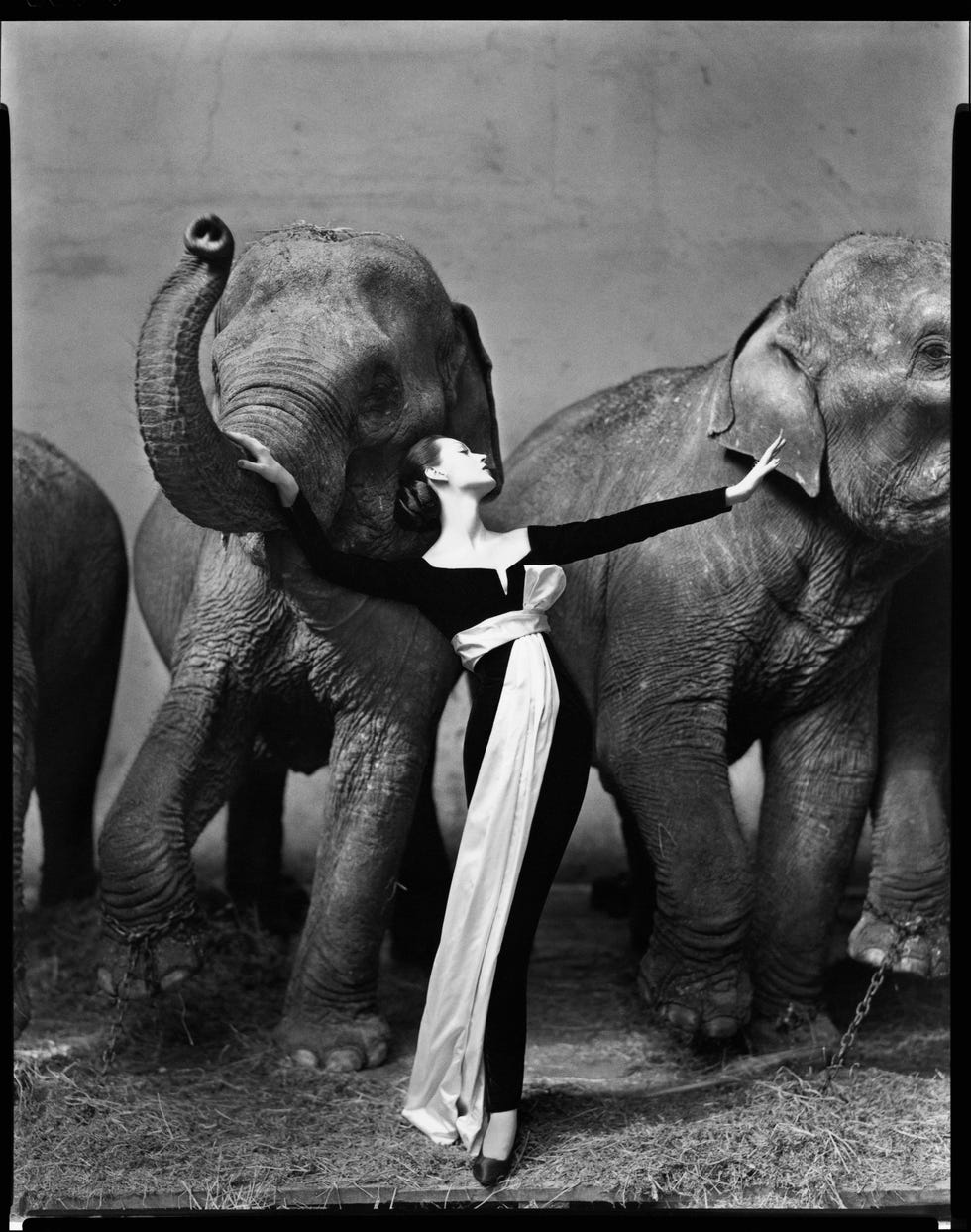
Dovima with elephants, evening dress by Dior, Cirque d’Hiver, Paris, August 1955
But Avedon also arrives at a moment when people are once again thinking about the power (and implications) of images, especially in the age of deepfakes and AI: what they do to our senses of self and reality; the way they can flatten our identities and manufacture aspiration; how they sometimes reveal truths despite themselves.
Avedon’s own voice is used to narrate much of the film; given the length and scope of his career, which stretched from the mid-1940s until his death at the age of 81 in 2004, Howard had a deep reservoir of interviews to draw from in which he speaks with literary precision about his passions, projects, insecurities, and compulsions. He was known enough that he served as the inspiration for the Fred Astaire character, Dick Avery, in the Stanley Donen musical Funny Face (1957). (Avedon was an advisor on the film.) He was also extraordinarily prolific, with a corpus that stretched beyond fashion into portraiture, journalism, art, and advertising, all connected by a curiosity, restlessness, and fascination with the theater of identity.
“The CAMERA gets in the WAY more than it HELPS,” Avedon said. “If I could do it with my EYES alone, I’d be a lot HAPPIER.”
Avedon was a presence, and when you’re that way as a photographer, it can alter the molecular structure of a moment, a vivaciousness Howard wanted to capture in the film. “I never met Richard Avedon, though I would’ve loved to be photographed by him back in the day for the status of it,” Howard says. “After making this film about him, I now wish I’d somehow gotten to know him not to be his subject, but to be his friend. I know I would have really enjoyed his company and been inspired by his creative energy and life spark,” he explains. “That remarkable quality is certainly one of the things I most want to share with audiences through our documentary.”

Jean Shrimpton, photographed by Richard Avedon, on the cover of the April 1965 issue of Harper’s Bazaar, which Avedon guest edited.
Avedon came along at a moment when people were beginning to understand the world differently through fixed images. Photographs were no longer conceived to simply document reality; images were beginning to shape aspiration, perception, and public life itself. Avedon changed the way we think about photography. But he also seemed to intuit something essential about the twisted mechanics of visibility—about how we see and feel seen, about the way we see each other.
Early on in Avedon, he describes his process this way: “I think for me the most interesting part of photography is that it’s almost as if I’m writing my own autobiography with the faces of the people I photograph,” he says. “I relate to them. And I feel connected to them and there is an exchange of energy between myself and the sitter and it’s when those two energies meet that the photograph is taken. But the camera gets in the way more than it helps. If I could do it with my eyes alone, I’d be a lot happier.”
Howard charts Avedon’s early life growing up on Manhattan’s Upper West Side. His father was in the garment business. His mother was creative and introduced him to the arts. He had a younger sister, Louise, whose struggles with mental illness would haunt him his entire life. He attended DeWitt Clinton High School, where Dick, as he was known, co-edited the high school literary journal with a classmate, James Baldwin. The Avedons had owned a department store on Fifth Avenue but lost it during the Depression. Nevertheless, his mother strove to keep up appearances, borrowing dogs and cars for family photos, which Avedon recalls her ruthlessly editing and re-editing.

China Machado, suit by Ben Zuckerman, hair by Kenneth, New York, November 1958
Avedon arrived at Bazaar in 1944. He was 21 and fresh out of the Merchant Marine, where he’d been photographing people for ID cards and taking pictures of shipwrecks. Bazaar’s famously imperious art director, Alexey Brodovitch, a Russian émigré immersed in the various strains of European modernism and a stickler for newness, became an early mentor. He encouraged Avedon to not “become” a fashion photographer but explore what fashion photography itself might become.
Avedon’s first assignment for Bazaar was a story on dresses for the teen-zine supplement Junior Bazaar; one of his final projects involved guest-editing and photographing the entire April 1965 issue, a rummaging survey of youth and pop culture with an image of model Jean Shrimpton, her face surrounded by a circular pink cutout, on the cover. In the intervening decades, he developed an approach and visual language that transformed the way we understand the world through images.
“The SCENES he created to show off the CLOTHES made magazine READERS want to be those CHARACTERS in those scenes,” says Howard.
In the 1940s, fashion magazines still treated the concept of elegance like a kind of deadening preservative: beautiful women posed beautifully in beautiful clothes alongside beautiful things, all of it suffocatingly refined. But once the war ended, America began to imagine itself differently. Europe was rebuilding. Consumer culture was accelerating. The collective notion of glamour was changing.
The women in Avedon’s pictures pulsed with life. They looked joyful, knowing, distracted, flirty, dangerous—like they’d arrived from somewhere and were headed someplace much better and much more fabulous. There was movement, narrative, drama, and soul in his images, which evoked entire worlds.
“Avedon’s work in fashion was a game changer due to that cinematic quality,” Howard says of that early work for Bazaar. “The scenes he created to show off the clothes made magazine readers want to be those characters in those scenes.”

Marian Anderson, singer, in the role of Ulrica in An Ballo in Maxhera, New York, June 30, 1955(contacts)
So many of those images have been so thoroughly absorbed into the bloodstream of visual culture at this point that it’s often easy to overlook just how singular and even strange some of them are.
Perhaps the most famous of them all is Avedon’s portrait of the model Dovima, photographed with a pair of elephants at the Cirque d’Hiver in Paris, often considered to be one of the most iconic fashion images of all time. But the image itself is almost shockingly surreal. The pachyderms are shackled and look heavy and melancholic. Dovima is impossibly glamorous in a sashed Dior gown but also appears somehow trapped inside of a fantasy that she’s projecting.
Avedon understood just how much of fashion was about identity. He also understood how much of life involved performing different versions of yourself for public consumption. These weren’t fake selves but performed selves—and he understood that there was a difference.
It’s a quality that Howard draws out even more in recounting the details behind some of Avedon’s most indelible portraits: his 1957 image for Life of a spent Marilyn Monroe, exhausted from having to inhabit a persona she created; his soaring picture of contralto Marian Anderson, renowned for singing on the steps of the Lincoln Memorial after the Daughters of the American Revolution barred her from performing at Constitution Hall. (As the film notes, Avedon later photographed the Daughters of the American Revolution as a way of capturing what institutional racism looks like.)

Marilyn Monroe, New York, May 6, 1957
Avedon photographed many of these cultural figures against increasingly spare backdrops to better highlight the topography of their faces, postures, and motions. His favorite subjects—Dovima, Audrey Hepburn, and model sisters Dorian Leigh and Suzy Parker among them—became part of his repertory company, appearing in different narratives and scenarios. He also fought for models of color like China Machado and Donyale Luna to play those kinds of starring roles in his stories at a time when representation was rarely a priority in fashion. (Resistance was more common.)
The social dimension of Avedon’s work expanded toward the end of his time at Bazaar. In 1963, he reconnected with his old high school friend James Baldwin on a shoot for the magazine. They would go on to collaborate on Nothing Personal, a book that paired Avedon’s images of artists, activists, outsiders, and politicians with Baldwin’s writing, a meditation on race, freedom, and the mythology of American innocence and prosperity, an unsentimental journey through a fragmented country.
“Avedon’s artistic SENSIBILITY and consistent AESTHETIC was his own whether his work was COMMERCIAL or SOCIOLOGICAL,” Howard offers.
It was during this period that Avedon honed what would become his signature portrait style. His backdrops became even more stark—an “existential white,” as Avedon described them—and the images were framed by a narrow black border. The effect is at once clarifying and destabilizing, the subjects unmoored from any context, set in some atemporal space.
Even now, with the arsenal of filters and AI-assisted photo-editing apps we have at our disposal, we still tend to fetishize the supposedly “candid” image—the raw moment, the accidental truth, the “authentic” self. Avedon operated under no such illusions.

Avedon photographing rancher Richard Wheatcroft in Jordan, Montana, for his In the American West series, 1983.
From the contact sheets and negatives in Avedon’s archives, Howard gleaned insight into the extraordinary rigor and attention that went into his formal choices. “As a fine artist would, Avedon kept refining and shaping his images until they reflected the feelings he wanted the picture to express—shading an ear, adding contrast to a cheekbone or a forehead,” Howard says. “These are not opportunistic snapshots; they are meticulously crafted works of art, rich with intention and a point of view.”
After leaving Bazaar in 1965, Avedon expanded his work outward while retaining the same verve and intelligence that made his fashion images so electric. At Vogue, his pictures grew even more psychologically charged as fashion became increasingly entangled with celebrity in the late 1960s and ’70s. He also turned more intensely toward his own personal projects. For an exhibition at the Metropolitan Museum of Art, Avedon positioned a wall-sized portrait of the American military and diplomatic leadership overseeing the Vietnam War opposite an equally sprawling mural of the denizens of Andy Warhol’s Factory, manifesting a literal confrontation between bureaucratic authority and downtown bohemia. Howard’s documentary also examines In the American West, Avedon’s monumental early-1980s portrait series of riggers, miners, laborers, ranch hands, and carnival workers, who he photographed (controversially, for some) with the same kind of formalism that he applied to models and movie stars.
At the same time, Avedon continued working in advertising, devising campaigns and directing commercials, often with his frequent collaborator Doon Arbus (daughter of Diane). Among them: their infamous Brooke Shields denim ads for Calvin Klein, which helped usher in the era of the fashion campaign as mass cultural event.

Avedon working on the In the American West series, 1985.
Through it all, Avedon’s close associates, former assistants, friends, and family (as well as Avedon himself) return repeatedly to his private anxieties: his obsessiveness (and occasional capriciousness) when it came to work; the looming impact of Louise, whose beauty and psychic pain many connect to the emotional tensions running through his images; the collapse of his marriages; the devastating portraits of his ailing father, Jacob, who Avedon photographed unsparingly as illness overtook him.
Over the last decade, Howard has made a string of documentaries—The Beatles: Eight Days a Week (2016), Pavarotti (2019), Jim Henson Idea Man (2024)—that circle subjects that have so thoroughly and profoundly altered the DNA of Western culture that the truly radical nature of their innovations is often forgotten. Avedon also falls squarely in that camp.
“Avedon’s artistic sensibility and consistent aesthetic was his own whether his work was commercial or sociological,” Howard says. “The way he allowed his creative sense of adventure to draw and push him into situations far outside his norm was something I related to and want to continue to emulate.”
Avedon died in 2004 after suffering a cerebral hemorrhage while on assignment for The New Yorker in Texas. At the time, he was working on a project called Democracy, a series focused on the political and cultural atmosphere of the U.S. in the run-up to the 2004 election, as the nation grappled with the aftermath of 9/11 and the wars in Afghanistan and Iraq—an attempt to take the measure of the country at yet another period of fracture and uncertainty.

From “The Editor’s Guest Book” section in the November 1944 issue.
Early on in Avedon, the photographer recalls one of his first brushes with image-making. “As a child, I used to walk along and blink,” he says. “I’d close my eyes, open them, and then close them again. This is before really I knew about photography. I used to like to keep images in my head that way.”
It’s a small, vivid, telling description of an innocent childhood game that’s both prescient and revealing—and thus, classically Avedonian in every way. But it’s also an acknowledgment of the degree to which images shape our understanding of each other: of who gets recognized as fully human and who becomes an abstraction; of which faces are granted complexity and which become symbols.
Today, images circulate faster than we can make sense of them. We live in a culture that processes people instantaneously. Everybody eventually gets algorithmically flattened into type: an aesthetic; a demographic; a code or a core. Complexity gets in the way of consumption. We are no longer afforded the opportunity to blink; if we do, we are told, we will most certainly miss something.
Avedon resisted that flattening instinct. In his images, beautiful people can appear longing. Powerful people can appear isolated. The marginalized can appear mythic. Celebrities can crash against the glass in the terrarium of their own fame. People like William Casby, who was born enslaved, can fill the frame in all their singularity and enormity. But no one—including Avedon—is ever just one thing.
In one snippet of archival audio in Avedon, an unseen interviewer asks him why he chose photography.
“I mean, look, I still can’t type. I can’t read my own handwriting. I don’t think consecutively. I am anecdotal. I’m instinctual,” Avedon says.
“But I can see like a son of a bitch.”
‘ The preceding article may include information circulated by third parties ’
‘ Some details of this article were extracted from the following source www.harpersbazaar.com ’