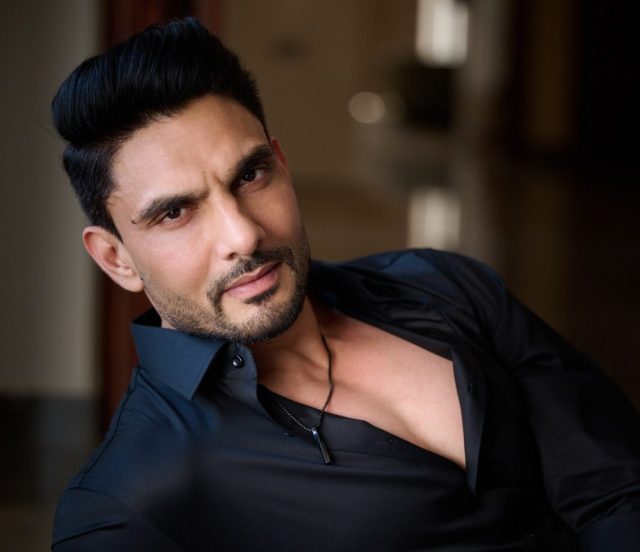
Actor Amal Sehrawat, known for his work across television and films, has shared his thoughts on the evolving dynamics of the entertainment industry, discussing informal bans, industry networking, paparazzi culture, celebrity image-building, and the changing opportunities available for artists today.
 Photo Courtesy Amal Sehrawat Instagram
Speaking about whether informal bans still exist in the industry despite no official acknowledgment, Amal Sehrawat said,
“The industry is witnessing a major shift in recent times. Many international production houses and corporate players have entered the Indian film industry and are actively making films.”
“In this scenario, informal bans become more difficult to impose, as these players view filmmaking purely as a business and generally do not involve themselves in industry lobbies or personal equations,” he added.
However, Amal believes that traditional structures can still influence opportunities.
“Some traditional Indian production houses still have the liberty to impose informal bans, and this can happen whenever their equations with actors change,” he said.
Talking about when networking turns into silent gatekeeping, Amal explained,
“Industry networking is healthy and essential as long as it creates opportunities, collaborations, and meaningful professional relationships.”
“However, it turns into silent gatekeeping when access to opportunities starts depending more on personal circles, favoritism, or lobbying rather than talent, hard work, and merit,” he added.
“The problem begins when deserving individuals are excluded not because of a lack of capability, but simply because they are not part of certain networks or camps. That is where networking stops being constructive and starts becoming a barrier,” Amal stated.
Discussing whether the industry is genuinely more open today or simply better at managing the perception of openness, Amal said,
“The industry is definitely more open today.”
“Many new filmmakers are actively searching for fresh and talented actors who can truly justify a character and fit naturally into the world of the story. Additionally, the rise of new platforms has created far more opportunities and space for fresh talent to showcase their abilities,” he shared. “While challenges still exist, there is certainly greater openness and accessibility than before,” he added.
On the growing paparazzi culture and whether it has crossed the line from coverage into intrusion, Amal shared,
“I believe nobody can completely intrude into an actor’s privacy unless the actor allows that access to some extent.”
He further explained,
“Paparazzi culture has also given actors an additional way to stay in the limelight, and many times paparazzi are invited or informed by an actor’s PR team about their presence at a particular location.”
“Celebrities who genuinely value their privacy usually find ways to avoid paparazzi, not entirely, but most of the time,” he said.
Sharing his observations about how celebrities manage paparazzi attention, Amal added,
“I have also seen celebrity teams use tactics such as blocking cameras with flash or umbrellas to prevent paparazzi from taking pictures when they are uninvited.”
“So, while paparazzi culture can sometimes cross the line into intrusion, in many cases the boundaries are also shaped by how much access celebrities choose to allow,” he explained.
Speaking about whether celebrities still have control over their public image or whether it is largely shaped externally, Amal said,
“Celebrities, not necessarily actors, are often selling an image as much as their work on screen.”
“Their PR teams work extensively to build, maintain, or even reinvent that image whenever required, and social media platforms are used very strategically in this process,” he added. “In many cases, celebrities are carefully guided on how to behave in public, what to say, and how to present themselves in order to strengthen that image,” Amal stated.
He further shared,
“While celebrities do have some control over their public image, a large part of it is also shaped externally by PR teams, media narratives, and public perception.”
Talking about whether controversies in the industry are always organic or sometimes strategically amplified, Amal said,
“The industry is run by smart, intelligent, talented, and highly creative professionals.”
“Most real controversies are usually handled within the industry and do not become public unless the intention is to malign someone’s image, or when a creative individual, driven by emotions, chooses to speak out publicly,” he explained.
Amal added,
“Many controversies are also carefully crafted narratives presented to the public to create curiosity and inquisitiveness. This often helps in image building, maintaining relevance, or even promoting a film.”
“So, not every controversy is entirely organic. Some are strategically amplified for visibility and impact,” he concluded.
Post Views: 25
Other Popular Stories

‘ The preceding article may include information circulated by third parties ’
‘ Some details of this article were extracted from the following source urbanasian.com ’