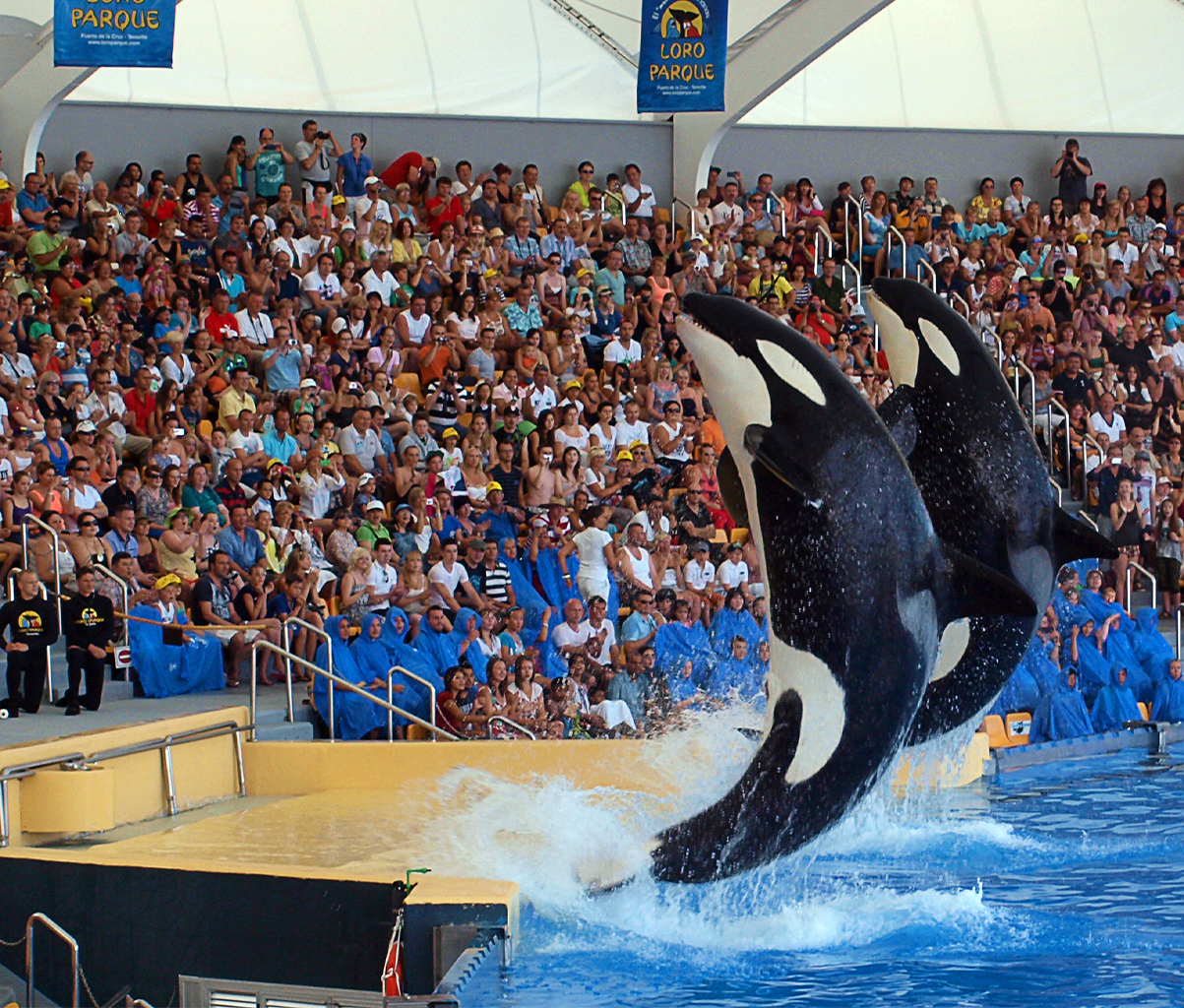
- In May, the French government announced plans to send its last captive cetaceans — two orcas and 12 dolphins — to zoos and entertainment parks in Spain, sparking an outcry from animal welfare advocates.
- France had previously considered sending the marine mammals to an under-construction sanctuary in Canada, but decided to act more quickly because of deteriorating conditions at the shuttered Marineland Antibes park, where the animals are currently housed, according to a French official.
- The dolphins will be shifted to two marine parks in Valencia and Málaga, while the orcas — a mother and son — will be transported to Loro Parque, a zoo and entertainment park in Tenerife, one of Spain’s Canary Islands.
- Animal welfare organizations have criticized the decision, saying they believe the orcas will be used in Loro Parque’s marine shows and bred, which would go against France’s law banning the keeping and breeding of cetaceans for entertainment.
The French government recently announced it has greenlit a plan to send its last captive cetaceans — two orcas and 12 dolphins — to zoos and entertainment parks in Spain. These cetaceans live in the Marineland Antibes park on the French Riviera, which closed in 2025. In 2021, France passed a law banning the breeding and keeping of cetaceans in captivity for entertainment shows, which will come into effect on Dec. 2, 2026. The orcas and dolphins at Marineland were the primary draw for visitors.
The two orcas (Orcinus orca), Wikie, aged 25, and her son, Keijo, aged 12, were born at Marineland Antibes on the French Riviera and spent all their lives in concrete tanks and performing in display shows. They will now be moved to Loro Parque, a zoo and entertainment park in Tenerife on the Canary Islands. The dolphins will be split up between two parks in Valencia and Málaga on the Spanish mainland, with plans for some of them to return to France’s Beauval Zoo, when it’s ready to have them, according to reporting by Le Monde.
A court-appointed expert team found in February 2026 that the concrete tanks in which the orcas lived at Marineland Antibes were in advanced structural decline, and if the mammals weren’t moved soon, they would have to be euthanized.
“Faced with this emergency, we are acting to avert the worst,” Mathieu Lefèvre, France’s minister delegate for ecological transition, said in a statement, explaining the rationale for the decision. “Loro Parque is currently the best viable option for the orcas.” The cetaceans are expected to be transferred as early as June, according to animal welfare NGO World Animal Protection, which has been following the case of the mother-son duo.
Sanctuaries would not be ready in time, France says
Prior to this decision, the French government was considering sending the cetaceans to seaside sanctuaries in Greece, Italy or Canada. A seaside sanctuary is specifically designed to keep once-captive cetaceans in an environment that closely resembles their natural habitat, rather than cramped concrete tanks typically found in marine parks. But since these animals have spent most of their years in captivity, they don’t have the survival skills necessary to live in the ocean on their own, and continue to depend on humans for food and care.
“They will do far better in terms of welfare on a daily basis if they have more natural surroundings as well as human care,” Naomi Rose, a marine mammal scientist at the U.S.-based Animal Welfare Institute, previously told Mongabay. “You put a large, wide-ranging carnivore in confinement, and they are going to, at the very best, develop neurosis, and at the very worst, develop serious health problems.
In December 2025, plans were being finalized to ship the orcas to a whale sanctuary being built off the coast of Nova Scotia, Canada, by mid-2026. The Whale Sanctuary Project, which will cost $12 million to $15 million, was also in talks to welcome some of the 30 beluga whales (Delphinapterus leucas) from another shuttered entertainment park in Ontario, Marineland Canada, which is unrelated to the one in France. But those plans did not materialize, and the Canadian government endorsed a plan earlier this year to send the belugas to U.S. aquariums. In June 2026, local media reported that Oceanogràfic València in Spain, Europe’s largest aquarium, will now receive some of the whales.
In February 2026, Lefèvre met in Paris with representatives from the under-construction sanctuary to learn when it would be completed, according to local reports. But in the May 2026 press statement, the French government said the sanctuaries in Canada, Greece and Italy could not accept the cetaceans within “a timeframe compatible with the emergency situation at Marineland.”

What the future might look like for Wikie and Keijo
Loro Parque, the prospective home for the orcas, currently has four captive orcas used for entertainment shows and research. Two of them were born in the park as part of its breeding program. Recent orca deaths have raised questions about their health and well-being: between 2021 and 2024, four orcas died at Loro Parque. There are also allegations of animal abuse, including using a 4-month-old orca being used in training and shows. While the park has refuted some of the abuse allegations, it has acknowledged the training of the young orca.
It’s unclear if Wikie and Keijo would be bred or used for entertainment in their potential new home. In a public statement, Loro Parque said the transfer “is not driven by economic or commercial interests” and that it is accepting the two orcas out of “moral, technical, and professional responsibility.”
“We do it because we know how to care for these animals and because we want to prevent Wikie and Keijo from dying in France without a real alternative,” Wolfgang Kiessling, Loro Parque Group’s president, said in the statement.
The park has bred orcas as recently as March 2025. Morgan, a wild orca rescued off the coast of the Netherlands in 2010, was shifted to the park a year later. She has had two calves so far, of which one died.
Worldwide, an estimated 3,700 cetaceans live in captivity, most of them in concrete tanks at marine parks and zoos. But public sentiment toward these captive animals has changed in recent years, with movies such as Blackfish and Free Willy depicting the toll a life of confinement takes on these intelligent mammals. It’s also reflected in laws: some 14 countries, including France, have passed regulations to phase out displaying cetaceans for entertainment.
Orcas are listed on Appendix II of CITES, the global wildlife trade treaty, which means their international commercial trade is regulated with import/export permits issued by countries.

Opponents of the proposal express concern for orcas
In April 2025, the Spanish CITES authority rejected a previous proposal to send the orcas to Loro Parque, citing poor conditions. The park challenged that decision in court. Mongabay contacted Spain’s CITES authorities to ask whether the agency has now permitted these transfers, but didn’t receive a response by the time this story was published.
The decision to transfer the orcas is a “systematic failure,” World Animal Protection said in a press release. “If the intent of the French legislation is to be upheld, Wikie and Keijo should not be used for breeding or performances.”
The Whale Sanctuary Project has said marine parks and zoos, including Marineland Antibes, have “refused to even engage in discussion with us.”
“Had the Minister kept his word and supported his own nation’s law to ban cetacean captivity for entertainment and breeding, Wikie and Keijo would have had a different future — a much brighter future,” the Whale Sanctuary Project said in a statement. “Now they will never know what they came so close to having.”
Banner image: Orcas performing in a show at Marineland Antibes in 2013. Image by Andreas Ahrens via Wikimedia Commons (CC BY 2.0).
Spoorthy Raman is a staff writer at Mongabay, covering all things wild with a special focus on lesser-known wildlife, the wildlife trade, and environmental crime.
Belugas facing euthanasia at shuttered Canada theme park may find new homes in US
Singapore resort said to halt controversial dolphin sourcing, breeding
FEEDBACK: Use this form to send a message to the author of this post. If you want to post a public comment, you can do that at the bottom of the page.

‘ The preceding article may include information circulated by third parties ’
‘ Some details of this article were extracted from the following source news.mongabay.com ’