I had heard about the hot chocolate at the Prague Main Train Station before I went. A neighbor, a locally famous half-Romani woman in the Slovak village where I lived, told me I could find the best hot chocolate in the world there.
It’s been decades since I went and had it, but I still remember its rich flavor — I’ve never tasted anything like it before or since. The closest I’ve come was adding cocoa powder and melted good chocolate to sweetened condensed milk, then carefully heating it
A dab will do ya.
As good as that hot chocolate was, it was not the best thing about the Prague Main Train Station.
The best thing was the destination sign — the one that told where the next trains were headed and from which platform to board.
I’ve never seen another sign like it. I understand they replaced it with an electronic version a few years ago. But for decades, they used what was called a split-flap display, a sensory marvel of digital electromechanics.
At various intervals, the whole sign would begin to change, line by line, and all these little cards would half-flip — showing, for the briefest of moments, an array of European destinations before landing on one.
Brno on platform 7. Paříž on platform 11. Vídeň on 2. Budapešť on 5. Mnichov on 3, and Berlin on 14.
I would stand and watch it, sipping hot chocolate, dreaming of Paris, Berlin and everywhere in between and beyond.
It performed an incredible alphabetical dance, but even better than watching it was listening to it. The clitter-clatter of Brno to Budapešť was the most mesmerizing sound I’ve ever heard. It was that near whisper of sound an old clock radio made, going from 10:59 to 11:00 on steroids. It wasn’t loud, but it felt like “sound travel,” inviting me to imagine where I might go next.
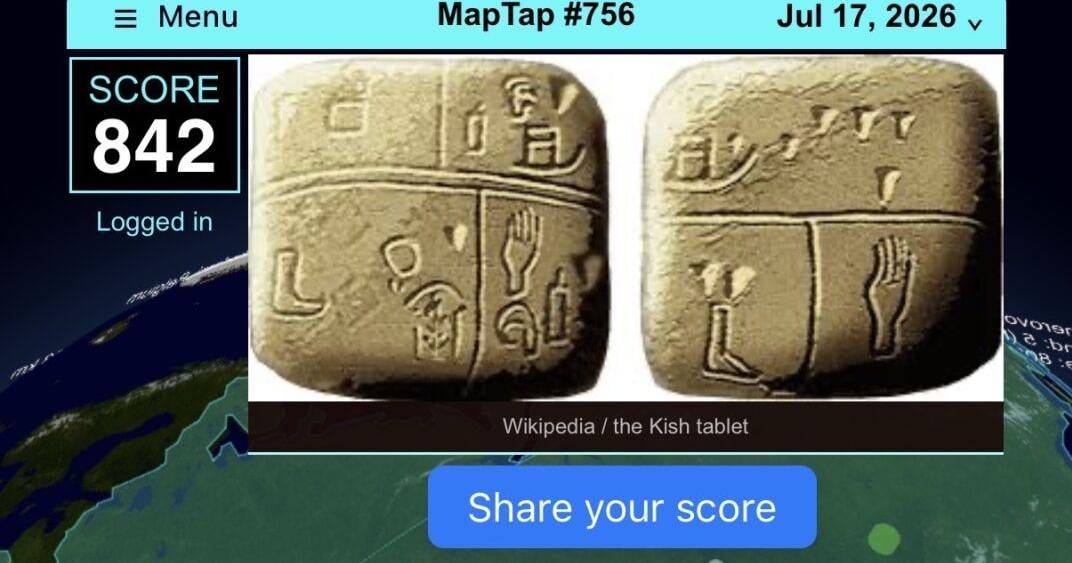
Lately, I’ve had a similar feeling playing a game on my phone called MapTap — a few moments to consider places I know and places I don’t and try to find them on a map.
The MapTap game asks players to pinpoint five specific places around the globe. The closer the pinpoint, the more points earned.
For more than a hundred days, I’ve played it each morning with different groups of friends — from New Orleans, Ocean Springs, Chicago, St. Louis, Kansas City and Denver.
The game asks players to pinpoint five locations on a world map, going from easiest to hardest, with points increasing as the locations progress in difficulty. Some sites I know well. Some sites I’ve never heard of.
The kicker is that the maps have no lines — it’s just the big land masses.
Keith Long, of New Orleans, has been my friend since grade school. He says that playing this game is like looking at the Milky Way when you’re a kid.
“You get that awesome feeling of realizing how vast everything is. India is huge! China is huge! Africa is enormous!” he said. “It’s also extremely humbling. You think you should know where, say, the Philippines are, but once you’re required to put a pin on a map, you realize you may not know at all.”
He’s right.
Without borders, even familiar cities go missing.
One group of “friends” I play the game with daily is my younger daughter and her boyfriend in Denver. They say they’ve become quite competitive, leading them to study maps independently.
My friend James McGuire in Chicago says that MapTap is a morning routine that doesn’t make him feel bad about looking at his phone. He also likes the trivia blurbs tied to each spot, but what surprised him more was what the game has revealed about his blind spots.
We both use rivers and natural landmarks to find places we’re familiar with, but Russia and China don’t have the same easily recognizable hints for us. He also plays Wordle every morning with his college roommate and friends — a habit he’s kept up for years. We put both games in the same category: small rituals that keep us tethered to people we don’t see enough.
I tracked down John Donham, MapTap’s creator. He says the game is a labor of love.
Donham had the idea in 2008 but didn’t begin building it until 2023. Last year, about 3,000 people played. Today, more than 2 million do.
Part of the game’s charm is the stories Donham and his team attach to each place.
“I generally pick the stories first that I think are the strongest. I aim for geographical, gender, cultural and era diversity. I have so many favorite stories it will fill any article,” he wrote.
Parachuting beavers, for example.
When Idaho needed to relocate dozens of beavers into the mountains, they turned them into paratroopers.
There’s Cecil Chubb, who bought Stonehenge.
I asked if he had a favorite story about a place, and his answer explains part of why so many people enjoy the game so much.
“Human history is so full of all these hopeful, joyful moments,” he wrote. “I don’t know that I could pick one. I think that’s part of why the game exists. Because there are thousands of them.”
A thousand miles away, someone I love is dropping a pin on a place we’ve never been, and for a second, I can hear the cards flip.
‘ The preceding article may include information circulated by third parties ’
‘ Some details of this article were extracted from the following source www.nola.com ’