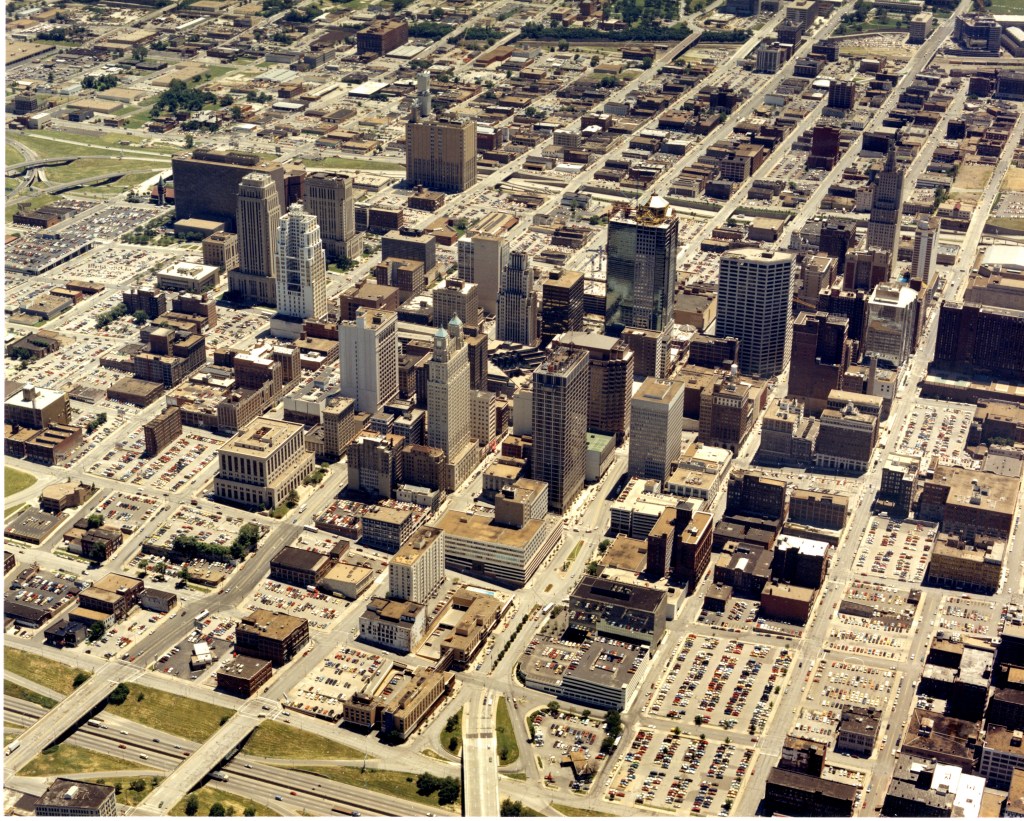
Before the Power & Light District became the hub of entertainment and economic activity in Kansas City that it is today, the area was blocks of unkempt parking lots and empty storefronts.
The district’s overhaul was in part financed through a piece of 2003 legislation called the Missouri Downtown Economic Stimulus Act, MODESA for short. The program expired and stopped taking new applications in 2013, but construction on projects with prior authorization, like the Power & Light apartment towers, continues.
Now, the same program could return and be used for upcoming developments like the Kansas City Current’s riverfront expansion and the Royals’ proposed ballpark at Crown Center.
The updated program recently approved by the Missouri General Assembly allows the expansion of existing developments, two new developments per municipality and an expansion of what taxes can be collected to fund the projects.
Dan Moye, the vice president of land development for the Economic Development Corp. of Kansas City, said the program’s revival would be helpful in tackling some of the same issues the city faced during its first iteration.
“We still have a ton of vacant property downtown,” Moye said. “We still have a lot of aging infrastructure to work through, and so there continues to be both extra costs for large-scale development and revenues that don’t achieve a market return. That continues to be, while different, a similar set of issues to what we were facing 20 years ago.”
An aerial view of Kansas City from the 1980s (Missouri Valley Special Collections, Kansas City Public Library, Kansas City, Missouri).
MODESA’s revival is part of a larger economic development omnibus bill that also would create Missouri Innovation Zones.
Within those areas, municipalities and businesses would be eligible for tax incentives relating to public safety upgrades, office-to-residential building conversions, angel investments, jobs that are relocated or created within the zone and employer retention and reinvestment. Taxpayers in those areas could defer some income tax liabilities when they reinvest into businesses or properties in those areas.
The bill would also create a capital investment tax credit through the Missouri Works program.
The bill received broad support from various economic development groups like Greater St. Louis Inc. and the EDC in Kansas City, which argued that the wide array of new incentives gives developers more tools as they pursue projects.
“I don’t think that any one of these (tax credits) in itself is a silver bullet,” Moye said. “But the ability to address things in different ways from different angles and craft structures that really match up well with the specific development just makes it easier to package a deal that makes Kansas City stand out.”
The bill awaits Gov. Mike Kehoe’s signature or veto. The deadline for decisions on bills this year is July 14.
How MODESA works
For each development project, the process starts with the municipality.
Municipalities apply for projects and select developers through a bid process after receiving approval from the Missouri Department of Economic Development, which administers the program.
The core funding mechanism for those projects works by diverting some of the new state and local tax revenue the development creates to reimburse project costs.
Under the original legislation, projects captured revenue primarily from property taxes and local incomes and sales taxes.
The updated version allows projects to capture 50% of new revenue from state and local income taxes, sales taxes, municipal earnings taxes and other economic activity taxes, such as the corporate tax.
Expanded development projects can capture up to 70% of new state income taxes if the DED determines the project is unlikely to occur without greater state contribution.
Jim Erickson, the director of strategic initiatives for the EDC, said the shift to emphasize more residential and retail taxes was necessary as markets have changed.
“I think in the early 2000s, the value of redirecting some of the taxes related to office development was a lot more lucrative than it is now,” Erickson said. “Now retail and residential make more sense, which is why the legislation’s kind of switched a little bit. That’s just where the market is right now, that’s where the value of it is.”

Fans celebrate and wave American flags as the results of the 2026 World Cup host cities are announced.
Soccer fans react to the official FIFA World Cup host city announcement on Thursday, June 16, 2022, at the Kansas City Power and Light District in Kansas City. (Zachary Linhares/The Beacon)
The program also requires local matches, meaning the municipality can issue bonds and accept payment in lieu of taxes to help fund the developments.
However, developers only receive these reimbursements after the project has proved it generates new revenues.
Sen. Kurtis Gregory, a Republican from Marshall and the Senate bill handler for a standalone version of the MODESA legislation, said during floor debate that payment only after investment was a key part.
“This bill is risk-free,” Gregory said. “The state does not have to put in a single penny, it doesn’t have to invest a single penny. … The private developers have to spend all of their own money, every single part of it, until the end. Only after it is completed and is proven to have generated new state taxes and new sales taxes, then and only then, do they get to share in a percent of those brand new revenues.”
Where could KC see new projects?
The bill allows for the expansion of existing developments and two new ones in eligible municipalities, but has some stipulations on where those projects can be located.
Development areas must be considered a blighted or conservation area and be in a central business district or the downtown area. New developments cannot be within a half-mile of an existing development or in a historic floodplain. However, properties can be exempt from the flood-plain rule if they are floodproofed in accordance with Federal Emergency Management Agency guidelines.
The statutory wording on what constitutes a “central business district” was left vague after language was removed that required the median household income of the area be $62,000 or less and buildings be 35 years or older.
‘ The preceding article may include information circulated by third parties ’
‘ Some details of this article were extracted from the following source www.semissourian.com ’