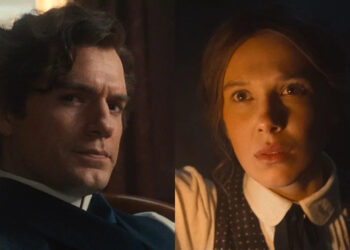
The third installment of Millie Bobby Brown’s addition to the Sherlock Holmes legacy, Enola Holmes, finally hit Netflix on July 1, and the threequel dives into a more mature era of Enola’s life as she ties the knot with Lord Tewkesbury. Don’t get it twisted, though. While there’s an element of romance in the Enola universe, the period piece still thrives on its signature empowering and adventurous storyline. But viewers couldn’t help but be pulled away from the story because of some distracting details in Millie’s on-screen glam and costuming.
When the movie’s trailer dropped back in April, fans noticed that our fearless heroine was rocking a classic natural 2026 manicure with almond-shaped Aprés Gel-X extensions. Others realized her lace-front wig was poorly applied, as her natural hairline peeked through on her forehead. Someone else even criticized Enola’s off-the-shoulder wedding gown and veil during her second-chance nuptials, jokingly adding, “Obsessed with the new Enola Holmes movie not even trying to make her wedding dress look like it’s from the 19th century.”
Millie, who has produced all three Enola films since 2020, even weighed in on the criticism upon the movie’s official release, telling the BBC that she finds “nitpicking” her appearance to be “boring” when there’s a larger narrative at play.
“It’s so boring. I’m like, guys, come on. Like, just enjoy the artistry of the work,” Millie said in the interview published on Sunday, July 5, later adding, “I don’t do that to other [projects]. I’m not the kind of girl to be, ‘Oh my God, did you see the way that wig was laid?’”
Of the reaction to her manicure and hairstyling choices, MBB added, “I wasn’t disappointed…but again, the internet does not surprise me these days.”
Though Nancy Springer’s book franchise was written throughout the 2000s, it’s set in 19th-century Victorian-era England and focuses on historical themes including women’s suffrage, labor rights, and the British Empire. And though Millie rightfully tried to emphasize that there’s more to the role than her appearance, her delivery didn’t quite land with viewers.
“Period pieces fail the second modern beauty standards leak in. Audiences read authenticity through tiny details now,” one person criticized, while another wrote, “If a detail takes you out of the illusion or story then it’s a problem.” Others even argued that hairstyling, nail design, and makeup application are still considered forms of artistry, as the Academy Awards have recognized and awarded glam teams for their efforts since 1982.
As a viewer, I’ve found myself getting distracted by such details—especially in period pieces—being missed over the years. Greta Gerwig’s 2019 adaptation of Louisa May Alcott’s 1860s novel, Little Women, similarly received flak for not being historically accurate in its lack of bonnets and aprons during the American Civil War. Sure, the Marches are a bit unconventional and might argue against certain societal expectations. But they wouldn’t totally dismiss a simple part of their dressing, either.
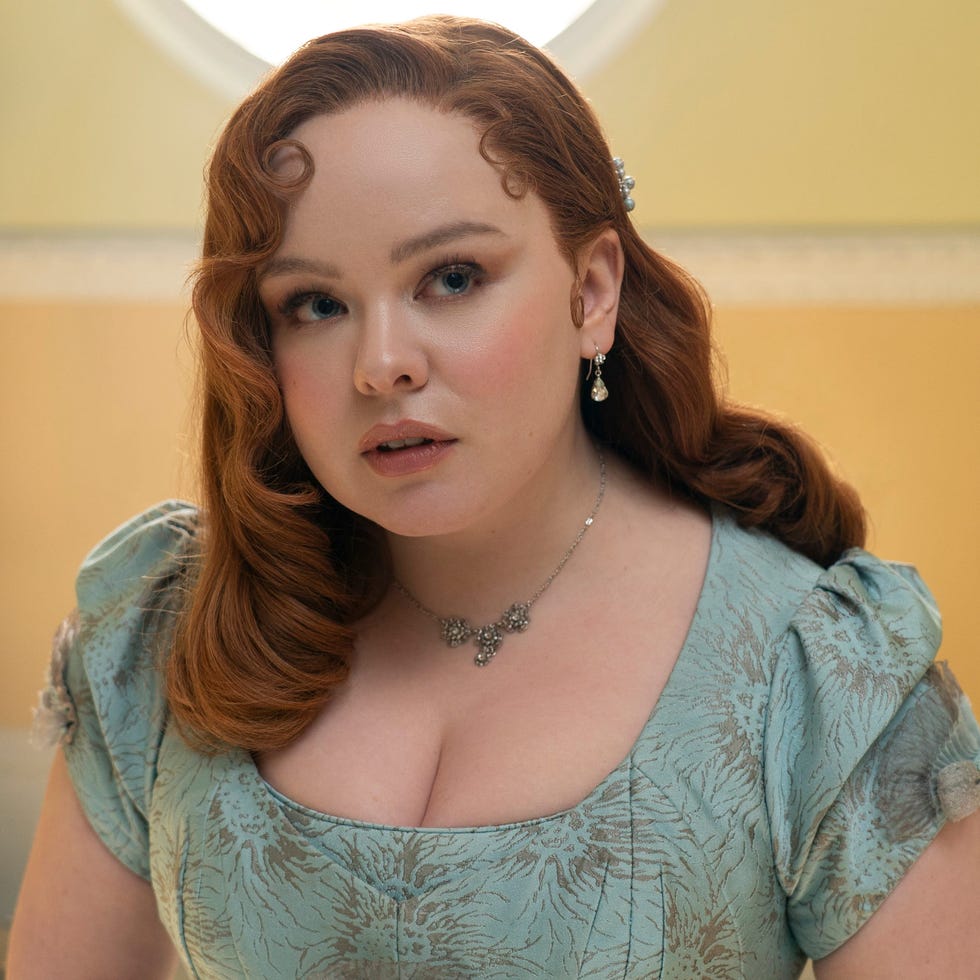
Emerald Fennell’s 2026 adaptation of Emily Brontë’s Wuthering Heights also caused a stir with literature fans, as some claimed her interpretation was a “50 Shades of Bridgerton style distortion of a Brontë novel” with costuming that didn’t necessarily follow the original piece’s historical elements. It’s something that Bridgerton—which isn’t necessarily a period piece, but set in a glossy and modernized version of the Regency era—also misses the mark on. Like, yeah, I am going to notice when Jacob Elordi’s fake sideburns blow in the wind or when Nicola Coughlin is wearing wispy lash inserts and layers of glowy Pat McGrath blush.
To be fair, Bridgerton is fully fictional and meant to sell a fantasy. Fennell also never claimed she was going the historically accurate route when it came to Cathy and Heathcliff’s story, as she told the BBC, “I wanted to make something that was the book that I experienced when I was 14.”

Nicola Coughlin in Bridgerton.

Jacob Elordi and Margot Robbie in Wuthering Heights.
Though Enola takes liberties with certain aspects of the story, it remains a period piece at its core, since it builds off the Sherlock Holmes universe created in the 1800s. The fact is, Millie should be defending her character aside from her appearance because there is so much more to women beyond their looks. The way she approached her take isn’t as powerful as she might have hoped, because she isn’t seeing the audience where they’re at. The main concern wasn’t about her appearance, but the lack of historical accuracy that causes the story to lose part of its integrity.
Folks aren’t wrong to vouch for historical pieces to be treated with the preservation and care they deserve, because there’s a reason such stories are adapted time and time again, from the March sisters’ timeless coming-of-age to Sherlock Holmes’s centuries-old legacy living on through his younger sister, Enola.
‘ The preceding article may include information circulated by third parties ’
‘ Some details of this article were extracted from the following source www.cosmopolitan.com ’