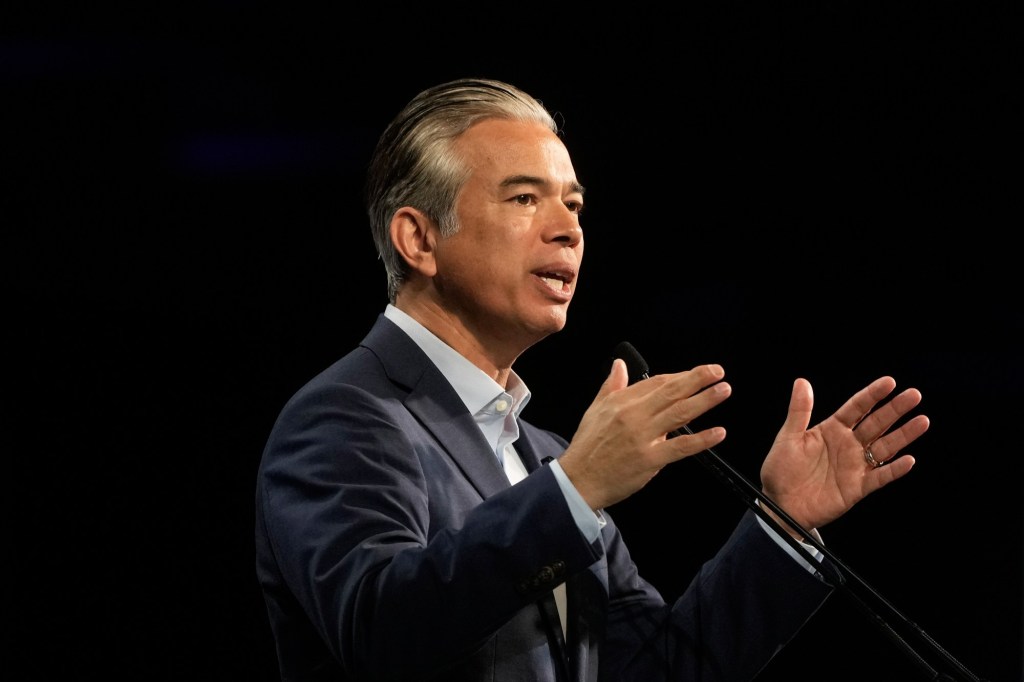
Rob Bonta’s crusade against a big Hollywood merger could have drastic repercussions for the entertainment industry in California. The state’s Attorney General says his lawsuit is to protect jobs, but those might be in New Jersey soon.
Warner Bros. Discovery and Paramount Skydance have agreed to a deal in which the latter will acquire the former for $110 billion. It is a private-sector arrangement with both parties voluntarily accepting its terms. Neither force nor the threat of force was used to complete the deal.
The merger isn’t happening because Paramount is too powerful. It’s happening because the traditional television business is shrinking, streaming competition is fierce, and legacy media companies are struggling to remain profitable.
Yet Bonta and 11 other state attorneys general can’t leave a private transaction alone. They believe the merger violates antitrust law. Whether it actually does is another matter.
Bonta’s office argues the deal would reduce competition, increase prices, and hurt competition by limiting film and television choices. These are serious allegations. The problem is that they rest on assumptions that ignore today’s vastly different entertainment marketplace.
The AGs, who are cheered on by lawmakers, studio executives as well as entertainers, will try to show that the merger will cause substantial harm to competition, consumers, workers and even the economy.
A bipartisan analysis by Stephen Moore of the Committee to Unleash Prosperity and Robert Wolf, who served as an economic adviser to President Barack Obama, reaches the opposite conclusion. They believe the combined companies would be “a stronger competitor in entertainment and media” and would unleash “new investment and dynamism.”
Consumers would have more choices while opportunities for industry workers — filmmakers, writers, directors, actors and theater operators — “would benefit from a revitalized pipeline of films and increased collaboration across the ecosystem.”
Even after combining, the company would compete against Netflix, Disney, Amazon MGM, NBCUniversal, Apple, YouTube and countless independent producers. Consumers have never had more entertainment choices than they do today.
So who’s right?
While competition is often vigorous even when the number of competitors is small, the combined company will still face challenges, say Moore and Wolf. It won’t be able to become a “dominant gatekeeper” because the market is already splintered among strong rivals. The abundance of major studios, independent producers and distributors, streamers and digital-first platforms will allow consumers to move freely across market players “quickly, often at little or no switching cost.”
They also rely on history.
“Mergers and acquisitions are a routine,” they say, and they are also an efficient and vital process for adding “productivity, synergy, profitability, and competitiveness to American companies.” They further increase American shareholders’ wealth and allow U.S. companies to position themselves to outcompete their foreign rivals.
Bonta and his allies are certain that Paramount will become an all-consuming monster, but mergers have produced the opposite of what was expected. History is littered with mergers that failed to deliver the dominance critics predicted, such as the Sears-Kmart union, “Quaker Oats’ acquisition of Snapple, Mattel’s botched buy of the Learning Company, and AOL and Time Warner’s disastrous deal,” says Kimberlee Josephson, an associate business professor of at Lebanon Valley College.
“If even industry experts can’t guarantee the continuation of dominant players or the success of an M&A, then why do government officials and appointees think they can know what will be best for the market?” she asks.
Rather than focusing scarce public resources on violent crime, consumer fraud, or fentanyl trafficking, California’s attorney general is devoting taxpayer dollars to blocking a private business transaction that many economists believe would strengthen competition.
Bonta’s hawkish position might result in Paramount becoming yet another company that flees California due to its hostility toward business. Perhaps the greatest irony is that the lawsuit could accomplish the very thing California leaders say they want to prevent. Semafor reported that Paramount CEO David Ellison’s “confidantes have pushed him to consider moving its corporate headquarters and reallocating much of its $30 billion in planned spending outside the state” if the lawsuit succeeds.
If Paramount ultimately concludes that California’s regulatory climate is too hostile to remain here, Bonta will have no one to blame but himself.
Kerry Jackson is the William Clement Fellow in California Reform at the Pacific Research Institute and co-author of “The California Left Coast Survivor’s Guide.”
‘ The preceding article may include information circulated by third parties ’
‘ Some details of this article were extracted from the following source www.ocregister.com ’