For better or for worse, Star Trek: Strange New Worlds has leaned hard into comedy, and the recent episode “Four-and-a-Half Vulcans” continued that trend with a story of Pike, Uhura, Chapel, and La’an being transformed into Vulcans. The episode was mostly played for laughs, with the uber-Vulcan crew and their awful new personalities bouncing off of Spock and other humans alike. Ironically, this comedic adventure may be one of Star Trek’s most racist episodes because of how it casts Vulcans as jerks on a purely racial level.
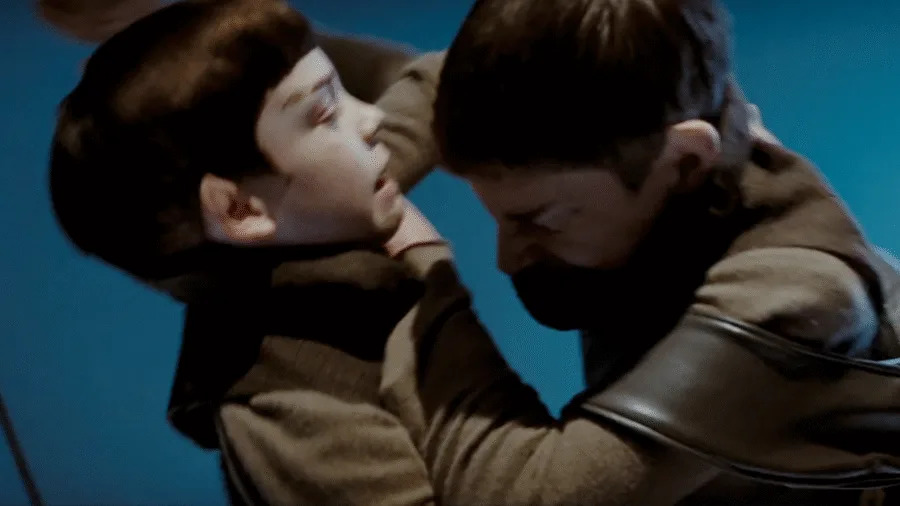
Obviously, the franchise has had plenty of annoying Vulcans, from the obnoxious baseball lovers on Deep Space Nine to the bureaucratic blowhards on Enterprise. Arguably, though, the worst Vulcans were the children we see bullying Spock in Star Trek (2009) over his half-human heritage. In all of these cases, it was conceivable that such bad behavior was an outlier; that it was a big galaxy, and these pointy-eared jerks were the exception rather than the norm.
Vulcan children bully young Spock in Star Trek (2009).
In “Four-and-a-Half Vulcans,” though, Pike and the rest of this transformed crew start acting awful as soon as they are turned into Vulcans. Pike sabotages Batel’s career, Uhura brainwashes her boyfriend, Chapel unfriends the whole ship, and so on. Most concerningly, all of them relentlessly mock Spock for his half-human heritage, just like the hated bullies of his childhood.
I was genuinely shocked: Star Trek just turned Spock’s traumatic backstory into a running gag in a wacky comedy episode. And it did so by confirming that some of our favorite characters, including friendly Boy Scout Pike, would have been bullies if they had been born on Spock’s planet. Forget the nature versus nurture debate: “Four-and-Half Vulcans” confirms that these crew members turned into judgmental monsters simply because they turned into Vulcans.

Vulcan Pike bullies Spock in “Four-and-Half Vulcans.”
To my mind, this is wildly racist because it implies most Vulcans are terribly bigoted towards other aliens because of where they were born. This arguably goes against Star Trek’s famous IDIC philosophy. How can we really buy the whole “Infinity Diversity in Infinite Combinations” thing when the guys who invented it have almost no diversity among their racist perceptions of others?
Now, you may be tempted to point out that Star Trek has given us plenty of good Vulcans, including Spock, Sarek, and even Patton Oswalt’s “Four-and-a-Half Vulcans” character. Notice, though, how each of these characters is marked by very positive associations with humanity: Sarek is an ambassador to Earth who marries a human woman who becomes Spock’s mother. Oswalt’s character, meanwhile, dates a woman he thinks is human (Una) and devotes his life to the study of humanity.

Spock is forced to carry the other Vulcans’ baggage in “Four-and-Half Vulcans.”
The disturbing implication is clear: for all their advancements as a culture, the Vulcans are the galaxy’s biggest jerks, and the only thing that can make them better is spending time around humans. Through this lens, the Federation looks like it is engaging in some good, old-fashioned colonialism, trying to expand human influence and human values throughout the galaxy. It’s worth noting that the Federation of this time period was, as the Klingon Azetbur said in The Undiscovered Country, mostly “a ‘homo sapiens only’ club.”
I’m a big fan of Strange New Worlds, and fellow fans might think I’m taking a silly comedy episode too seriously. But this is one case where comedy is a slippery slope: for example, writers chasing cheap laughs just confirmed that almost every member of Star Trek’s most famous aliens is racist. And now that the post-merger Paramount is making this franchise a top priority, it’s more important than ever for the studio to embrace Trek’s oldest ideals before it muddles them so much that it destroys the brand altogether.
‘ The preceding article may include information circulated by third parties ’
‘ Some details of this article were extracted from the following source www.yahoo.com ’