LOS ANGELES — As a young teen, Shaina Taub remembers being hungry to learn about the women who fought for the right to vote, but her history classes didn’t offer much information.
“I heard about Susan B. Anthony and sort of that one anecdote that gets cherry-picked to be taught to us in school,” she recalled.
Then, when she was 25, a producer gave her the book “Jailed for Freedom” by Doris Stevens, and she was hooked.
“I stayed up all night reading this thrilling, dynamic story about how women were the first American citizens to march on Washington, to picket outside the White House,” Taub said. “They were imprisoned. They went on hunger strikes. It absolutely blew my mind, and I just wanted to try and write the show for my 14-year-old self.”
The show is “Suffs,” Taub’s musical which tells the story of Alice Paul — a central figure in the suffragist movement who spearheaded an unprecedented march of thousands of women in 1913. Taub starred as Paul in the original Broadway production and made history herself, as the first woman to independently win Tony Awards for best score and best book of a musical.
That musical is now in LA, and Taub took a break from playing Emma Goldman in the Broadway revival of “Ragtime” to celebrate opening night at the Pantages.
“The last time I was at the Pantages was almost 30 years ago to see ‘The Lion King’ with my grandparents,” she told the audience after the show.
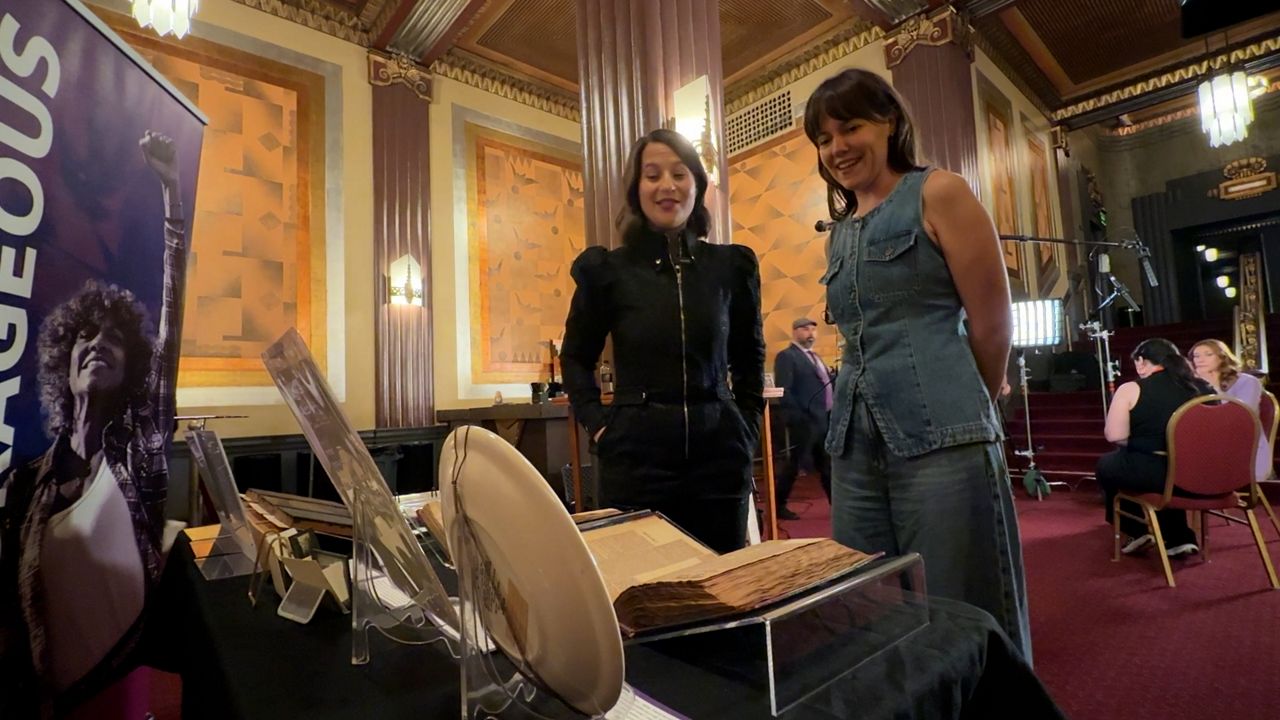
During her visit, she was greeted by a collection of artifacts from the Ebell of Los Angeles, which Ilana Turner, the institution’s senior manager of marketing and communications, says was home to the local suffragist movement.
“The Ebell of Los Angeles was founded in 1894 by Harriet Strong, who was a suff,” Turner explained. “She founded the Ebell … in an effort to give the women of Los Angeles a place to congregate and come together, promote arts and culture, fight for education, and fight for the right to vote.”
“This is really cool,” Taub said, noticing a plate bearing one of Ebell’s mottos: “I will find a way or make one.” It’s a sentiment that’s echoed in a pivotal song in the show called “Find a Way.”
“It’s just about the determination to figure something out,” Taub explained. “I phrase it as a question sometimes of like, how will we find a way? How are we going to do this?”
The answer wasn’t easy. Different groups fighting for the same goal were also fighting each other about how to achieve it. The show also delves into the role Black women played in the movement and how race was included or not. When Paul, capitulating to Southern groups, asks Ida B. Wells to march in a segregated section at the back of the demonstration, Wells sings a stirring anthem, “Wait My Turn.” (She ultimately refused, and marched with her delegation from Illinois.)
Although it mostly chronicles the years between 1913 and the ratifications of the 19th Amendment in 1920, the show also alludes to the decades of activism that led up to those events and the decades of activism before Paul was involved.
“I think you see that cyclical aspect of activism that you have to always keep fighting, and there’s always going to be a new fight,” Maya Keleher, who plays Paul in the touring company said. “They were met constantly with different challenges and had to keep picking up the fight and keep going and that’s just really inspiring to me as a woman and as a person in the world.”
Even now, Taub says, the fight continues, in ways that have become very personal to her. She recently suffered a pregnancy loss that required her to have a life-saving surgical procedure called a dilation and curettage, or D&C — the same procedure used in abortions, which is no longer available in parts of the country.
“It was a revelation to me that miscarriage care is identical to abortion care,” she said. “There are over 20 states in this country where we are forcing women to undergo very dangerous miscarriages and potentially not make it to care on time or have to flee state line. … It’s extremely frightening.”
Shaina Taub and Maya Keleher looking over artifacts from the Ebell of Los Angeles. (Spectrum News/Tara Lynn Wagner)
She also worries about moves by the current administration to control how history is presented. Earlier this year, President Donald Trump signed an executive order that called for, among other things, a review of Smithsonian Institution museums, which he accused of promoting “narratives that portray American and Western values as inherently harmful and oppressive.”
“Who knows? What’s on our stages can be next,” Taub warned. “Because I think people in power know how potent narrative is, and that when people, especially young people, see a story about our past, they get ideas in their head about what how powerful they could be.”
Following the opening night performance, she encouraged the Pantages audience members to come back and bring someone who might be inspired by the actions of the women of the stage.
“Maybe a loud, stubborn little girl you know, who may feel seen by this story that the systems of power in this country would rather she never learn,” she said.
She hopes the lesson they learn from Alice Paul is that you don’t have to wait for conditions to be perfect to fight for what you believe. The perfect time is always now.
‘ The preceding article may include information circulated by third parties ’
‘ Some details of this article were extracted from the following source spectrumnews1.com ’