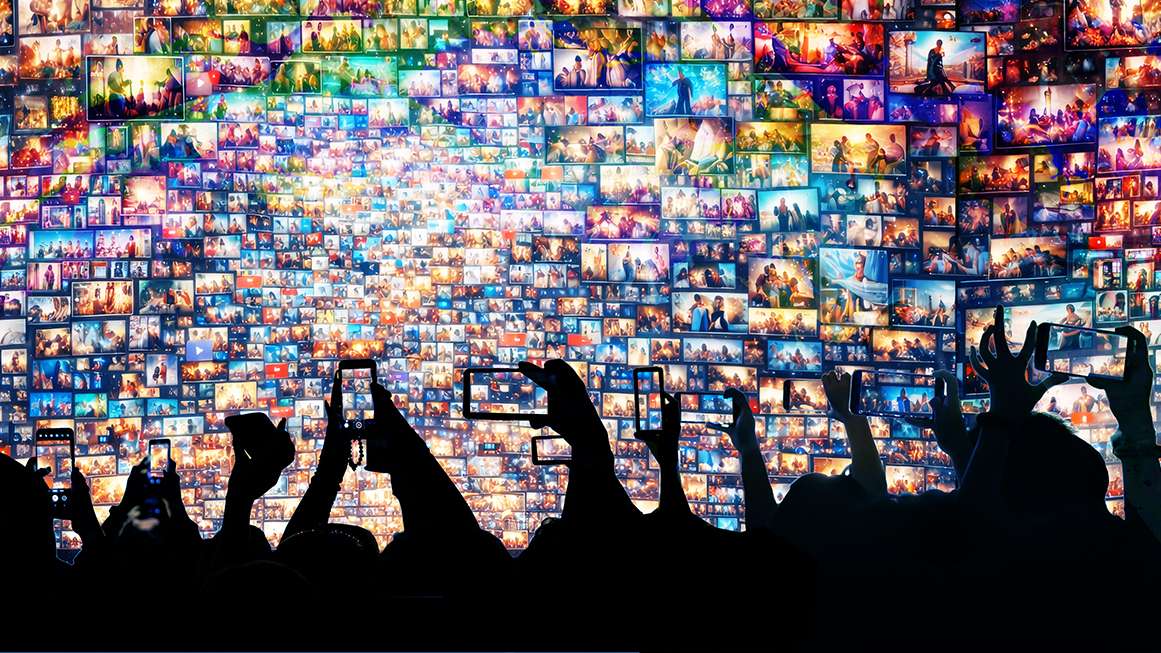
The walls that once separated TV shows, feature films, viral videos, and holiday snapshots are collapsing. All those forms are (or can be) movies, in the original sense of the word: They’re moving pictures. And now they are more and more likely to be moving on the same screens.
This convergence has been in progress for a while. But it crystallized with the announcement last year that YouTube, long associated with phones and laptops, had surpassed Disney to become the company with the most U.S. viewers on television sets. The biggest player in American TV today is a hub where you can rent Hollywood hits, watch pirated sitcom reruns for free, or enjoy thousands of amateur clips in the vein of “Charlie Bit My Finger“—not to mention all the programming posted by YouTube-native celebrities, some of whom attract larger audiences than anyone on celebrity.land or Fox News.
With all those moving pictures packed into the same place, you might find yourself thinking about them as a whole, not as separate art forms with some superficial similarities. Yes, there are differences in their production structure—particularly with TV, a medium with roots not just in cinema but in radio and vaudeville. But they are all part of the same continuum, each influencing the others. And when you examine them as a continuum, the last two decades look different from some of the standard stories our cultural pundits like to tell.
In the 2010s, for example, critics often complained that mature midbudget movies were dying out, their habitat now dominated by superhero blockbusters. But in retrospect, those dramas didn’t dwindle so much as they migrated to other places: Cable TV and then streaming sites made room for artistically serious visual storytelling. In the process, they liberated storytellers from both the more rigid length of a feature film and the more rigid frequency of a network show.
More recently, some critics have bemoaned the end of the so-called Peak TV era. After a long increase, the number of shows started declining, and so did the percentage of those programs that reward close attention rather than serving as dumbed-down background wallpaper (though both numbers are surely far higher now than they were 20 years ago). But the same period saw an explosion of low-budget videos on user-driven platforms, many of them entertaining and some of them bona fide art. The sequel to Peak TV is Peak Content: an age when most of the public routinely carries a device that can shoot a movie and instantly share it with the world, and when new tools have made F/X and editing far easier as well.
It is fashionable to bemoan short-form video today, to damn YouTube and TikTok as trivial, addictive, stupid, and perhaps some sort of Fu Manchu mind-control conspiracy. If you point out that people said the same things about television, one common retort is that those old-school critics were basically right and that things are now getting even worse.
I’d like to suggest something different: that the old-school critics were (sometimes) right, but things are now getting better. Screens today are less passive and more participatory. People can produce their own programming, and can interact more easily with the artists whose creations they consume. While the platforms where these productions appear are more centralized than I’d prefer, the media environment is not nearly as centralized as TV was in the network or even the cable age. And screens don’t even keep you indoors anymore, since they’re highly portable. If kids aren’t going outside as much, that has more to do with overbearing laws and helicopter parenting than with phones.
***
The foes of short-form video trot out Neil Postman’s Amusing Ourselves to Death and similar TV-era texts the way a street-corner evangelist pulls out his Bible. But the three-network era produced another group of social critics whose observations were more interesting and whose work may have more lessons for today. In journals like Radical Software and organizations like the Raindance Foundation, a sometimes brilliant, sometimes cracked, and frequently prescient collection of artists and theorists condemned TV for being too centralized.
When they said that, they didn’t just mean that power was concentrated in a broadcast cartel and in the federal agency that served as that cartel’s guardian. They meant that viewers had virtually no role in shaping what appeared on screen. When Nicholas Johnson, a liberal commissioner at the Federal Communications Commission, published a book in 1970 called How To Talk Back to Your Television Set, one of the Raindance radicals roasted him for thinking the best path to better TV was for viewers to send letters to federal bureaucrats who in turn would pressure programmers to improve their output.
“Striving towards better content on broadcast TV is like building a healthy dinosaur,” Michael Shamberg wrote in Radical Software. “Better to decentralize the medium and get people into using it as their tool. There just isn’t enough time to fool around with changing the broadcast mode of television when decentralized, portable [videotape] systems can and are leapfrogging the old system.” Shamberg topped off his critique of Johnson by declaring that the money spent launching Sesame Street could have instead put thousands of video recording systems into children’s own hands.
Half a century later, countless children (and adults!) have immensely powerful systems for recording and sharing videos. To borrow a phrase from another member of the Radical Software crowd—Gene Youngblood, in his 1970 book Expanded Cinema—we’ve entered “the end of the era of cinema as we’ve known it, the beginning of an era of image-exchange between man and man.”
Granted, the images being exchanged are often banal and sometimes clichéd and conformist. But you could say the same thing about the words people scrawl on pieces of paper, and that doesn’t change the fact that mass access to the tools of writing meant there was more room for masterpieces to grow. In any case, not every video needs to be a masterpiece—they certainly weren’t in the old days of TV or of pre-TV moviegoing.
Indeed, not every artistically successful work needs to be a masterpiece. In 1962, the painter and critic Manny Farber pushed back against the “idea of art as an expensive hunk of well-regulated area,” noting how vibrant expression can be “ruined” when someone feels the need “to spread these small pleasures into great contained works.”
The alternative, Farber argued, was the “termite art” of craftsmen who didn’t set out to make something great-with-a-capital-G but just chewed away skillfully at what was in front of them. Today, TikTok overflows with attractive termite art: a pensive skateboard video with a nostalgic soft-rock soundtrack, a comedy sketch where one actor plays every part, a communally constructed sea shanty.
And sometimes we see something with more heft. Consider the eerie YouTube videos known collectively as Local 58, most of them presented as broadcasts from a fictional TV station in West Virginia. They were made by Kris Straub, the cartoonist and writer best known for the viral horror tale “Candle Cove,” and they have been coming out at irregular intervals for just over a decade now. The most striking is “Contingency” (2016), which invents a comically unsettling LBJ-era government film to be transmitted in the event that the U.S. surrenders to a foreign enemy. It features grainy footage of America, a distorted “Star-Spangled Banner,” and instructions that gradually reveal themselves as a call for the entire country to commit patriotic suicide.
The Local 58 shorts share a mythology, but the storytelling is done more by inference than by narrative, as though we’re poking through a box of documents and slowly putting an account together. Their aesthetic—glitchy, low-fi, with close attention to the textures of different eras and different technologies—offers an evocative mixture of nostalgia and dread. They owe an obvious debt to found-footage horror films, but they are much more experimental in both form and content.
The Blair Witch Project, the movie that brought found-footage horror into the mainstream in 1999, marketed itself with fragments of text and video planted in different intersections of the internet, each one extending the story or setting. Local 58 takes that a step further, as though Blair Witch consisted entirely of those ancillary materials with no theatrical film at its core. You can watch its constituent parts in any order, can choose whether to explore related materials around the web. It’s an approach to video storytelling that did not really begin to emerge until this century.
***
A quarter of the way into that century, yet another new force is now upending the video environment. There are legitimate fears about the ways Hollywood studios might deploy artificial intelligence stupidly, using AI to replace the most irreplaceable human creators and to crank out sloppily executed formula stories. Yet from the perspective of artists outside the studios—people hoping to keep creativity in the driver’s seat but looking for ways to automate tasks that once were prohibitively expensive—AI could make it easier to realize their visions.
Paul Schrader, the director of Mishima and screenwriter of Taxi Driver, made the bullish case for AI filmmaking in a February Facebook post, predicting that soon “a savvy student will be able to create a 90min narrative in 2–3 weeks. On zero budget. Without leaving home. Without anyone’s permission. The originality of the story would determine the value of the product.”
If you’re skeptical, I understand. Most of what the average viewer knows about these tools’ capabilities comes from demo reels circulated by people whose talents are in tech development, not art or entertainment. And as this essay goes to press, that impressive 90-minute narrative has yet to surface. But if nothing else, we need to distinguish the dumb ways AI can be used as an institutional tool from the smart ways it will be used as an individual tool.
I know that AI can be wielded to make genuinely interesting art, because I’ve seen at least one genuinely interesting piece of art made with AI. Mark Wachholz’s The Cinema That Never Was (2025) is a compendium of moments from old movies that never existed. Every shot is beautifully composed, and every shot seems to suggest a haunting tale from a parallel timeline; at times it feels less like a compilation of clips from forgotten films than a compilation of clips from half-remembered dreams. Each of those fragments lasts just a few seconds, which not only intensifies the video’s hypnagogic flavor but ensures that each scene is cut off before continuity starts to break—a sign we’re dealing with an artist who’s aware of AI’s current limitations and is wisely working within them.
Well, mostly within them. The video’s one substantial flaw is its faux-poetic narration, which feels overwrought and repetitive: a reminder that one thing AI still isn’t good at is composing compelling prose.
Each of the developments sketched above was shaped by institutional forces, not just changes in technology. The rise of streaming video may have guaranteed some sort of boom in serialized storytelling, for example, but the particular boom we got in the 2010s owed a lot to the Federal Reserve’s zero-interest-rate policy, which stimulated risky investments and blew a bubble. Similarly, what AI does to movies will depend a lot on the policies that shape AI, from energy regulations to intellectual property laws. The emerging media environment can be more or less centralized, more or less regulated, more or less open. None of this is inevitable.
But the larger shift will be very hard to undo, short of a police state shutting down the internet entirely. We are surrounded like never before both by in-depth, complex dramas and by termite art that you can watch while waiting for the bus. And we are able like never before to add our own moving images to the flow.
The post Swarms of Termite Moviemakers Have Made Cinema More Personal appeared first on Reason.com.
‘ The preceding article may include information circulated by third parties ’
‘ Some details of this article were extracted from the following source www.yahoo.com ’