Spoilers below.
Are dreams worth pursuing at any cost?
Back in 2006, The Devil Wears Prada posed that question, chronicling the journey of Andrea “Andy” Sachs (Anne Hathaway), a plucky, eager-to-please millennial who couldn’t get hired for the kind of “serious” journalism job she longed for, despite her fancy degree from Northwestern University and impressive portfolio. Through hilarity and happenstance, she instead became a low-level assistant to Miranda Priestly (Meryl Streep), the villainous editor-in-chief of Runway magazine. Hijinks ensued, and, ultimately, the hellish experience helped Andy get the glowing reference from Miranda that would cement her path forward as a newspaper reporter.
True to the rom-com genre, the original film is wrapped in a bow of optimism, suggesting that while hustle culture may be costly—to one’s health, relationships, sanity, etc.—rest assured, it does pay off in the end. If you were berated by your boss, chronically underpaid, or downright exploited along the way, that’s just the price to be paid for Following Your Dreams™.
Twenty years later, though, the sequel doesn’t seem so sure.
In The Devil Wears Prada 2, we learn that over the last two decades, Andy realized her dream of being a globe-trotting, award-winning investigative journalist. In fact, she’s in the middle of taking home yet another accolade when she and her entire team of editors and writers are axed due to budget cuts—via text. This opening scene illustrates the painful conundrum many working professionals find themselves in, at one point or another: You can be incredibly talented, do everything right, receive recognition from your peers, and still be on the chopping block. (And, in Andy’s case, she didn’t even have clean, running water in her dilapidated apartment to come home to.)
Andy tells her BFF Lily (Tracie Thoms) that everyone she knows is experiencing some kind of personal and/or professional tumult—layoffs, consolidation, burnout—all while attempting to tick off the life milestones we were always taught to prioritize and pursue: marriage, homes, kids. It’s a sentiment that deeply resonates for those of us raised for a world that no longer exists. For millennials like Andy, and Gen Z especially, job security is a thing of the past, buying a house and starting a family is more fantasy than reality, and sociopolitical upheaval is hindering our ability to plan for the near- or long-term.
This is a new world, and no one is safe.
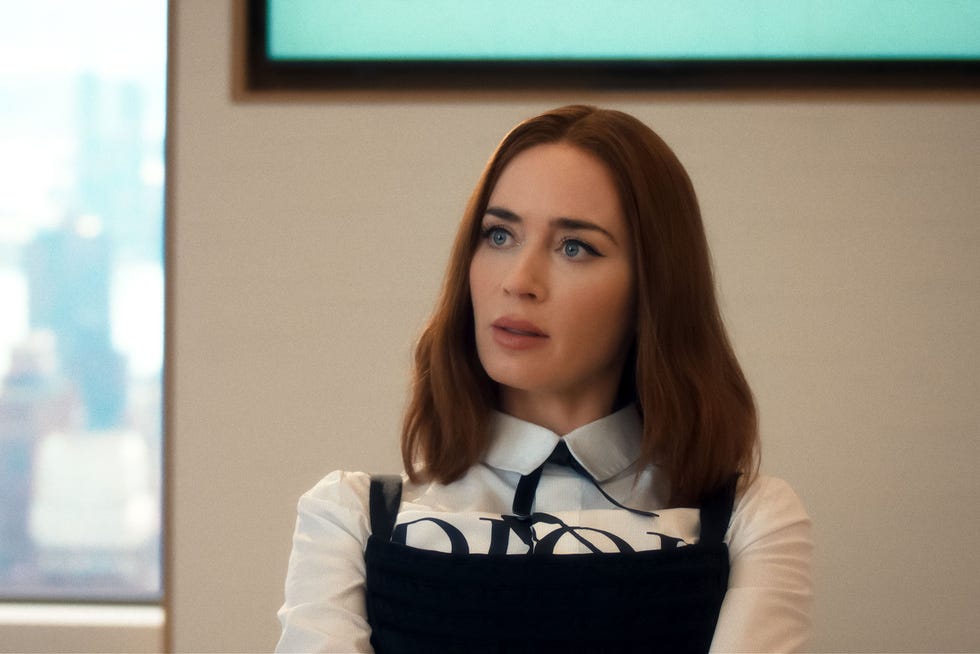
Even Emily (Emily Blunt), the once-faultless first assistant, is cracking. Though she seems to have risen to the upper echelons of the fashion world as a high-powered exec at Dior, the reality is a bit sadder and, quite frankly, darker. After leaving her marriage to “a pathological narcissist”—but still having to co-parent two kids with him—she dates the ick-inducing billionaire Benji Barnes (Justin Theroux), who she later admits was no more than an ideal “patron.”
The sequel provides striking portraits of two women who pursued their respective dreams and achieved them, only for careers to crumble and marriages to fall apart. Andy never married and has frozen her eggs, presumably until she can afford to have kids either solo or coupled; Emily, meanwhile, seems legitimately traumatized from both her marriage and her fraught departure from Runway to Dior.
Both women pursued and attained their dreams. Then things fell apart, as they do.
Who “won”? Does it matter?

Anne Hathaway as Andy Sachs.
In the sequel, Miranda, steely and scary as ever, makes a comical, somewhat noble effort to be more politically correct in the office. She hangs up her own coat now, too, because of various HR complaints over the years. She’s up for a major promotion at Runway’s parent company, but when the CEO dies suddenly, his self-serving son takes the reins. Miranda stumbles into the rather unchic position of having to placate a billionaire bro who’s half her age, just to keep her job and ensure the magazine’s future.
While Miranda never overtly grovels, the power dynamics between her and Jay Ravitz (B.J. Novak) probably feel painfully familiar to many women who are perpetually maneuvering around aloof, entitled men in the workplace and beyond. These Kendall Roy-esque types, who quite literally inherit their power, money, and influence, can (and do) get away with so much more than women ever could or would.
If the original movie was both an acceptance of and ode to millennial hustle culture, the sequel softens that argument. The rise-and-grind, no-days-off mentality hasn’t completely disappeared; it’s merely evolved, because people today have to fight harder for fewer and fewer opportunities. And while most of us know this relentless hustle isn’t exactly healthy, by nature of operating in late-stage capitalism, it’s kind of, well, necessary.
At the very least, the sequel offers a word of caution. In one of the final scenes, Miranda and Andy are in a Maybach after securing the Elias-Clarke takeover deal with Sasha Barnes (Lucy Liu). Miranda reveals that she knows about Andy’s six-figure deal to write an exposé about her. Not only does she encourage Andy to write the book, but she also instructs her to include all of the unflattering details, to not leave anything out. She’s impatient. She’s imperious. She’s missed a lot of her kids’ lives. “People should know there’s a cost,” she tells Andy.

Meryl Streep and Anne Hathaway in The Devil Wears Prada 2.
Miranda’s confession is a departure from what she told Andy 20 years ago in Paris: “Everybody wants this.” Even if that were true, she’s finally admitting that being a trailblazer requires sacrifice. She crystallizes what women know in our bones, but sometimes shy away from discussing openly, often out of shame or fear of judgment. We understand that hard work and hustle may “pay off” in the end, but that there are costs to securing the “dream” job, the “dream” marriage, the “dream” house, the “dream” family.
Whether it’s defending how we handle our choices around marriage and motherhood, dealing with discrimination and unequal pay at work, or managing poorer health outcomes, the price of getting to—and staying at—the top as a woman is incredibly steep. And yet, as of 2025, just 11 percent of Fortune 500 companies were run by women. The 119th Congress was made up of 28 percent women. Considering we make up half of the population, more change needs to happen to truly level the playing field for everyone who wants a shot at the dream, whatever that means to them.
Of course, none of this is to say that dreams are futile. Miranda adds that despite the costs, she still loves her work. After all this time, it’s clear Miranda’s strength and success stem from her ability to hold these two truths together: Dreams are costly and you get to decide whether those costs are worth it.
‘ The preceding article may include information circulated by third parties ’
‘ Some details of this article were extracted from the following source www.elle.com ’