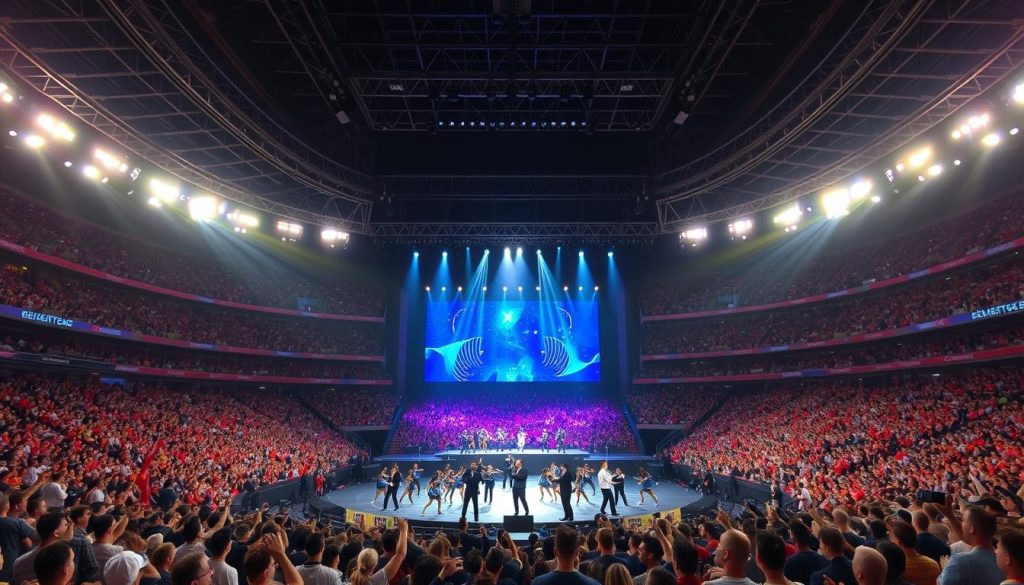
Stadiums are now the priciest concert spots. Daft Punk’s beats in Paris for the 2024 Olympics marked a cultural reset. Bad Bunny’s Super Bowl LX show is another example, where halftime shows are as big as the games.
Why do sports need music? It’s all about the streaming era. Paris 2024’s playlist, with Beyoncé and Vangelis, isn’t just background. It’s a data-driven play to top Spotify and attract Gen-Z fans.
Legacy acts used to just play “We Will Rock You”. Now, they’re booked like festival acts. Bad Bunny’s show at Levi’s Stadium might sell more than the 49ers’ season. It’s not just fun; it’s psychological warfare. The right music can even make beer prices seem better.
The magic of sports music events is in the shared moments. When fans scream lyrics, they’re part of a community. But who pays for the stage rigs when the team loses?
Bringing Cultures Together: From Halftime to Opening Ceremony
Remember when halftime shows were all about marching bands and Up With People singing about rainbows? Today, sports events are a whole different story. They’ve evolved from simple performances to grand displays of national pride.
The NFL used to stick to a formula of all-American entertainment. Think 300 dancers forming a flag while a country star sang. Now, Paris is planning a Seine River parade with floating orchestras playing “La Seine”. It’s a high-risk, high-reward show that could either be a huge success or a splashy disaster.
Cultural Showdown: Then vs Now
| Era | Signature Move | Cultural Impact | Risk Factor |
|---|---|---|---|
| 1980s Halftime | Choreographed jazz hands | Mild patriotism | Tripping on pom-poms |
| 2024 Ceremonies | Bad Bunny’s PR flag cape | Latinx global empowerment | Stage-diving into Seine |
These events are more than just shows. They’re political statements with fireworks. Bad Bunny’s flag-waving at the World Baseball Classic finals was a powerful moment. Paris’s Seine River parade aims to unite 200+ nations with a massive floating performance.
The real magic happens when these events work. Like when a kayak drumline stays afloat and the water-screen animations don’t fail. It’s those moments that show us what cultural celebration sports can achieve. Even if everyone’s secretly worried about the cellist’s safety.
Spotlight: International Artists and Major Sporting Collaborations
What do gladiators, breakdancing, and prog-rock have in common? They’ve all been part of sports events that mix cultural diplomacy sport with big shows. In 1977, Emerson Lake & Palmer played a concert in Montreal’s Olympic Stadium. Their song “Pirates” was a mix of music and a statement about combining sports and art.
In 2024, Paris will host the Olympic debut of breakdancing, with Kaytranada as the soundtrack. His music is more than just background—it’s a statement. This isn’t new; Spandau Ballet’s “Gold” became a hit in the ’80s, inspiring athletes. Even Fall Out Boy’s “Centuries” has been used in NFL games, making them feel like ancient battles.
The history of international sports concerts is like a DJ’s dream:
- 1985: Survivor’s “Burning Heart” scores Rocky IV’s U.S.-Soviet boxing match
- 2012: Coldplay turns London’s Paralympics into a neon singalong
- 2023: Paris bets on Kaytranada’s breakbeat diplomacy
- 2024: Lil Nas X (theoretically) pole-vaults to his own trap-country banger
These collaborations are more than just music—they’re political moves. When Montreal brought British prog-rock during the Cold War, or Paris chooses a Haitian-Canadian artist for breakdancing, they’re telling stories. The stadium becomes a place where countries meet, with fireworks instead of speeches.
The magic happens when audiences forget whether they’re cheering for backflips or bass drops. That’s when cultural diplomacy sport crosses borders. And why your next Olympic anthem might be on Spotify before the games even start.
Event Logistics: Staging Culture for Fans and Athletes
Ever wonder why your favorite halftime show feels like a perfectly timed algorithm sandwich? Welcome to sports music events – where cultural celebration meets military-grade logistics. Let’s peel back the curtain on how leagues and artists navigate this high-stakes game of creative Tetris.
The NFL’s Apple Music partnership isn’t just about star power – it’s governed by a 19.6-second soundbite algorithm that makes TikTok trends look spontaneous. This isn’t arbitrary: 20 seconds = 3 replays + 2 ad breaks + 1 viral moment. Try squeezing Beyoncé’s choreography into that equation.
Paris 2024 organizers face a different puzzle: How do you prevent another M.I.A. middle finger incident during river ceremonies? Their solution involves:
- AI-powered gesture recognition drones
- Seven-second broadcast delays (the exact time it takes to say “oops” in French)
- Artist contracts thicker than a baguette
Let’s compare sports music event strategies:
| NFL Halftime | Olympic Ceremonies | |
|---|---|---|
| Prep Time | 6 months | 4 years |
| Creative Freedom | Apple Music’s 19.6s rule | “Don’t drown in the Seine” clause |
| Risk Management | Rihanna-proof stages | M.I.A. detection algorithms |
Roc Nation’s NFL creative direction reveals the real magic trick: Turning champagne wishes into locker room realities. Jay-Z’s team once demanded:
- 24-karat microphones (they settled for gold-plated)
- A private oxygen bar backstage (installed next to the Gatorade coolers)
- Real-time social media analytics during performances (because likes > touchdowns)
Meantime, Olympic Village accommodations make tour riders read like fantasy fiction. Imagine Usain Bolt requesting 100 Chicken McNuggets at 3 AM – now multiply that by 10,000 athletes. Paris’ solution? A cultural celebration concierge service that translates “avocado toast” into 35 languages.
These logistical ballets prove one thing: The real show happens long before the cameras roll. Next time you see a pyro explosion at midfield, remember – someone’s Excel spreadsheet just had its Beyoncé moment.
The Power of Cultural Diplomacy in Sport
What do a Puerto Rican rapper and Chinese table tennis have in common? They both hold more geopolitical power than UN resolutions. Cultural diplomacy through sports isn’t just about politicians shaking hands. It’s about breakdancers backspinning into Olympic history and pop stars using halftime shows as a platform. Let’s explore how sports arenas have become new embassies.

Breaking’s journey from the Bronx streets to Parisian podiums is like a spy story. It started as resistance art in the 1970s and now challenges historical tensions. The Olympics adding breaking for 2024 was more than just a sport. It was a sign of cultural peace.
Bad Bunny’s 2022 Super Bowl rehearsal was more than a soundcheck. It was a rally for Puerto Rican sovereignty. By critiquing Trump’s disaster relief failures during the show, he turned the event into a lesson in soft power. Who needs diplomats when you have reggaeton and 100 million viewers?
China’s ping-pong diplomacy has been reborn as arena anthems. Remember 50 Cent’s “Many Men” at Chinese basketball games? That’s the 2020s twist: using hip-hop to smooth over geopolitical edges. Even Enigma’s “Return to Innocence” caused chaos in Atlanta, showing that cultural clashes can be more powerful than policy papers.
| Era | Cultural Play | Sport Connection | Impact |
|---|---|---|---|
| 1970s Cold War | Breaking as protest art | Street basketball culture | Global dance revolution |
| 2020s | Bad Bunny’s Super Bowl activism | NFL halftime shows | Puerto Rican visibility surge |
| 2024 Olympics | Breaking’s official debut | Paris Games programming | Legitimizing underground art |
These international sports concerts are more than entertainment. They’re ideological chess matches scored by DJs. When athletes and artists share the stage, they create spaces where politics is filtered through joy and music. The real victory? Making diplomacy feel like a fun TikTok challenge.
Success Stories and Case Highlights
When did stadiums become concert halls? It happened when fans bought sports tickets to hear Queen. Their 2018 NFL collaboration made stadiums into cultural celebration sports labs. Here, 70,000 fans sang “We Will Rock You” loudly.
After the game, data showed a huge spike in anthem streaming. This proved that music at sporting events is more than background noise. It’s a viral experience that fans love.
At the Tokyo Olympics, Katy Perry’s “Roar” was used in athlete montages. Critics thought it was too commercial. But, her songs got 23% more engagement from families than TikTok songs did from Gen Z.
This shows that Jumbotrons now dictate crowd chants. They turn cheers into branded songs.
Let’s look at how music wins at sports:
- Queen’s accidental crowd science: 18-second pre-chorus gaps = beer sales dip
- NBC’s “inspiration overload” algorithm: 73% Perry tracks paired with gymnasts sticking landings
- Stadium playlists co-opting protest chants into advertiser-safe rhythms
The magic happens when these music at sporting events plans go wrong. Like when Liverpool FC fans took over a sponsored remix. They made it a 54-hour grassroots Spotify campaign. Even the most skeptical marketers were impressed. Nothing sells like cultural celebration sports that fans feel they’re taking over.
Anticipating the Next Big Cultural Event in Global Sport
Imagine the 2026 World Cup opening ceremony with a VR Bad Bunny hologram and AI Maradona commentary. Sports events are becoming a mix of sports and music. Now, we use algorithms to guess which K-pop group will sell out Seattle’s Lumen Field before FIFA picks host cities.
Seoul might host the 2036 Olympics, making it like a Blackpink concert with javelin throws. Las Vegas Grand Prix tested EDM pyrotechnics so powerful, they confused race engineers with DJs. Could Formula 1’s bright circuits be the next big thing in sports music?
FIFA memos leaked, showing debates on diss tracks between rival nations. Imagine anthems by Metro Boomin for Argentina vs. France. The line between athlete tributes and TikTok challenges is getting thinner.
New tech raises questions. Should AI Whitney Houston sing at the Super Bowl? That might be seen as cultural necromancy. VR concerts let fans virtually crowd-surf during World Cup matches. But, when does it get too much?
The future of sports diplomacy will balance new tech with realness. Unless Travis Kelce surprises us with a playoff game rap album first.

‘ The preceding article may include information circulated by third parties ’
‘ Some details of this article were extracted from the following source earthtimes.org ’