The iconic Grand Ole Opry has been around for a century, and as the institution celebrates its big birthday, The Tennessean is taking a look back.
The long-running radio show has become one of the most respected stages and platforms for country music, inviting both guest performers and Opry members to its stage at Nashville’s Grand Ole Opry House.
Opry membership is a coveted honor reserved for artists who’ve shown a commitment to country music and the Opry over the years.
Right now, there are 74 Grand Ole Opry members, including Garth Brooks, Luke Combs, Reba McEntire, Dolly Parton and Darius Rucker. And while Opry membership invitations are highly coveted, they hold all performers to high standards.
100 years of the Opry: Relive the Grand Ole Opry’s top moments with our collector’s edition book
Since 1925, there’s been a handful of performers who’ve been asked not to return to the Opry, having either their membership dissolved or their regular performances halted.
Here are six artists who have been banned — both temporarily and permanently — from the Opry stage.
Johnny Cash
In 1965, Johnny Cash drunkenly took the stage at the Opry and smashed out the lights on stage with a microphone stand.
The Opry had been wary of Cash’s rebellious ways for some time, but this was the final straw.
“I don’t know how bad they wanted me in the first place, but the nights I broke all the lights on the stage with the microphone stand, they said they couldn’t use me anymore,” Cash later said.
“So I left and used that as an excuse to really get wild and wound up in the hospital with my third time I broke my nose.”
Cash and the Opry mended their relationship in 1968 and he remained a member until his death in 2003.
Johnny Cash: Farewell to the Man in Black, 16 years later
Hank Williams, Sr.
Hank Williams, Sr. was banned from the Opry in 1952 after a slew of missed performances due to his struggles with alcoholism.
His unreliability led to disruptions in the Opry program, and eventually, the radio show fired him.
Williams died in 1953 at the age of 29 from a heart attack caused by heart failure, which was due to a combination of drugs and alcohol in his system.
Though Williams is known as one of the most iconic country performers of all time, his Opry membership was never posthumously reinstated — but not without a lack of trying. Williams’ family members even led a “Reinstate Hank Campaign.”
“Hank Williams will always be a treasured past member of the Grand Ole Opry,” said Opry Vice President Dan Rogers in 2020.
“The Grand Ole Opry is made of living, breathing artists who can contribute to the show, and to whom the Opry can give back.”
Jerry Lee Lewis
Renowned rocker Jerry Lee Lewis was banned from the Opry in 1973 after a performance that broke a handful of Opry rules.

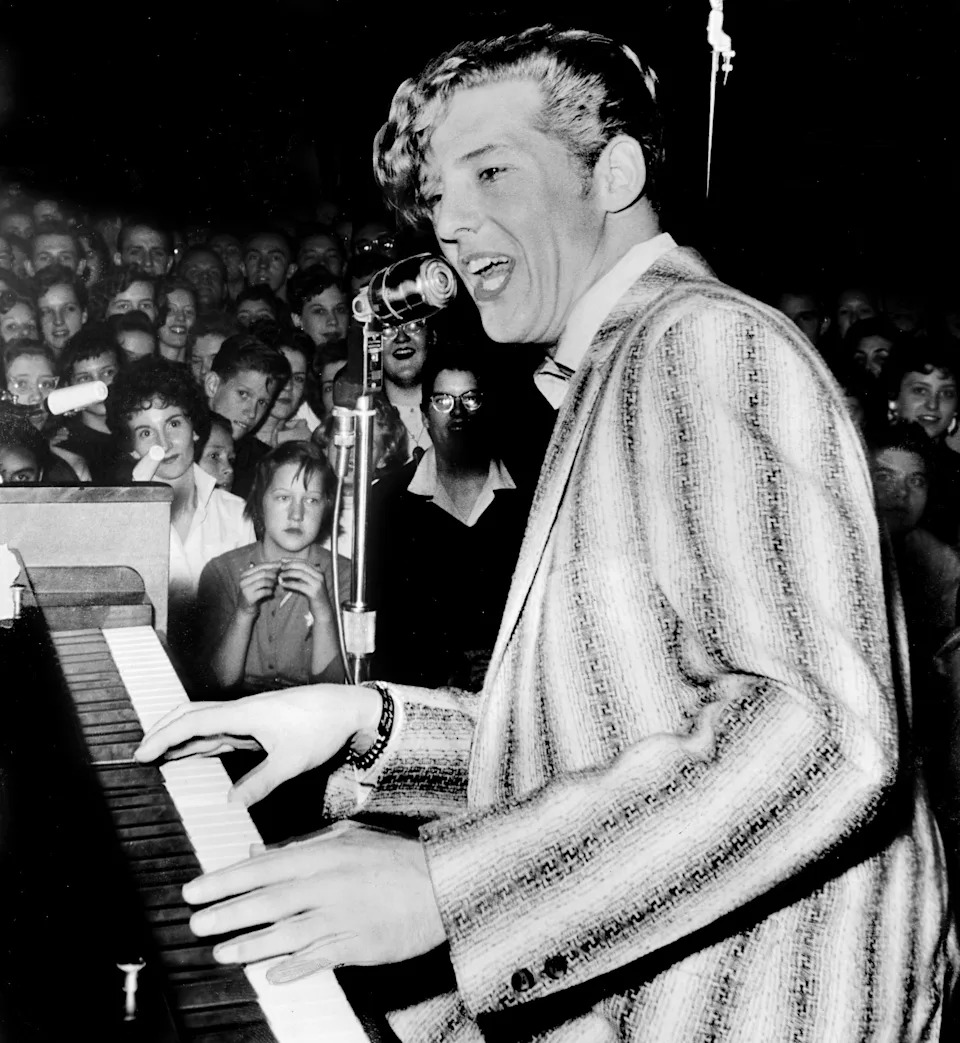
Jerry Lee Lewis, young rock and roll prince, bellows there’s a “Whole Lot of Shakin’ Goin’ On,” on Jan 18, 1958, during the Record Hop show at the Tennessee State Fairgrounds Coliseum in Nashville.
He played rock ‘n’ roll — a no-no at the time — dropped the f-bomb, performed for 40 minutes instead of his allotted smaller time slot, and ignored the show’s built-in commercial breaks.
The “Great Balls of Fire” artist was never an Opry member, but after his raucous performance, he had no shot at membership. Lewis was not invited back to the Opry stage.
Skeeter Davis

Skeeter Davis is performing for the audience during the Opry Spectacular show at the Grand Ole Opry House on Oct. 16, 1975.
Skeeter Davis was banned from the Opry after a 1973 performance where she spoke out against the Nashville police for arresting street preachers.
Law enforcement had detained 11 preachers that were approaching shoppers at a local mall.
“I felt so unloved when I got kicked off the Opry,” Davis later told CMT. “I’m childlike in many ways. It seems to me I’ve been a rebel all my life, too.”
A year later, Davis was invited back to the Opry and the ban was dissolved.
Neko Case
Indie-rocker Neko Case was asked not to return to the Opry in 2001 after performing at the Opry Plaza Party in the dead of summer.
Case was suffering heat stroke during the show and had asked for water as she performed. When she could no longer handle the heat, Case removed her top, revealing her bra.
She was banned from the Opry for life.

Neko Case performs Saturday, Sept. 26, 2015, at the Pilgrimage Music and Cultural Festival in Franklin.
“There was nothing ‘punk rock’ about being kicked off the Opry,” Case told Rolling Stone in 2015. “I was having heat stroke, trying not to barf or pass out. It just sucked. It was a perfect storm. There is no awesome, ‘I stuck it to the man,’ story behind it.”
Case said playing the Opry “mattered very much” to her. ” I will never play in that town again, according to them,” she said. “I’m happy just to play the Ryman. It’s the greatest-sounding venue, and that’s really what matters to me.”
Dierks Bentley
Before Dierks Bentley rose to fame as a country singer, he worked as a researcher at The Nashville Network (TNN), which was near the Opry.
Since he was close by, Bentley would sneak into the Opry and watch shows on weekends and socialize with performers.

Dierks Bentley performs during the Let Freedom Sing! Music City July 4th event in Nashville, Tenn., Friday, July 4, 2025.
“Eventually I got a letter at work saying, ‘Hey, we love Dierks, but he can’t come to the Opry every single weekend,'” he told Taste of Country in 2023. “So I knew the only way to solve that was to become a member, which I was lucky enough to do.”
Later on, the Opry extended an olive branch to Bentley and invited the singer to the stage.
Bentley became an Opry member in 2005 at 29 years old.
Audrey Gibbs is a music journalist at The Tennessean. You can reach her at [email protected].
This article originally appeared on Nashville Tennessean: Banned from the Grand Ole Opry: These singers were not invited back
‘ The preceding article may include information circulated by third parties ’
‘ Some details of this article were extracted from the following source www.yahoo.com ’






![[CREDIT: WP Composite] Warwick Weekend events this week include music in Conimicut, Christmas in July and a new art exhibit, among other attractions.](https://celebrity.land/en/wp-content/uploads/2026/07/Warwick-Weekend-Events-July-23-Music-Art-Skate-120x86.jpg)