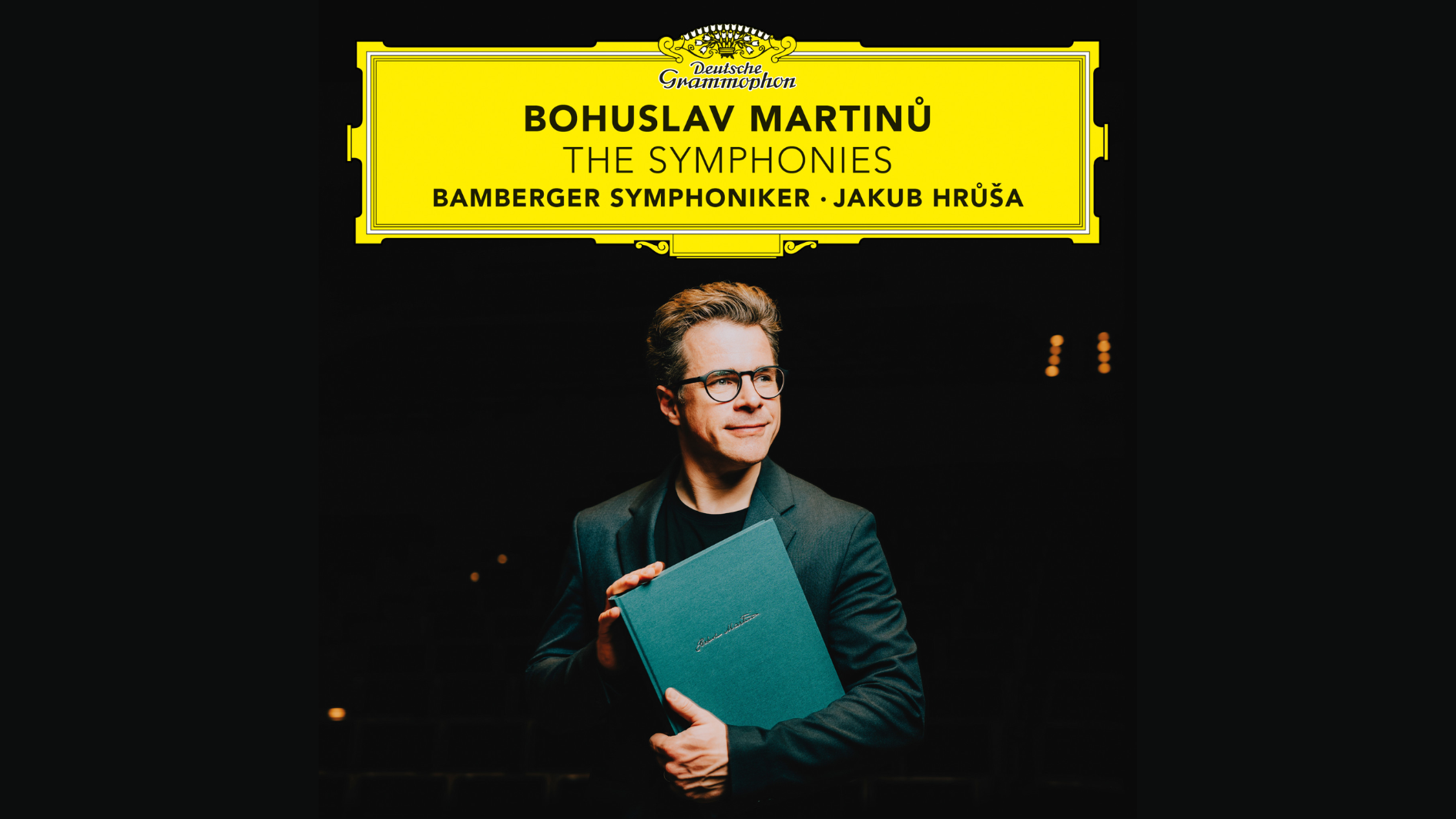
Czech composer Bohuslav Martinů left his home country for Paris after World War I, where he quickly absorbed the nascent neoclassical style. This movement was a direct reaction to the violence of the war, as composers attempted to cool tempers down by bringing back a pre-Beethoven aesthetic, updated for a modern age.
After the Second World War broke out, Martinů fled to the United States in 1941, and it was in this country that he composed all six of his symphonies over an 11-year span. Recordings of Martinů’s symphonies are still rare, which is all the more reason why this new and exciting set from the Bamberg Symphony and conductor Jakub Hrůša is so welcome.
As a Czech conductor who has written extensively about Martinů and his music, Hrůša is a natural leader for this project. He became music director of the Bamberg Symphony, a German orchestra with Czech roots, in 2016, when he was just 35 years old. Since then, Hrůša’s career has been on a meteoric rise: He took over as director of London’s Royal Opera in 2025, and in 2028, he’ll leave Bamberg for Prague to become the next chief conductor of the Czech Philharmonic.
Understanding Wisconsin, Together.
WPR’s “Wisconsin Today” newsletter keeps you connected to the state you love without feeling overwhelmed. No paywall. No agenda. No corporate filter.
All but one of Martinů’s symphonies were commissioned by orchestras in the U.S., and their premieres were major events at the time, making Martinů one of the most popular and successful European émigré composers in this country. Musically, they show the composer adapting his Czech-inflected neoclassical style for an American audience, while at the same time working through his feelings about being driven out of Europe by another destructive war.
Just a few highlights from this set can illustrate Martinů’s musical evolution through the 1940s to the early 1950s. He wrote his First Symphony for the Boston Symphony Orchestra and conductor Serge Koussevitzky in 1942, and the piece plunges us into the composer’s uniquely traditional yet modern sound world at the start of the first movement.:
While Martinů was working on his Third Symphony, in the summer of 1944, the Allied invasion of Normandy took place, and a noticeable tonal shift made its way into the symphony itself. The finale conveys a distinct note of optimism, but the second movement remains a moving portrait of the uncertainty of the war years:
The war had just ended when Martinů started writing his Fifth Symphony, and it seems that the composer was looking forward to the possibility of returning home, since he dedicated the work to the Czech Philharmonic. That return never happened, due to the postwar Soviet takeover of Czechoslovakia, but the symphony premiered without him in Prague in 1947. The music here is equal parts celebratory and nostalgic, with a finale that seems to be asking questions about the war that can’t be answered:
Hrůša’s new cycle with the Bamberg Symphony is so thoughtfully approached, brilliantly performed and clearly recorded that it will surely be the reference recording of this repertoire for years to come. If you’ve never heard Martinů’s symphonies before, this is the ideal place to start — and if you know them well, it should be a welcome addition to your collection. It’s available now on the Deutsche Grammophon label.
Wisconsin Public Radio, © Copyright 2026, Board of Regents of the University of Wisconsin System and Wisconsin Educational Communications Board.
‘ The preceding article may include information circulated by third parties ’
‘ Some details of this article were extracted from the following source www.wpr.org ’