Erykah Badu held her palms outstretched towards the sky, sounding apologetic as she started to close out her headlining Hollywood Bowl show on Friday night. She had to return, as she told the roaring crowd before her, “through the portal I came here from.”
Conduits are a fundamental part of Badu’s worldview, as much in her musical output and in her work as a doula. Yet she seems to have these metaphysical gateways top of mind lately. Not long ago, she built a “portal” out of wood in her backyard, as she told the Los Angeles Times: “Hopefully it works and I can go to another dimension every now and then,” she laughed. At the Bowl, Badu opened another portal and took the crowd with her: She played through the entirety of her revelatory second album, “Mama’s Gun,” whisking audiences to its release 25 years ago.
She wasn’t sure she wanted to step through this particular portal at first. Badu’s Bowl gig happened just weeks after the prolific performer closed out yet another tour, which involved a no-phone show where media had to acquiesce to using disposable cameras. After Badu performed cuts from her upcoming collaborative album with the producer and DJ the Alchemist, her first release in 10 years, she “almost didn’t want to go back to ‘Mama’s Gun’ after performing those songs because it is my evolution,” she told the paper.

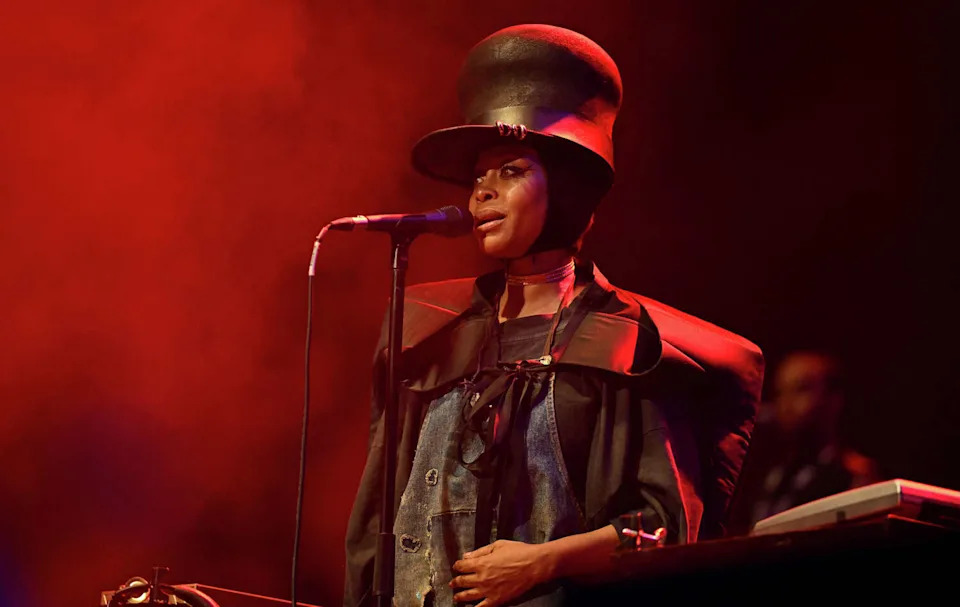
Erykah Badu performs onstage during Night 2 of the 2025 Essence Festival Of Culture at Caesars Superdome on July 5, 2025 in New Orleans, Louisiana. (Paras Griffin/WireImage)
But at the sold-out Hollywood Bowl show – the first date in a national tour of Badu running through all of “Mama’s Gun”- any hesitation about stepping into the past had calcified into a steely assuredness. The sustained glance backward into this doorway reaffirmed what’s always made “Mama’s Gun” such a remarkable album. In 2000, it sounded like something from the future; a quarter of a century later, it still does. Badu’s commanding live interpretation of “Mama’s Gun” showed that those portals, opaque as the other side might seem, are often worth stepping into.
Getting there was its own journey. Following a quirky opening set by the Buffalo rapper Westside Gunn, a few hiccups appeared to delay the start of Badu’s show. Audiences could see a tech messing with the audiovisuals from the software company Resolume, a color wheel from someone’s laptop projected clearly onto the stage. Badu is known for starting her shows late – when she began her annual Dallas birthday jam on time two years ago, that alone made headlines – but this felt different. When her DJ and drummer came out, they laid down a cosmic-sounding beat and rhythm, holding it for five minutes, then another. Then another. Several techs bounded onstage and messed with the drums as smoke filled the stage, Badu nowhere to be seen. The crowd started getting visibly itchy, and a small argument about using the flash on a phone camera erupted behind me.
Then, the outline of a towering hat finally appeared near the rear of the stage. Badu had arrived. She launched into the album’s opener, the poetic funk manifesto “Penitentiary Philosophy,” calling out for her vocals to be turned up several times. When she and the band settled into a taut groove by the album’s plush second cut “Didn’t Cha Know,” a cherished meditation on whether the paths taken in life were the right ones (and made far moodier with the shimmering blue and green lights via a beaded-esque curtain onstage, as if to mimic falling rain), something remarkable happened: The outdoor theater, a near-18,000-seater and second home of the LA Philharmonic renowned for its crisp sound, seemed barely able to contain the supercharged precision of Badu’s vocals. I can say with conviction that I’ve never seen someone fill the Bowl space so thoroughly with their voice before, making the expressive turns in her inflections – by turns come-hither and teeth-clenching – feel bone-shakingly immediate.

Erykah Badu performs onstage during Night 2 of the 2025 Essence Festival Of Culture at Caesars Superdome on July 5, 2025 in New Orleans, Louisiana. (Paras Griffin/WireImage)
There are well-resourced musicians who thrive more in the controlled environment of studio recording than onstage. Others become transcendent during the unpredictable headrush of live performance and aren’t exactly clamoring to get back into the booth once the tour wraps up. Badu is the rare exception in that she straddles both the studio sound and live performance with equal prowess, making deeply introspective tunes that happen to play amazing to a crowd feeling every syllable of her words.
BEST OF SFGATE
History | Why a wealthy banker blasted a huge hole in a Bay Area cliff
Local | There’s a mansion hidden directly under the Bay Bridge
Culture | Inside the Bay Area’s cult-like obsession with Beanie Babies
Local | The world’s last lost tourist thought Maine was San Francisco
Get SFGATE’s top stories sent to your inbox by signing up for The Daily newsletter here.
Her Bowl concert was a feat in that sense, especially considering how “Mama’s Gun” was steeped in lore from its inception. At the turn of the millennium, Badu mostly recorded it at Electric Lady Studios (where Jimi Hendrix used to lay down tracks) with her fellow Soulquarians, a loose collective of extraordinary artists that included Ahmir “Questlove” Thompson and James Poyser, of the Roots; the late producer J Dilla; the multi-instrumentalist and vocalist D’Angelo; the late jazz musician Roy Hargrove; bassist Pino Palladino; and rappers Q-Tip, Common and Talib Kweli. Their experimental sessions led to a collection of songs that are among some of Badu’s most beloved.
But Badu, who has said her best work is yet to come, refuses to be hemmed in by the conceptions of her own lauded songwriting history. It’s a theme she touches on in “Bag Lady,” a standout from “Mama’s Gun” about the struggle to not be subsumed by personal baggage and learning to let it go. It felt thrilling, albeit weighty, when she unleashed this one at the Bowl; it sounded like someone wrestling with the shadow of her now-legendary album. Badu had a retort, though. She’d play the album top to bottom, but not in the way you’d expect.
By the time she and the band worked their way to “Cleva,” Badu riffed on one of the song’s most staying affirmations – “I’m alright with me” – and bantered with the audience about not getting distracted and staying in that locked-in groove together (A nod, perhaps, to the many smartphones staring back at her.) Midway through the show, she launched into what sounded like slam poetry about black boxes that seems to be a teaser for her forthcoming album with the Alchemist. She veered from the album’s 14 tracks in order a few other times, including a deep cut called “Annie Don’t Wear No Panties” and a cover of the gospel song “It’s Gonna Be Alright,” by Donald Lawrence & the Tri-City Singers. Other songs took on a completely different tenor in their live incarnations, notably “Kiss Me on My Neck.” What scans as a tender and pleading declaration on “Mama’s Gun” became something with more grit in this timeline – the sound of someone who has realized that they don’t necessarily need another person to be fulfilled at this stage in their life.
As an artist who’s created a handful of no-skip albums like “Baduizm” and “Mama’s Gun” that still inspire legions of imitators – while belting these sumptuous songs to audiences at a steady drip – it’d be reductive to say that the neo-soul and hip-hop icon merely enjoys the work itself. Badu’s oeuvre smacks of someone who unwaveringly interrogatess her own intuition, then channels her observations through a daring array of sounds.
But if the act of performing live is an exercise in proving yourself over and over again, Badu’s hard-won triumph translated to every corner of the Bowl. Her showing was rapturous, save for one ear-splitting feedback screech in the middle of the set, an audio mishap that jarred the audience into covering their ears for the better part of a minute (and posting about it afterwards). She then left at 11 p.m. sharp, cutting short the album closer “Green Eyes” presumably to meet curfew.
So maybe the portal back to the turn of the millennium still has a few kinks to work out. Time travel may be an imperfect prospect, but Badu’s transportive powers remain intact regardless.
More LA Culture Coverage
–How a roller-skating Deadhead became one of LA’s biggest local celebrities
–Skip the hotel room and party all night in the LA neighborhood that never sleeps
–This retro Calif. diner has starred in classic films. Its latest role is its most unusual.
–She’s a suburban soccer mom. Her downtime is spent chasing ICE officers out of LA.
For more SFGATE LA stories, subscribe to our new weekly newsletter The Southland here.
This article originally published at Erykah Badu’s LA tour opener had wild sound issues. She’s never sounded better..
‘ The preceding article may include information circulated by third parties ’
‘ Some details of this article were extracted from the following source www.yahoo.com ’